No Result
View All Result
SUBMIT YOUR ARTICLES
  • Login
Friday, April 3, 2026
TheAdviserMagazine.com
  • Home
  • Financial Planning
    • Financial Planning
    • Personal Finance
  • Market Research
    • Business
    • Investing
    • Money
    • Economy
    • Markets
    • Stocks
    • Trading
  • 401k Plans
  • College
  • IRS & Taxes
  • Estate Plans
  • Social Security
  • Medicare
  • Legal
  • Home
  • Financial Planning
    • Financial Planning
    • Personal Finance
  • Market Research
    • Business
    • Investing
    • Money
    • Economy
    • Markets
    • Stocks
    • Trading
  • 401k Plans
  • College
  • IRS & Taxes
  • Estate Plans
  • Social Security
  • Medicare
  • Legal
No Result
View All Result
TheAdviserMagazine.com
No Result
View All Result
Home Market Research Cryptocurrency

Washington has started selecting which crypto firms control custody at a national level

by TheAdviserMagazine
5 hours ago
in Cryptocurrency
Reading Time: 7 mins read
A A
Washington has started selecting which crypto firms control custody at a national level
Share on FacebookShare on TwitterShare on LInkedIn


On Apr. 2, Coinbase received conditional approval from the Office of the Comptroller of the Currency for a national trust charter.

Coinbase joined a cluster of at least eight firms that the OCC has moved toward federal trust-charter status since December 2025, and the cluster reveals a deliberate federal decision about which parts of crypto belong inside the supervised system.

Why this matters: The US is shifting from regulating crypto to selecting which parts of the stack sit inside the banking perimeter. That decision defines who can scale nationally, who captures institutional flows, and who remains outside the system.

The OCC conditionally approved Circle, Ripple, BitGo, Fidelity, and Paxos on Dec. 12, 2025. Bridge followed in February, Crypto.com in February, and Coinbase in April.

Eight approvals in roughly four months, all clustered around custody, reserve management, stablecoin infrastructure, and settlement. That density reframes the Coinbase headline as a data point in a federal design decision.
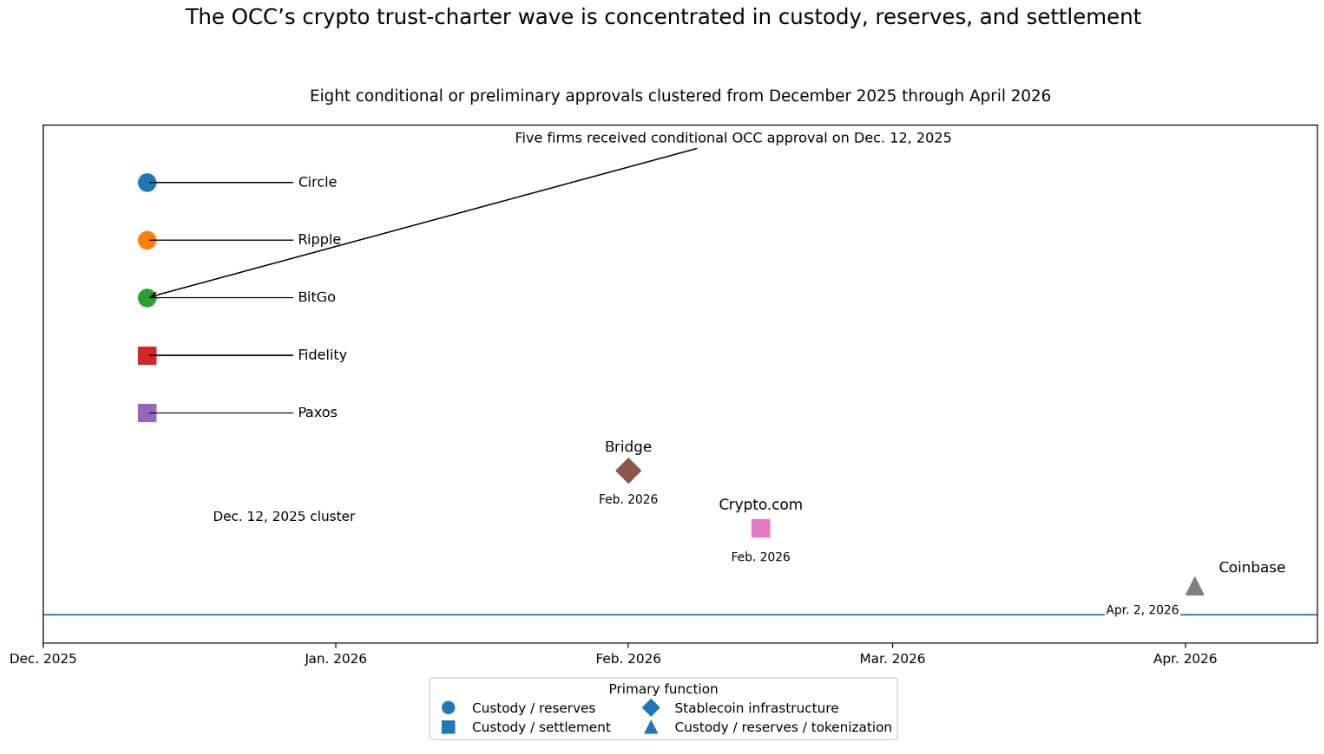
OCC's crypto trust charter wave
A scatter plot charts eight conditional OCC trust-charter approvals across three primary functions, custody, settlement, and stablecoin infrastructure, from December 2025 through April 2026.

A national trust charter gives firms federal reach under a single OCC supervisor, allowing them to operate across all 50 states without having to assemble a patchwork of state approvals.

National trust banks hold client assets and facilitate settlement under a fiduciary mandate, operating within a purpose-built custody-and-settlement structure. The lane’s practical value lies in scope and supervisory clarity: firms can hold client assets and handle settlement functions under a single federal framework.

Paxos explicitly framed its national trust push as a move beyond its New York state trust structure, and that framing reveals an architectural logic.

The functions Washington is comfortable supervising

The approvals cluster around custody, reserves, and settlement because that is where the OCC’s comfort level currently sits.

Reports noted that Crypto.com’s charter would cover client asset management and trade settlement, keeping the firm within custody and settlement functions. Bridge’s approval covered stablecoin issuance and orchestration, as well as reserve management.

The OCC’s Circle decision described digital-asset custody and reserve-management services tied to its fiduciary activities. Coinbase said full approval could support tokenized securities and stablecoins.

Washington is drawing a perimeter around the functions tokenized finance needs most, such as asset custody, stablecoin reserve backing, and settlement infrastructure, and extending supervisory authority over firms that provide them.

The firms best positioned in this environment are custodians, reserve managers, and stablecoin infrastructure operators.

Adjacent regulatory moves reinforce that reading. In March 2026, US bank regulators said tokenized securities would not face additional capital charges purely for being tokenized, calling the framework technology-neutral.

The SEC allowed intraday trading of tokenized shares of the WisdomTree money-market fund, approved Nasdaq’s tokenized trading proposal, and cleared NYSE’s tokenized securities partnership with Securitize.

The OCC charter wave and the tokenization rule stack are moving in tandem, with institutional infrastructure as the common thread.

VISUAL 2

The re-intermediation arc

Crypto’s original commercial promise was removing the regulated intermediaries that traditional finance required.

The practical outcome of the OCC cluster is re-intermediation: the most commercially durable crypto firms are now competing to become a new class of regulated intermediaries. Tokenized finance needs custodians, reserve managers, and settlement rails before it needs another trading venue with more listed assets.

Capital is already pricing that reality. Mastercard agreed to buy BVNK, a stablecoin infrastructure firm, for up to $1.8 billion. OpenFX raised $94 million and reported annualized payment volume climbing from $4 billion to $45 billion in a year, with over 98% of transactions settling in under 60 minutes.

The global stablecoin market stood at over $310 billion in February 2026. These are backend-plumbing bets, concentrated in custody, settlement, and reserve management.

The competitive map is also narrowing. Anchorage is currently the only digital asset company operating under a full national trust bank charter. The December cluster and subsequent approvals are conditional or preliminary.

CryptoSlate Daily Brief

Daily signals, zero noise.

Market-moving headlines and context delivered every morning in one tight read.

5-minute digest 100k+ readers

Free. No spam. Unsubscribe any time.

Whoops, looks like there was a problem. Please try again.

You’re subscribed. Welcome aboard.

Getting to the final operating status requires demonstrating capital adequacy, governance, and operational controls to OCC examiners. This bar will compress the field toward well-capitalized incumbents with existing compliance infrastructure.
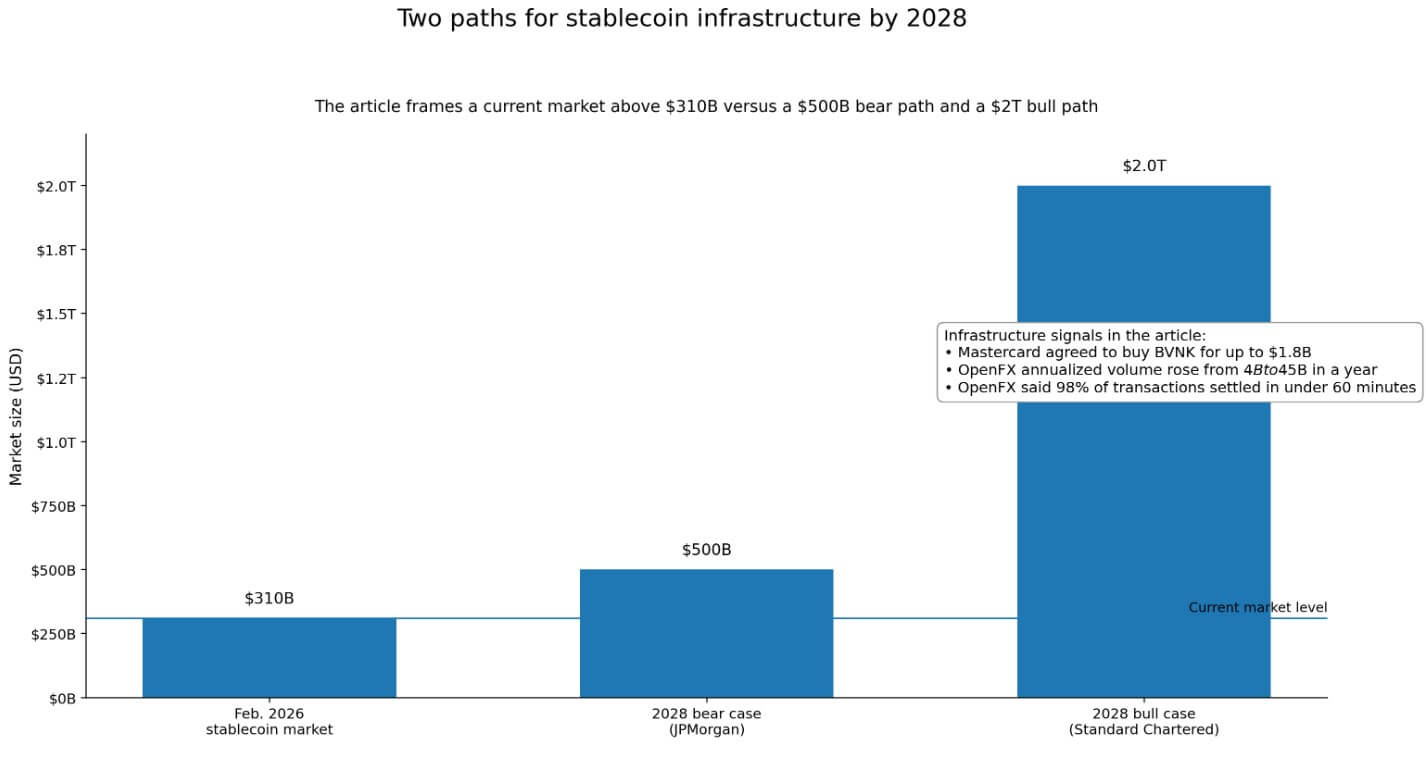
OCC crypto charters and the two paths for stablecoin infra by 2028OCC crypto charters and the two paths for stablecoin infra by 2028
A bar chart contrasts the $310 billion February 2026 stablecoin market against JPMorgan’s $500 billion bear forecast and Standard Chartered’s $2 trillion bull forecast for 2028.

Two paths forward

In the bull case, the OCC finalizes its stablecoin implementation in terms that institutions can operationalize.

Tokenized securities pilots on Nasdaq and NYSE move from proof-of-concept to live settlement infrastructure, while firms like Mastercard accelerate the adoption of stablecoin rails across global payment corridors.

If stablecoins approach Standard Chartered’s $2 trillion forecast by 2028 and tokenized real-world assets reach comparable scale, federally supervised crypto utilities become the scarce picks-and-shovels of digital finance.

The OCC’s chartered custodians and reserve managers collect margin on trillions of dollars in assets that flow through the infrastructure they control.

In the bear case, final approvals move slowly as bank trade groups press their “lighter-touch charter” objection, and the OCC responds by tightening conditions on reserve buffers, liquidity stress tests, and operational controls.

The stablecoin market tracks closer to JPMorgan’s $500 billion by 2028 forecast, a ceiling anchored by the fact that payments account for only about 6% of current stablecoin demand, roughly $15 billion of the $310 billion outstanding.

In that world, state trust structures and bank partnerships stay practical, and the federal lane becomes a premium niche.

The federal bet

Washington is sorting crypto’s functions into those it wants to supervise and those it does not, or at least not yet.

The charter cluster, the stablecoin reserve rules under the GENIUS Act, and the technology-neutral treatment of tokenized securities together form a regulated stack for crypto-native financial infrastructure.

The power the OCC is extending is real. Still, it carries supervisory costs: monthly public reserve disclosures for stablecoin issuers, weekly confidential reporting under the proposed implementation rule, and full OCC examination authority.

Comparison pointOCC national trust charterState trust / state-licensed structureBank-partnership modelPrimary supervisorOCCState regulatorsPartner bank’s federal/state bank supervisor plus partner compliance requirementsGeographic reachNational, under a single federal framework across all 50 statesMore limited; state-based and potentially patchworkDepends on partner bank structure rather than firm’s own charterCore functions highlighted in articleCustody, reserve management, stablecoin infrastructure, settlement, potential support for tokenized securitiesSimilar functions can be done, but without the same single federal lanePractical way to access banking, payments, and settlement functions without own federal charterStrategic valueSupervisory clarity and national scaleFlexibility, but less unified than federal laneFaster/practical access for firms that do not want or cannot obtain a charterSupervisory burdenHighLower than OCC lane, based on article’s contrastShared/mediated through bank partner requirementsStablecoin disclosure burdenMonthly public reserve disclosures; weekly confidential reporting under proposed implementation ruleNot described in article at the same levelNot described in article at the same levelExamination authorityFull OCC examination authorityState examination authorityBank partner oversight and exam environment, not direct OCC trust-bank status for the crypto firmFirms best positionedWell-capitalized incumbents with strong governance, capital adequacy, and operational controlsFirms comfortable staying in state-licensed layerFirms using partnerships as a practical alternative to federal charteringCompetitive implicationCould become scarce “picks-and-shovels” infrastructure if tokenized finance scalesRemains viable if federal approvals stay slow or narrowRemains viable in bear/slower-adoption scenarioMain tradeoffNational reach and legitimacy, but heavier compliance and supervisory costsLess supervisory intensity, but less federal uniformityLess direct control over infrastructure stack, but easier access routeBest fit in article’s framingFirms aiming to be federally supervised crypto utilitiesFirms that stay outside the federal laneFirms choosing a practical alternative while the federal lane remains selective

The firms that clear that bar will operate nationally under a single federal supervisor, hold institutional assets, and process tokenized settlements in a framework that traditional finance counterparties can use.

Those who cannot or choose not to will stay in the state-licensed layer, and the charter wave is starting to sort itself out.

Mentioned in this article


Source link

Tags: ControlCryptocustodyfirmslevelNationalselectingStartedWashington
ShareTweetShare
Previous Post

Leaders push for a ‘Manhattan Project’ and public-private solutions around AI and labor

Next Post

The Most Boring Way to Get Rich with Rentals

Related Posts

edit post
Nonfarm Payrolls Rise To 178k, Bitcoin Drops

Nonfarm Payrolls Rise To 178k, Bitcoin Drops

by TheAdviserMagazine
April 3, 2026
0

The U.S. jobs report has come in stronger than expectations, signaling that the labor market may be stabilizing even amid...

edit post
Dogecoin (DOGE) Breakdown Risk Grows, Is a Sharp Decline Next?

Dogecoin (DOGE) Breakdown Risk Grows, Is a Sharp Decline Next?

by TheAdviserMagazine
April 3, 2026
0

Dogecoin started a fresh decline below the $0.0920 zone against the US Dollar. DOGE is now consolidating losses and might...

edit post
US Attorney Connecticut Forfeits 0,000 in Tether Linked to Ledger Phishing Letter – Bitcoin News

US Attorney Connecticut Forfeits $600,000 in Tether Linked to Ledger Phishing Letter – Bitcoin News

by TheAdviserMagazine
April 2, 2026
0

Connecticut Crypto Phishing Victim to Recover Funds Local media reported that the U.S. Attorney’s Office for the District of Connecticut,...

edit post
Bitcoin Bulls Must Clear K To Avoid New Lows In 2026

Bitcoin Bulls Must Clear $76K To Avoid New Lows In 2026

by TheAdviserMagazine
April 2, 2026
0

Bitcoin’s (BTC) range-bound trading within the $60,000 to $73,000 range is impressive, especially when considering the macroeconomic backdrop of Brent...

edit post
Polymarket taps Pyth to power stock, commodity, and index prediction markets

Polymarket taps Pyth to power stock, commodity, and index prediction markets

by TheAdviserMagazine
April 2, 2026
0

Polymarket has integrated Pyth Network as the resolution source for a new slate of financial prediction markets, further extending the...

edit post
Coinbase Lawyer Just Revealed The Truth About The “Secret” CLARITY Act Deal — Crypto Traders, Don’t Sleep On This Vote  

Coinbase Lawyer Just Revealed The Truth About The “Secret” CLARITY Act Deal — Crypto Traders, Don’t Sleep On This Vote  

by TheAdviserMagazine
April 2, 2026
0

Trusted Editorial content, reviewed by leading industry experts and seasoned editors. Ad Disclosure Coinbase chief legal officer has suggested that...

Next Post
edit post
The Most Boring Way to Get Rich with Rentals

The Most Boring Way to Get Rich with Rentals

edit post
Barter, Media of Exchange, and Colonial America

Barter, Media of Exchange, and Colonial America

  • Trending
  • Comments
  • Latest
edit post
Massachusetts loses billions in income after millionaire tax

Massachusetts loses billions in income after millionaire tax

March 24, 2026
edit post
Illinois’ Paid Leave for All Workers Act Takes Effect — Every Employee Now Gets Guaranteed Time Off

Illinois’ Paid Leave for All Workers Act Takes Effect — Every Employee Now Gets Guaranteed Time Off

March 27, 2026
edit post
Virginia Permits ADULT MIGRANT MEN To Attend High School

Virginia Permits ADULT MIGRANT MEN To Attend High School

March 30, 2026
edit post
A 58-year-old left NYC for Miami to save on taxes — then retired early thanks to hidden savings. Here’s the math

A 58-year-old left NYC for Miami to save on taxes — then retired early thanks to hidden savings. Here’s the math

March 30, 2026
edit post
Publix to Open 5 New Stores by End of April. See Upcoming Locations.

Publix to Open 5 New Stores by End of April. See Upcoming Locations.

March 20, 2026
edit post
Hospitals in This State Routinely Sue Patients Over Unpaid Bills

Hospitals in This State Routinely Sue Patients Over Unpaid Bills

March 27, 2026
edit post
Your 8-step e-invoicing implementation roadmap

Your 8-step e-invoicing implementation roadmap

0
edit post
How to Read an Earnings Call Transcript: A Step-by-Step Guide for Investors

How to Read an Earnings Call Transcript: A Step-by-Step Guide for Investors

0
edit post
Adam Smith and Reciprocal Tariffs

Adam Smith and Reciprocal Tariffs

0
edit post
Newt Gingrich wants to drop a nuke on the Strait of Hormuz. America actually looked at the same thing in 1977 in Latin America

Newt Gingrich wants to drop a nuke on the Strait of Hormuz. America actually looked at the same thing in 1977 in Latin America

0
edit post
Nonfarm Payrolls Rise To 178k, Bitcoin Drops

Nonfarm Payrolls Rise To 178k, Bitcoin Drops

0
edit post
Restrictions eased on outbound flights

Restrictions eased on outbound flights

0
edit post
Your 8-step e-invoicing implementation roadmap

Your 8-step e-invoicing implementation roadmap

April 3, 2026
edit post
Newt Gingrich wants to drop a nuke on the Strait of Hormuz. America actually looked at the same thing in 1977 in Latin America

Newt Gingrich wants to drop a nuke on the Strait of Hormuz. America actually looked at the same thing in 1977 in Latin America

April 3, 2026
edit post
9 subtle behaviors that reveal someone grew up in a household where money was discussed in whispers, and why those behaviors persist long after financial security has arrived

9 subtle behaviors that reveal someone grew up in a household where money was discussed in whispers, and why those behaviors persist long after financial security has arrived

April 3, 2026
edit post
US Jobs Up 178,000 in March as Grads Ease Expectations to Get Hired

US Jobs Up 178,000 in March as Grads Ease Expectations to Get Hired

April 3, 2026
edit post
Orgain Protein Shake (4 count) only .83 shipped!

Orgain Protein Shake (4 count) only $3.83 shipped!

April 3, 2026
edit post
Nonfarm Payrolls Rise To 178k, Bitcoin Drops

Nonfarm Payrolls Rise To 178k, Bitcoin Drops

April 3, 2026
The Adviser Magazine

The first and only national digital and print magazine that connects individuals, families, and businesses to Fee-Only financial advisers, accountants, attorneys and college guidance counselors.

CATEGORIES

  • 401k Plans
  • Business
  • College
  • Cryptocurrency
  • Economy
  • Estate Plans
  • Financial Planning
  • Investing
  • IRS & Taxes
  • Legal
  • Market Analysis
  • Markets
  • Medicare
  • Money
  • Personal Finance
  • Social Security
  • Startups
  • Stock Market
  • Trading

LATEST UPDATES

  • Your 8-step e-invoicing implementation roadmap
  • Newt Gingrich wants to drop a nuke on the Strait of Hormuz. America actually looked at the same thing in 1977 in Latin America
  • 9 subtle behaviors that reveal someone grew up in a household where money was discussed in whispers, and why those behaviors persist long after financial security has arrived
  • Our Great Privacy Policy
  • Terms of Use, Legal Notices & Disclosures
  • Contact us
  • About Us

© Copyright 2024 All Rights Reserved
See articles for original source and related links to external sites.

Welcome Back!

Login to your account below

Forgotten Password?

Retrieve your password

Please enter your username or email address to reset your password.

Log In
No Result
View All Result
  • Home
  • Financial Planning
    • Financial Planning
    • Personal Finance
  • Market Research
    • Business
    • Investing
    • Money
    • Economy
    • Markets
    • Stocks
    • Trading
  • 401k Plans
  • College
  • IRS & Taxes
  • Estate Plans
  • Social Security
  • Medicare
  • Legal

© Copyright 2024 All Rights Reserved
See articles for original source and related links to external sites.