No Result
View All Result
SUBMIT YOUR ARTICLES
  • Login
Tuesday, May 5, 2026
TheAdviserMagazine.com
  • Home
  • Financial Planning
    • Financial Planning
    • Personal Finance
  • Market Research
    • Business
    • Investing
    • Money
    • Economy
    • Markets
    • Stocks
    • Trading
  • 401k Plans
  • College
  • IRS & Taxes
  • Estate Plans
  • Social Security
  • Medicare
  • Legal
  • Home
  • Financial Planning
    • Financial Planning
    • Personal Finance
  • Market Research
    • Business
    • Investing
    • Money
    • Economy
    • Markets
    • Stocks
    • Trading
  • 401k Plans
  • College
  • IRS & Taxes
  • Estate Plans
  • Social Security
  • Medicare
  • Legal
No Result
View All Result
TheAdviserMagazine.com
No Result
View All Result
Home IRS & Taxes

Supreme Court Trump Tariffs Ruling: Analysis

by TheAdviserMagazine
2 months ago
in IRS & Taxes
Reading Time: 5 mins read
A A
Supreme Court Trump Tariffs Ruling: Analysis
Share on FacebookShare on TwitterShare on LInkedIn


On Friday, February 20, 2026, the Supreme Court ruled against President Trump’s use of the International Emergency Economic Powers Act (IEEPA) to impose sweeping new tariffs on US imports. The decision strikes down all the tariffs imposed under the statue, including the “Liberation Day” tariffs and returns the case to United States Court of International Trade to address the issue of refunds. We estimate more than $160 billion of tariffs have been illegally collected under IEEPA Removal of the IEEPA tariffs will shield the economy and taxpayers from damage, but uncertainty remains over what the Trump administration will do next.

Which Tariffs Did the Supreme Court Rule Illegal?

President Trump used IEEPA to impose most of his new tariffs, which was the first time the emergency law was used to do so. We estimate that from 2026 through 2034, the IEEPA tariffs would have generated $1.4 trillion in revenue for the federal government:

Border security and fentanyl tariffs target imports from the US’s three largest trading partners at varying rates: China (10 percent on all imports), Mexico (25 percent on non-USMCA imports), and Canada (35 percent on non-USMCA imports, or 10 percent for certain energy or fertilizers).
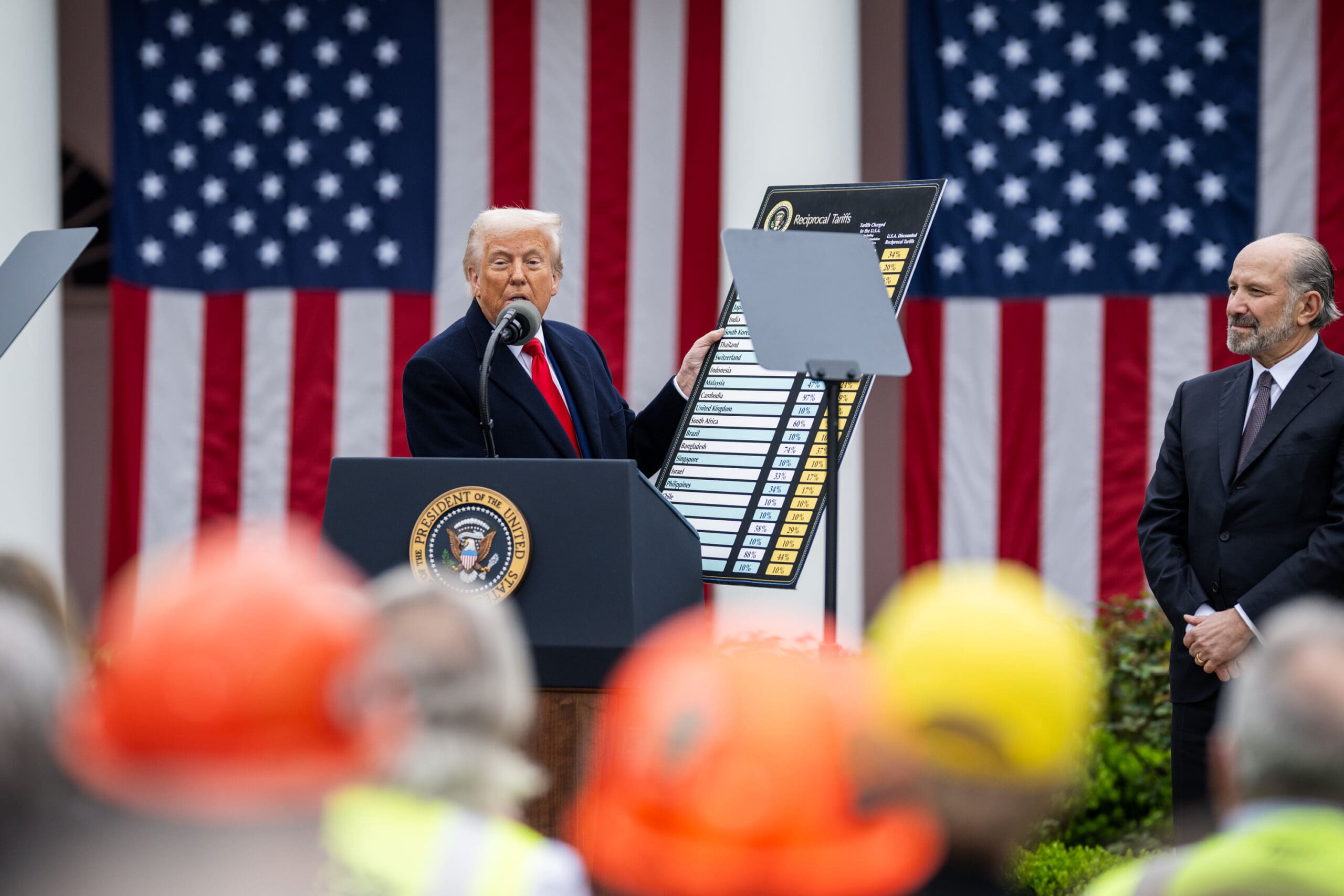
“Liberation Day” reciprocal tariffs target imports from nearly every US trading partner at rates ranging from 10 percent to 50 percent but exclude goods that face separate product-specific tariffs or that are on exemption lists. IEEPA actions also end the de minimis exemption for low-cost imports from all countries.
Russian oil tariffs that currently apply to India.
Brazil tariffs.
Additional threatened tariffs.

US imposed tariffs are taxes on imported goods purchased by importers in the US. While importers are legally responsible for paying the taxA tax is a mandatory payment or charge collected by local, state, and national governments from individuals or businesses to cover the costs of general government services, goods, and activities. on their imports to the US government, they may pass some of the tariffTariffs are taxes imposed by one country on goods imported from another country. Tariffs are trade barriers that raise prices, reduce available quantities of goods and services for US businesses and consumers, and create an economic burden on foreign exporters. burden on to their consumers through higher prices or foreign sellers may absorb some of the burden by lowering their sales price. Whether tariffs remain at the importer level or are passed to the consumer level, they reduce incentives for work and investment in the US economy, leading to lower output, wages, and incomes.

Several US businesses sued the federal government over the tariffs (Learning Resources, Inc. v. Trump), arguing the tariffs exceeded the president’s authority under IEEPA. The plaintiffs are small business owners, including American manufacturers and retailers, and several state attorneys general.

On May 28, 2025, a panel of judges at the US International Court of Trade unanimously ruled that the IEEPA tariffs were illegal, a decision that was upheld by the US Court of Appeals on August 29, 2025. The tariffs remain in effect while the administration prepares its appeal to the Supreme Court. The Supreme Court heard oral arguments on November 5, 2025. On February 20, 2026, the Court ruled in a 6-3 decision in Learning Resources Inc. v. Trump and V.O.S. Selections v. United States that “IEEPA does not authorize the President to impose tariffs.” Chief Justice John Robert was joined by Justices Sotomayor, Kagan, Gorsuch, Barrett, and Jackson, while Justices Thomas, Kavanaugh, and Alito dissented.

While the ruling strikes down the IEEPA tariffs, estimated to raise $1.4 trillion over the next decade, it does not affect the industry-specific Section 232 tariffs imposed by President Trump. The Section 232 tariffs affect products including steel, aluminum, autos, and heavy trucks, and they will remain in place. We estimate that these remaining section 232 tariffs would raise $635 billion in revenue over the next decade, amounting to average tax increase of $400 per US household in 2026.

More than $160 Billion in Illegal Tariff Payments Must be Refunded

As of December 14, 2025, the latest data available, the government had collected $133.5 billion of IEEPA tariff payments from US importers. We estimate through February 20, 2026, they have generated at least $160 billion.

The case has been remanded to the United States International Trade Court deal with the issue of refunds. If the IEEPA tariffs are fully refunded to US importers, it would erase nearly three-fourths of the new revenues from President Trump’s tariffs. The US government should make the process for importers to receive their refunds as simple and transparent as possible.

Table 1. US Importers Have Paid More than $133 Billion in IEEPA Tariffs Ruled Illegal as of December 14

Source: CBP Trade Statistics.

Altogether, Trump tariffs were the largest US tax increase as a percent of GDP in more than 30 years and amounted to an average tax increase per US household of $1,000 in 2025 and $1,300 in 2026, primarily driven by the now-illegal IEEPA tariffs.

The IEEPA tariffs, including the “Liberation Day” reciprocal tariffs, raised the applied US tariff rate by 7 percentage points and the effective tariff rate by nearly 5 percentage points.

Supreme Court Decision Provides Economic Relief, But with a Major Caveat

If the IEEPA tariffs had been left in place, we estimate US GDP would have shrunk by 0.3 percent. Removing the tariffs will remove that drag on US growth by reducing marginal tax rates on work and investment going forward.

However, in the near term, uncertainty is likely to increase because the Trump administration may pursue other avenues to impose tariffs, such as Section 232, Section 301, Section 122, or Section 338. If the IEEPA tariffs are replaced by other types of tariffs the Trump administration can impose using its other authorities, then tariff-related headwinds would increase.

Currently, the Trump administration is conducting 12 Section 232 investigations on various products. These investigations allegedly target imports that “threaten or impair the national security” of the US. Some imports, such as copper, lumber, and heavy trucks, have already had tariffs imposed on them, while the President has threatened but not yet imposed tariffs on others, such as semiconductors and pharmaceuticals. The President may replace IEEPA tariffs with more product-focused tariffs, which he has broad powers to do.

Additionally, the President may also consider imposing new Section 301 tariffs, which target “discriminatory” trade practices by other countries. President Trump invoked this authority to impose tariffs as high as 25 percent on Chinese imports in 2018, which still remain in place. The President may consider raising existing duties or targeting other countries.

Finally, the administration might consider more obscure authorities, such as Section 122 and Section 338. Section 122 gives the President the authority to impose tariffs to address balance-of-payment concerns, while Section 338 targets discriminatory practices that affect US commerce. However, tariffs under Section 122 could not exceed 15 percent, and any extension of those tariffs would require Congressional approval after 150 days. Similarly, tariffs could not exceed 50 percent under Section 338. Neither authority has ever been invoked by a US President.

Overall, the Supreme Court ruling against the IEEPA tariffs provides immediate relief to US businesses and workers and is a welcome rebuke of President Trump’s overreach of executive authority to unilaterally impose significant tax hikes on the US economy.


Stay informed on the tax policies impacting you.

Subscribe to get insights from our trusted experts delivered straight to your inbox.

Subscribe

Share this article

Twitter
LinkedIn
Facebook
Email


Source link

Tags: AnalysiscourtRulingSupremeTariffsTrump
ShareTweetShare
Previous Post

Indian delegation heads to UK as country ties deepen

Next Post

The Origins of Myanmar’s Coup Culture and Military Dictatorship

Related Posts

edit post
Is Unemployment Compensation Taxable Income?

Is Unemployment Compensation Taxable Income?

by TheAdviserMagazine
May 4, 2026
0

Unemployment benefits can be a vital support for those experiencing unexpected job loss. If you received unemployment compensation for the...

edit post
Audit technology assessment: Mid-year review

Audit technology assessment: Mid-year review

by TheAdviserMagazine
May 4, 2026
0

Before the 2027 busy season pressure mounts, use this mid-year moment to honestly assess whether your audit technology is delivering...

edit post
Digital Services Taxes in Europe, 2026

Digital Services Taxes in Europe, 2026

by TheAdviserMagazine
May 4, 2026
0

Austria (AT)5%Online advertisingEUR 750 million (USD 878 million)EUR 25 million (USD 29 million)Implemented (Effective from January 1, 2020); joined statement...

edit post
Can Your Business Deduct Credit Card Interest When the Card Is in Your Name? – Houston Tax Attorneys

Can Your Business Deduct Credit Card Interest When the Card Is in Your Name? – Houston Tax Attorneys

by TheAdviserMagazine
May 2, 2026
0

Small businesses often struggle to get credit. Banks want collateral, financial history, and revenue figures that newer or smaller operations...

edit post
How direct tax departments can be proactive in 2026

How direct tax departments can be proactive in 2026

by TheAdviserMagazine
May 1, 2026
0

Highlights Direct tax automation helps teams shift from reactive firefighting to strategic advisory roles. Technology enables faster compliance, centralized data,...

edit post
An evolution of tax tools and how agentic AI will shape 2026

An evolution of tax tools and how agentic AI will shape 2026

by TheAdviserMagazine
May 1, 2026
0

The shift from search-and-find to reason-and-act is transforming professional judgment in the tax and accounting world. Highlights Agentic AI will...

Next Post
edit post
The Origins of Myanmar’s Coup Culture and Military Dictatorship

The Origins of Myanmar’s Coup Culture and Military Dictatorship

edit post
Capitalism Is Not to Blame for Wokeness

Capitalism Is Not to Blame for Wokeness

  • Trending
  • Comments
  • Latest
edit post
Florida Warning: With Senior SNAP Benefits Averaging 8/Month, Thousands Risk Losing Assistance in 2026

Florida Warning: With Senior SNAP Benefits Averaging $188/Month, Thousands Risk Losing Assistance in 2026

April 27, 2026
edit post
Gavin Newsom issues ‘final warning’ amid California’s dire housing crisis — what’s at stake for millions of residents

Gavin Newsom issues ‘final warning’ amid California’s dire housing crisis — what’s at stake for millions of residents

May 3, 2026
edit post
Tax Flight Accelerates In Massachusetts

Tax Flight Accelerates In Massachusetts

April 6, 2026
edit post
The Stevia Loophole Why Some Sweetened Drinks are Still SNAP-Legal While Others are Banned in Texas

The Stevia Loophole Why Some Sweetened Drinks are Still SNAP-Legal While Others are Banned in Texas

April 4, 2026
edit post
10 Cheapest High Dividend Stocks With P/E Ratios Under 10

10 Cheapest High Dividend Stocks With P/E Ratios Under 10

April 13, 2026
edit post
Exclusive: America’s largest Black-owned bank launches podcast with mission to unlock hidden shame holding back generational wealth

Exclusive: America’s largest Black-owned bank launches podcast with mission to unlock hidden shame holding back generational wealth

April 29, 2026
edit post
Cogent Communications Holdings Reports Narrower Q1 Loss; Revenue Down 3%

Cogent Communications Holdings Reports Narrower Q1 Loss; Revenue Down 3%

0
edit post
GameStop shares tank 10% as CEO skips fundraising question on  billion eBay deal

GameStop shares tank 10% as CEO skips fundraising question on $55 billion eBay deal

0
edit post
Why GSA’s anti-DEI certification is raising alarm in higher education

Why GSA’s anti-DEI certification is raising alarm in higher education

0
edit post
Stock index futures rise ahead of economic reports (SPX:)

Stock index futures rise ahead of economic reports (SPX:)

0
edit post
The War On Crypto Was Always About Control

The War On Crypto Was Always About Control

0
edit post
If GameStop buys eBay, Bitcoin payments could suddenly have a 135M-buyer marketplace test case

If GameStop buys eBay, Bitcoin payments could suddenly have a 135M-buyer marketplace test case

0
edit post
Stock index futures rise ahead of economic reports (SPX:)

Stock index futures rise ahead of economic reports (SPX:)

May 5, 2026
edit post
I watched my father run his business through the Lebanese Civil War. Here’s what it taught me about leading through disruption.

I watched my father run his business through the Lebanese Civil War. Here’s what it taught me about leading through disruption.

May 5, 2026
edit post
GameStop shares tank 10% as CEO skips fundraising question on  billion eBay deal

GameStop shares tank 10% as CEO skips fundraising question on $55 billion eBay deal

May 5, 2026
edit post
HSBC shares drop as first-quarter pre-tax profit misses estimates

HSBC shares drop as first-quarter pre-tax profit misses estimates

May 5, 2026
edit post
The War On Crypto Was Always About Control

The War On Crypto Was Always About Control

May 5, 2026
edit post
Delta Cuts Food and Beverage Service on Short Flights

Delta Cuts Food and Beverage Service on Short Flights

May 4, 2026
The Adviser Magazine

The first and only national digital and print magazine that connects individuals, families, and businesses to Fee-Only financial advisers, accountants, attorneys and college guidance counselors.

CATEGORIES

  • 401k Plans
  • Business
  • College
  • Cryptocurrency
  • Economy
  • Estate Plans
  • Financial Planning
  • Investing
  • IRS & Taxes
  • Legal
  • Market Analysis
  • Markets
  • Medicare
  • Money
  • Personal Finance
  • Social Security
  • Startups
  • Stock Market
  • Trading

LATEST UPDATES

  • Stock index futures rise ahead of economic reports (SPX:)
  • I watched my father run his business through the Lebanese Civil War. Here’s what it taught me about leading through disruption.
  • GameStop shares tank 10% as CEO skips fundraising question on $55 billion eBay deal
  • Our Great Privacy Policy
  • Terms of Use, Legal Notices & Disclosures
  • Contact us
  • About Us

© Copyright 2024 All Rights Reserved
See articles for original source and related links to external sites.

Welcome Back!

Login to your account below

Forgotten Password?

Retrieve your password

Please enter your username or email address to reset your password.

Log In
No Result
View All Result
  • Home
  • Financial Planning
    • Financial Planning
    • Personal Finance
  • Market Research
    • Business
    • Investing
    • Money
    • Economy
    • Markets
    • Stocks
    • Trading
  • 401k Plans
  • College
  • IRS & Taxes
  • Estate Plans
  • Social Security
  • Medicare
  • Legal

© Copyright 2024 All Rights Reserved
See articles for original source and related links to external sites.