No Result
View All Result
SUBMIT YOUR ARTICLES
  • Login
Saturday, April 4, 2026
TheAdviserMagazine.com
  • Home
  • Financial Planning
    • Financial Planning
    • Personal Finance
  • Market Research
    • Business
    • Investing
    • Money
    • Economy
    • Markets
    • Stocks
    • Trading
  • 401k Plans
  • College
  • IRS & Taxes
  • Estate Plans
  • Social Security
  • Medicare
  • Legal
  • Home
  • Financial Planning
    • Financial Planning
    • Personal Finance
  • Market Research
    • Business
    • Investing
    • Money
    • Economy
    • Markets
    • Stocks
    • Trading
  • 401k Plans
  • College
  • IRS & Taxes
  • Estate Plans
  • Social Security
  • Medicare
  • Legal
No Result
View All Result
TheAdviserMagazine.com
No Result
View All Result
Home Market Research Economy

Constitutions and Chaos | Mises Institute

by TheAdviserMagazine
3 months ago
in Economy
Reading Time: 4 mins read
A A
Constitutions and Chaos | Mises Institute
Share on FacebookShare on TwitterShare on LInkedIn


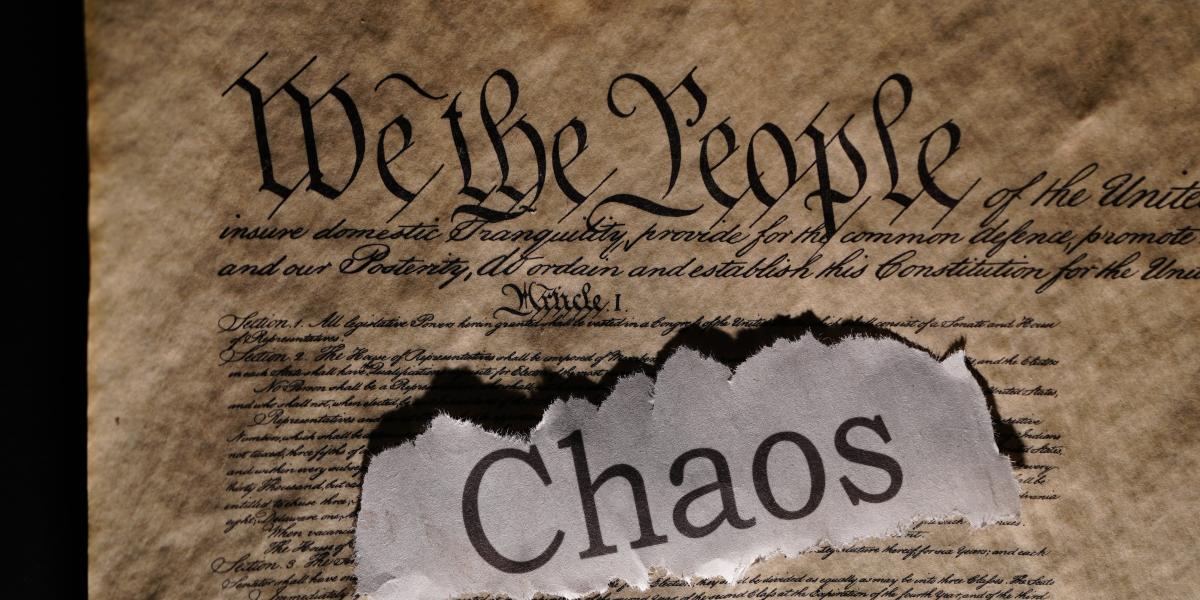
There is much to agree with in both Matt Walsh’s comments and Phil Duffy’s “Ken Burns Plays the “Founding Chaos” Card” criticisms of Ken Burns’s “The American Revolution,” flawed in the politically correct ways you would expect from PBS. Duffy focuses on Burns’s simplistic generalization “The Constitution saved the nation from chaos.”

There were a lot of problems in the aftermath of the Revolution that ended in 1783. The 13 states had suffered extensive destruction and financed an extremely expensive war with debt and paper money rather than taxes (as becomes a new confederation founded partly on resistance to taxation). But, in consequence of having built such an overhang of debt, the states were paying, on average, three to four times the taxes they paid as pre-Revolutionary colonies!

Shays’s Rebellion was prompted by Massachusetts attempting to raise taxes in order to pay their part of the Confederation debt. As Duffy emphasized, Massachusetts put down the Rebellion, but their electorate subsequently ejected much of the legislature that had raised taxes.

This sort of electoral response—very democratic yet perverse in terms of solving the debt problem—motivated those gathering for that 1787 conspiracy (sworn to secrecy and behind locked doors) which produced the Constitution. In other words, the American states had become excessively democratic. After 1775, legislatures were expanded so that each member represented rather small constituencies, and more representatives were middle class rather than aristocratic. (The proportion of legislators who were wealthy before the Revolution was 46 percent; it declined to 22 percent after the Revolution. This is detailed in The Founding Fortunes: How the Wealthy Paid for and Profited from the American Revolution by Tom Shachtman). Also, they were elected annually, so they were infinitely more responsive to the electorate than anything we can imagine today.

This led naturally to paying for the war with debt and paper money, rather than directly with taxes. It also led, as debts grew, to laws making it difficult for anyone to collect genuine debts. Foreigners and Americans grew very leery of lending to Americans by 1787.

So, both “Federalists” (nationalists in sheep’s clothing) and “Anti-Federalists” (the true federalists) were motivated by what they saw as the irresponsibility of excessive democracy. There was general agreement on creating a federation that was republican, as far from “mobocracy” as possible. In the words of Pennsylvania delegate Robert Morris, it was necessary to “restrain the democratic spirit.”

In this vein, there was consensus about one of the best things the Constitution did: It outlawed paper money, or at least they all thought it did. They explicitly forbade the states from using paper money. Article I, Section 10 forbade the states to “emit Bills of Credit; make any Thing but gold and silver Coin a Tender in Payment of Debts” and also forbade laws impairing the obligation of contracts, solving the debt collection problem. They also rejected in their deliberations giving the federal government the power to create paper money. And, since they argued at the time that the federal government could do nothing not explicitly authorized by the Constitution, they thought they “had gotten rid of paper money.”

Among other problems in post-Revolution America were the loss of trading opportunities that had previously existed within the British empire and the tendency of the individual states to impose tariffs and restrictions on interstate commerce. Virginia and South Carolina charged North Carolina such high tariffs that James Madison referred to North Carolina “as a patient bleeding from both arms.”

Thus, while I disagree with Burns that the Constitution was the only way to prevent a descent into chaos, there were some serious problems that the Constitution successfully addressed. Another important improvement it brought about was the uniform national import tariff as the chief method of taxation. It was initially set low to merely fund the government and the debt, but it was set higher than the competing states with ports (who were in competition) could set theirs, so it proved very efficient and crucial in addressing the large debt.

Alas, how much better would it have been had the delegates followed their legal instructions from the Congress to revise the Articles of Confederation with the improvements we’ve touched upon? For the Confederation’s looser, more voluntarist structure was much more protective of individual liberty over time in many ways.

For instance, because of geography and the wealth liberty created, the US has never been vulnerable to foreign attack before the nuclear era. Every US war has been a war of choice—the War of 1812, the Mexican War, Lincoln’s War, the Spanish-American War, WWI, WWII (FDR purposefully manipulated the US into it), the Korean War, the Vietnam War, Kosovo, Iraq (twice), Afghanistan, Libya, etc.—all wars engaged in by a US ruling class with the levers of national power. It is unimaginable that any of those wars would have been initiated by the US under the Articles of Confederation.

So just which constitution resulted in more chaos? The US-initiated War of 1812 caused tremendous death and destruction and nearly caused the New England states to secede. Absolutely no gain but plenty of chaos. Such an offensive war would have been impossible to initiate under the Articles of Confederation.

More than 85 million died in WWII because of US entry and its ruthless methods of prosecuting the war, with the consequent sequelae of the enslavement of Eastern Europe and China by Communism and on the order of 100 million murdered under Communism. That’s chaos.

Governments are inherently corrupt. The degree of corruption increases with the size of the government and its distance from the governed. The best you can do is have lots of smaller states (among which the citizens may vote with their feet) in confederations for mutual defense and free trade. That describes what was within reach with an improved Articles of Confederation.



Source link

Tags: ChaosConstitutionsInstituteMises
ShareTweetShare
Previous Post

With Global Attention on Venezuela, Israel Intensifies Assault on Gaza, Lebanon

Next Post

Wall Street Heavyweight Morgan Stanley Files for Bitcoin and Solana ETFs

Related Posts

edit post
The Myth that Won’t Die: “War is Good for the Economy”

The Myth that Won’t Die: “War is Good for the Economy”

by TheAdviserMagazine
April 4, 2026
0

What is the Mises Institute? The Mises Institute is a non-profit organization that exists to promote teaching and research in...

edit post
When Corporations Resist the State: Ethics, AI, and the Limits of Government Power

When Corporations Resist the State: Ethics, AI, and the Limits of Government Power

by TheAdviserMagazine
April 4, 2026
0

Corporations are frequently accused of moral indifference. Critics often portray large firms as institutions that pursue profit while ignoring the...

edit post
Why the Post Office and Non-Profits Share a Socialist Calculation Problem

Why the Post Office and Non-Profits Share a Socialist Calculation Problem

by TheAdviserMagazine
April 3, 2026
0

Public debate usually treats Mises’s Economic Calculation in the Socialist Commonwealth as a Cold War claim that “government is inefficient.”...

edit post
Jobs report March 2026:

Jobs report March 2026:

by TheAdviserMagazine
April 3, 2026
0

The U.S. labor market bounced back in March, with job creation much stronger than expected though the broader picture of...

edit post
Barter, Media of Exchange, and Colonial America

Barter, Media of Exchange, and Colonial America

by TheAdviserMagazine
April 3, 2026
0

In preparation for the 2026 Austrian Economics Research Conference, where I was presenting a forthcoming paper entitled “The United States:...

edit post
The Golden Rule | Mises Institute

The Golden Rule | Mises Institute

by TheAdviserMagazine
April 3, 2026
0

In the acknowledgements to his last great work of scholarship, An Austrian Perspective on the History of Economic Thought, Murray...

Next Post
edit post
Wall Street Heavyweight Morgan Stanley Files for Bitcoin and Solana ETFs

Wall Street Heavyweight Morgan Stanley Files for Bitcoin and Solana ETFs

edit post
How “Easy Money” Turned Into A  Million Loss

How “Easy Money” Turned Into A $50 Million Loss

  • Trending
  • Comments
  • Latest
edit post
Massachusetts loses billions in income after millionaire tax

Massachusetts loses billions in income after millionaire tax

March 24, 2026
edit post
Illinois’ Paid Leave for All Workers Act Takes Effect — Every Employee Now Gets Guaranteed Time Off

Illinois’ Paid Leave for All Workers Act Takes Effect — Every Employee Now Gets Guaranteed Time Off

March 27, 2026
edit post
Virginia Permits ADULT MIGRANT MEN To Attend High School

Virginia Permits ADULT MIGRANT MEN To Attend High School

March 30, 2026
edit post
A 58-year-old left NYC for Miami to save on taxes — then retired early thanks to hidden savings. Here’s the math

A 58-year-old left NYC for Miami to save on taxes — then retired early thanks to hidden savings. Here’s the math

March 30, 2026
edit post
Property Tax Relief & Income Tax Relief

Property Tax Relief & Income Tax Relief

April 1, 2026
edit post
Publix to Open 5 New Stores by End of April. See Upcoming Locations.

Publix to Open 5 New Stores by End of April. See Upcoming Locations.

March 20, 2026
edit post
I’m 66 and the friends I have left are the ones who saw me fall apart at least once and stayed — not because the falling apart was a test I designed, but because it turned out to be the only reliable way I ever found to discover who was actually there

I’m 66 and the friends I have left are the ones who saw me fall apart at least once and stayed — not because the falling apart was a test I designed, but because it turned out to be the only reliable way I ever found to discover who was actually there

0
edit post
Forrester’s New Principal Analyst Covering Consumer Behavior

Forrester’s New Principal Analyst Covering Consumer Behavior

0
edit post
StudyIn’s Rob Grimshaw names the international education markets to watch

StudyIn’s Rob Grimshaw names the international education markets to watch

0
edit post
Social Security Transition to Electronic Payments—Deadline Approaching: What You Need to Do Before September 30 | Social Security Matters

Social Security Transition to Electronic Payments—Deadline Approaching: What You Need to Do Before September 30 | Social Security Matters

0
edit post
Breakeven hiring negative: The economy can shed jobs and still keep the unemployment rate flat

Breakeven hiring negative: The economy can shed jobs and still keep the unemployment rate flat

0
edit post
“My Favorite Thing is to Take the Oil”

“My Favorite Thing is to Take the Oil”

0
edit post
I’m 66 and the friends I have left are the ones who saw me fall apart at least once and stayed — not because the falling apart was a test I designed, but because it turned out to be the only reliable way I ever found to discover who was actually there

I’m 66 and the friends I have left are the ones who saw me fall apart at least once and stayed — not because the falling apart was a test I designed, but because it turned out to be the only reliable way I ever found to discover who was actually there

April 4, 2026
edit post
CLARITY Act Unlikely to Pass if Crypto Bill Stalls Until Summer, Pro-XRP Lawyer Warns

CLARITY Act Unlikely to Pass if Crypto Bill Stalls Until Summer, Pro-XRP Lawyer Warns

April 4, 2026
edit post
Breakeven hiring negative: The economy can shed jobs and still keep the unemployment rate flat

Breakeven hiring negative: The economy can shed jobs and still keep the unemployment rate flat

April 4, 2026
edit post
The S&P 500 Sank by 5% Last Month, but Here’s Why This Super Semiconductor Stock Bucked the Sell-Off

The S&P 500 Sank by 5% Last Month, but Here’s Why This Super Semiconductor Stock Bucked the Sell-Off

April 4, 2026
edit post
The Myth that Won’t Die: “War is Good for the Economy”

The Myth that Won’t Die: “War is Good for the Economy”

April 4, 2026
edit post
China steps forward into world leadership role on Iran war, crisis as America looks on with disinterest

China steps forward into world leadership role on Iran war, crisis as America looks on with disinterest

April 4, 2026
The Adviser Magazine

The first and only national digital and print magazine that connects individuals, families, and businesses to Fee-Only financial advisers, accountants, attorneys and college guidance counselors.

CATEGORIES

  • 401k Plans
  • Business
  • College
  • Cryptocurrency
  • Economy
  • Estate Plans
  • Financial Planning
  • Investing
  • IRS & Taxes
  • Legal
  • Market Analysis
  • Markets
  • Medicare
  • Money
  • Personal Finance
  • Social Security
  • Startups
  • Stock Market
  • Trading

LATEST UPDATES

  • I’m 66 and the friends I have left are the ones who saw me fall apart at least once and stayed — not because the falling apart was a test I designed, but because it turned out to be the only reliable way I ever found to discover who was actually there
  • CLARITY Act Unlikely to Pass if Crypto Bill Stalls Until Summer, Pro-XRP Lawyer Warns
  • Breakeven hiring negative: The economy can shed jobs and still keep the unemployment rate flat
  • Our Great Privacy Policy
  • Terms of Use, Legal Notices & Disclosures
  • Contact us
  • About Us

© Copyright 2024 All Rights Reserved
See articles for original source and related links to external sites.

Welcome Back!

Login to your account below

Forgotten Password?

Retrieve your password

Please enter your username or email address to reset your password.

Log In
No Result
View All Result
  • Home
  • Financial Planning
    • Financial Planning
    • Personal Finance
  • Market Research
    • Business
    • Investing
    • Money
    • Economy
    • Markets
    • Stocks
    • Trading
  • 401k Plans
  • College
  • IRS & Taxes
  • Estate Plans
  • Social Security
  • Medicare
  • Legal

© Copyright 2024 All Rights Reserved
See articles for original source and related links to external sites.