
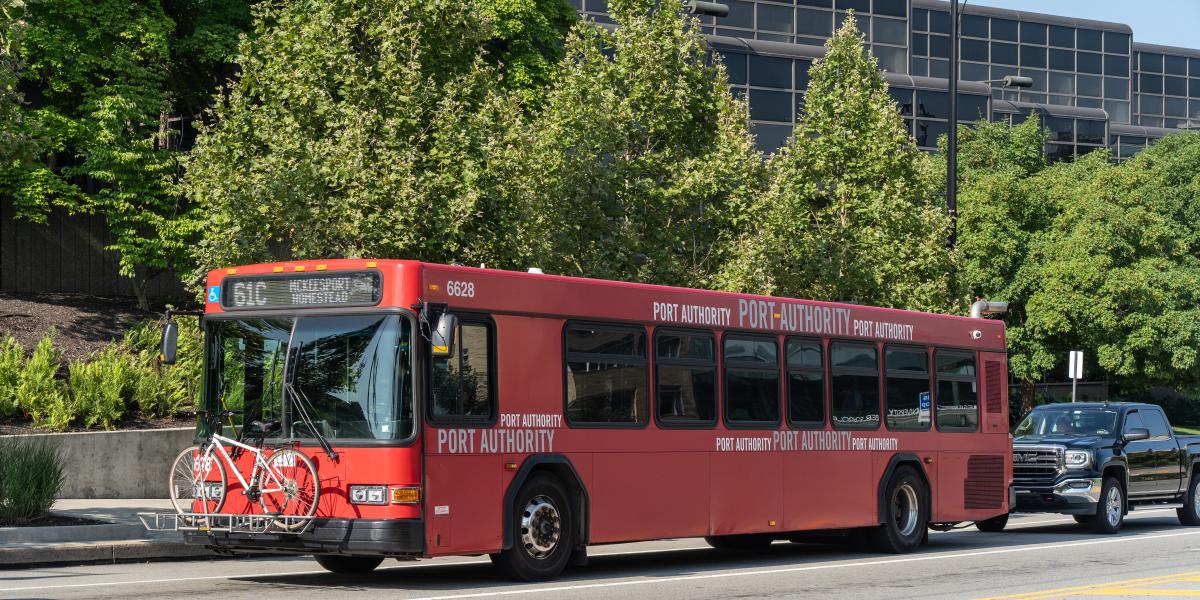
It’s a weekend in Pittsburgh and lots of people here and elsewhere around the country are waiting for a money-losing service called government transit.
The system here, the same as many others throughout the nation, has two speeds—slow and slower. People search on their cellphones for when the buses are coming. Yet the system’s updates are often misleading. Buses never seem to come in the predicted time. Sometimes a promised bus—say one supposedly coming in ten minutes or less—will disappear from your cellphone. “The bus just dropped from my cellphone. That’s the second time it’s happened to me in the last few minutes,” said one frustrated rider. The bus information is worse than slow, it’s misleading.
Yet I am not criticizing Pittsburg’s polite bus drivers who seem to suffer under the same problems as the riders: Their interaction with the incompetence of government reminds me of other government enterprises in other cities. (My childhood friend from New York City drove subway trains for several decades. He thought those running the system were “idiots”.) My target is more than sleazy, vote-hungry, pols on the hustings calling for more and more of this noxious thing called government enterprise.
Our career politicians of both parties will promise you anything. I’m aiming at a big target: the dysfunctional idea that government knows best, whether it’s running New York City’s disastrous public transportation systems or almost any business. Pittsburgh’s transit system faces deficits and our rulers’ solution—the solution of their political brethren in other cities—is always the same. Make riders and other taxpayers more miserable. More spending on government enterprise as they cut service.
Pittsburgh Regional Transit (PRT) says it is facing a $100 million deficit. But the Steel City’s transit woes aren’t unique. Every other local transit agency across the state will also want more money if Pittsburgh gets more. Why does this happen again and again across government transit agencies? Don’t blame us, say the people who run these dysfunctional agencies and their political enablers. They will tell you public transit can never make money or even break even, which ignores the historic successes of the private sector.
But how far should Pennsylvania go in paying for this mess? Does the Commonwealth have limitless amounts of money it can hand out to every city, town, and county that engages in government enterprise; an offshoot of other government services from public education to roads that are usually egregious. Most government spending, especially when it tries to run businesses from transportation to road services, is like a drug addict who demands more and more money from the citizens yet provides less and less in service.
For example, after limitless bipartisan infrastructure bills, what is the condition of our roads and bridges? Here in Pittsburgh, I walk across some bridges that have holes. Why weren’t these roads and bridges fixed or could it be that more government enterprise often leads to government corruption? The one bridge I used to drive across years ago that was well maintained was one of the few that was privately owned. It was the tiny Dingman’s Bridge, which linked Sussex County, New Jersey with Pike County, Pennsylvania).
Yet the answer of our political ruling class for the woes of government enterprise never changes: Give the system of government enterprise more money. That’s an argument I heard constantly back in my native Rancid Apple, the land of Plunkitt, Tweed, and Donald Manes. It is the rationale of pols from coast to coast. They are protecting one of the tenets of their religion called bigger government without anyone mentioning the word socialism.
The other problem is the lack of understanding of our career pols. Whether talking about public schools or government buses or trains, they seem clueless because their actual experience with government services is skimpy. Take Pittsburgh’s latest transit woes.
State Rep. Jessica Benham—a Pittsburgh Democrat—said she and her Allegheny County colleagues have made still more state funding for the transit agency “a top priority. There is a regional commitment to getting this funding across the finish line.” She explained the issue was personal, “Before I was an elected official, I actually didn’t have a car. I took public transit everywhere.” She continued, “I know what it’s like to wait for a bus that only comes every 40 minutes. I know what it’s like to be outside in the rain and the snow and all kinds of weather relying on public transit.”
This is an amazing statement: “I actually didn’t have a car.” She makes it sound as though she served in World War II on a Pacific island where the Japanese fought to the last man and she was lucky to come out of it uninjured. It is ironic because Pittsburgh’s leading political columnist—a left-wing fellow who jokes about his “inner Marxist” mind—recently wrote a column in which he said he was fed up with the buses and was going to buy a car! Our pols and elite media in de facto one-party cities are a symptom of bad governance, but the disease is something much more serious.
It is the oxymoron, this disease called government enterprise. It is the ridiculous idea that governments can run businesses better than men and women in the private sector. Yes, the latter has some clods, especially those pretending to be business people called crony capitalists. The difference is when the real capitalists fail, unless they are people who get a bailout, they go out of business. That’s the way it should be. The road to their success often goes through considerable failure (Sam Walton, in his autobiography Made in America, documented how his initial retail models blew up. Yet, like a scientist using trial and error, he learned something each time. Eventually, Walmart—the greatest retailer on the planet—was created).
When true capitalists—men and women who risk capital; people who, demonstrating lower time preference, impose a lower standard of living on themselves today in the hope that their risks will result in a higher standard of living at some future time with no guarantee of success because they must compete with others—succeed, as some do after initial failures, they make the world a better place. They provide quality goods and services that can’t be produced by career pols and government authorities that seem unaccountable.
For example, the golden age of the New York City subways was at the beginning in 1904. That’s when a private management company built much of the system—because the city was at its debt limit and couldn’t do it—and made a lot of money, helped clear slums in Lower Manhattan, and created what was called “an engineering marvel” by author Robert Caro in the book The Power Broker, a biography of uber-builder Robert Moses.
Later, the subway system was taken over by the government because the private management system—over 37 years—was never able to raise the nickel fare. The government took over and started to wreck the system. It promised—like Amtrak some three decades later—to make money. The nickel fare was quickly raised by a government “authority” that few understood or knew then or today. This is a system of obfuscation that our pols love. They can always blame someone else when the system is a mess and taxpayers are paying through the nose.
Quick, can you name anybody on the transit commission in your town? That’s the way our rulers—most of whom don’t actually ride public transit—want it. When fares rise and service reek, the politicians say it’s not their responsibility. When trains and buses break down, when the roads are a mess (as they are here in Pittsburgh), our Tweeds run for cover.
This isn’t about Pittsburgh or New York or Democrats or Republicans. It is about restoring reason to our economy. It is about recognizing that putting career pols and their allies in charge of huge parts of the economy is mashuggah. It is about how we invite waste and disaster by constantly voting for people who never tire of enlarging the public sector while making life difficult for many in the private sector. It is about imposing still more burdens on groaning taxpayers. It’s about rewarding historic failure, incompetence and political disaster. It is about sending the idea of government enterprise to where it belongs: to the ash heap of history.
























