Technology giant Oracle Corporation (NYSE: ORCL) began the new fiscal year on a mixed note, reporting Q1 FY26 results that grew year over year but fell short of market expectations. The company has secured several large contracts in recent months, and the momentum is expected to continue. As one of the major players in enterprise technology, Oracle’s results often serve as a barometer for broader trends in the sector.
Q2 Report Due
Oracle is expected to publish its second-quarter numbers on Wednesday, December 10, at 4:05 pm ET. Wall Street analysts are looking for total revenues of $16.19 billion and adjusted net income of $1.64 per share for the November quarter. A year earlier, the tech firm posted earnings of $1.47 per share, excluding special items, on revenues of $14.06 billion. Over the past decade, the company has significantly reduced its outstanding shares by actively repurchasing stock. Oracle’s stock has grown more than 12% in the past twelve months.
In early September, the stock rallied and climbed to a new high after the management issued bullish guidance. A multi-fold growth in remaining performance obligations, which represents the total value of contracted revenue yet to be delivered, also contributed to the upbeat investor sentiment. Since then, the stock changed course and steadily declined. The weakness primarily reflects the company’s high exposure to OpenAI and growing debt, mainly due to aggressive borrowing to fund AI and cloud expansion.
Orders Spike
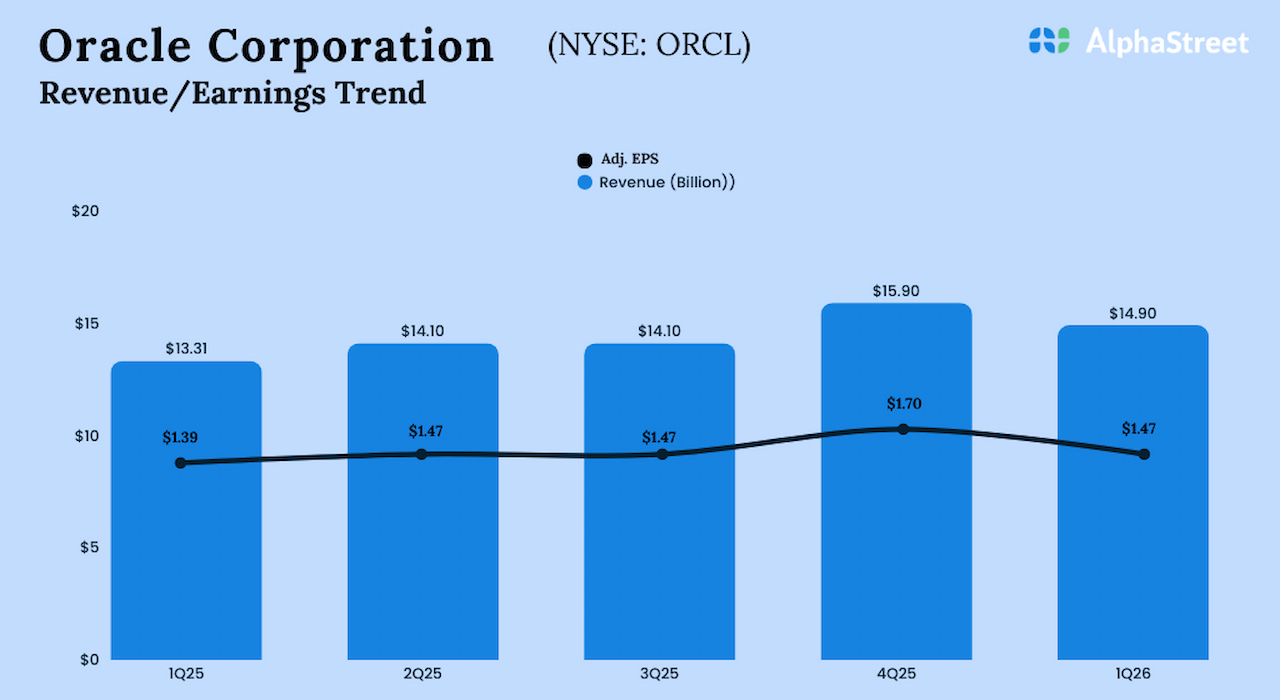
In the first three months of fiscal 2026, Oracle’s revenue increased to $14.9 billion from $13.31 billion in the corresponding period a year earlier. Adjusted earnings, excluding one-off items, were $1.47 per share in the first quarter, compared to $1.39 per share in Q1 2025. On a reported basis, net income was $2.93 billion or $1.01 per share in Q1, compared to $2.93 billion or $1.03 per share in the year-ago quarter. Both earnings and the top line missed analysts’ estimates after beating in the prior quarter.
From Oracle’s Q1 2026 Earnings Call:
“As we bring more capacity online, we will convert the large RPO backlog into accelerating revenue and profit growth. Now, before I dive into specific Q2 guidance, I’d like to share some of the overarching thoughts on fiscal year 2026 and the coming year. Clearly, it was an excellent quarter, and demand for Oracle Cloud infrastructure continues to build. I expect we will sign additional multibillion-dollar customers and that RPO will likely grow to exceed half a trillion dollars. The enormity of this RPO growth enables us to make a large upward revision to the cloud infrastructure portion of our financial plan.“
Bullish Outlook
Remaining performance obligations more than quadrupled to $455 billion in the first quarter. Taking a cue from the continued strong demand for cloud infrastructure, the management has forecast that remaining performance obligations will exceed half a trillion dollars in the coming months. Meanwhile, Oracle’s high exposure to OpenAI is viewed as risky. The long-term infrastructure contract with the latter requires significant capital spending—potentially financed with large amounts of debt—and concentrates a substantial portion of the company’s cloud growth on a single partner.
This week, ORCL traded slightly above the $200 mark, broadly matching its 12-month average price. The stock was trading up 3% on Wednesday afternoon.