“The need to limit the discretion of subordinates is present in every organization.”— Ludwig von Mises, Bureaucracy
“General Turgidson, I find this very difficult to understand. I was under the impression that I was the only one in authority to order the use of nuclear weapons.”—Merkin Muffley, Dr. Strangelove
“Well, I, uh, don’t think it’s quite fair to condemn a whole program because of a single slip-up, sir.”—Gen. “Buck” Turgidson, Dr. Strangelove
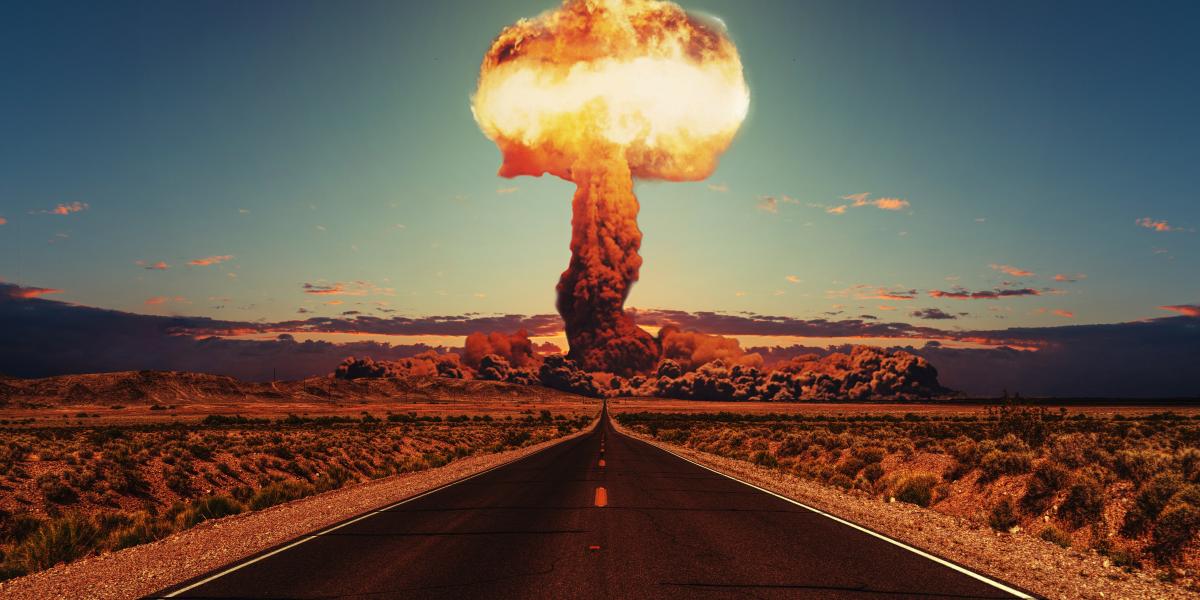
The Doomsday Clock—created by Albert Einstein, J. Robert Oppenheimer and other scientists in 1945—gives us some idea of how close the world is to global catastrophe “caused by man-made technologies”—and by their measure it’s 89 seconds to midnight, the closest it’s ever been. With the US war industry steering our direction behind the scenes while world leaders in charge of nuclear arsenals trade threats, it’s like watching children playing with dynamite and matches, oblivious to the consequences.
Perhaps President Trump should invite the nuclear bomb fraternity to one of his golf courses where they can focus on driving a ball instead of unleashing Armageddon. Or perhaps this would be a good time to organize society based on respect for the individual rather than the majority. But that will be a topic for another day.
The US government has made many enemies since it adopted the National Security State model following World War II, yet most people continue to believe we’re a free people whose votes count, and that our elected leaders and their bureaucratic subordinates are “unswervingly attending day and night to the welfare of the nation,” as Mises wrote.
Along with everything being judged by whether it threatens national security, including Chinese coffee, the government has relentlessly pursued a foreign policy of unilateralism, a deceitful way of telling the world we’re in charge and will beat you up if you don’t cooperate. And, to underscore this policy, the president has decided to rename the Department of Defense to its former label—the Department of War. But as Ron Paul noted, this could backfire on warmongers if it revives the constitutional requirement for “a Congressional declaration of war.”
According to different sources the federal government has between 400 and 2,000 agencies, depending on what’s counted as an agency. Some of them operate under the name “independent” allegedly to avoid political influence, with examples including NASA, EPA, FTC, and the most independent of all, the Federal Reserve Board.
Standing on the outside of all this is the Constitution, once briefly kept in Fort Knox during WWII, but permanently secured in an airtight, bulletproof glass case filled with argon gas to prevent deterioration, located at 701 Constitution Avenue in Washington, DC. Every federal employee swears to “support and defend the Constitution of the United States against all enemies, foreign and domestic.” It’s the “domestic” part that might cause problems in this nuclear-armed world.
As derived from a 2017 Harvard University conference, “Presidential First Use: Is it legal? Is it constitutional? Is it just?” the protocol for unleashing the most destructive weapons ever developed,
…has two main functions and virtues: first, it concentrates the power and authority over the use of nuclear weapons in the presidency, at the highest level of the executive branch of the US government, thus keeping it out of the hands of the military and others. Second, it enables the president to respond rapidly and decisively to a nuclear attack by an enemy whose missiles may fly from one side of the planet to the other in 30 minutes; or whose missiles launched from submarines in the oceans may fly to targets in the United States in 15 minutes.
Consider for a moment what it means to arm the president with nuclear weapons. Joe Biden was officially president from 2021-2025 but his cognitive impairments left people wondering who was really making presidential decisions. Democrats and a Trump-averse media tried to conceal Biden’s problems but a televised debate exposed them to the world. Democrats did succeed, though, in protecting President Wilson in 1919 when he suffered a catastrophic stroke that “profoundly and irreversibly altered the trajectory of United States history in the 20th century.”
Whether Donald Trump has any secret disabilities that would affect his judgment remains speculative but it’s clear he’s not afraid of taking off-the-wall actions such as renaming the Gulf of Mexico or going on a tariff spree, recently declared illegal but which constitutes “the centerpiece of his economic agenda.”
For now, the government has no first-use nuclear policy, so all nuclear launches would be in response to perceived attacks from another government. The current protocol is said to launch with minimum delay while securing its necessity through multiple steps of verification and consultation. In summary,
…the president wakes up, gives an order through a system so streamlined that there’s almost no gatekeeping, and, within five minutes, 400 bombs leave on missiles launched out of the Midwest. About 10 minutes later, another 400 leave on missiles launched out of submarines. That’s 800 nuclear weapons—roughly the equivalent of, in round numbers, 15,000 Hiroshima bombs.
Fifteen thousand Hiroshimas? Really? That in itself is utter madness.
During this streamlined process the president consults with numerous military aides and advisors who are “legally bound by the Uniform Code of Military Justice to obey lawful orders from officers above them in the Chain of Command, which includes the President.”
But these same people swore to uphold and defend the Constitution, not the president. “Therefore, military personnel have a ‘duty to disobey’ unlawful orders that would violate that oath—even if those orders came directly from the President.”
Under Article II, Section 2, Clause 1—The Commander in Chief Clause—according to interpretation, “The President had the duty and the power to repel sudden attacks,” which would include sudden missile attacks. But what if there is disagreement about the threat? Early detection relies on technology, which always has an element of uncertainty.
On September 26, 1983, in the early hours of the morning, Soviet duty officer Stanislav Petrov saw on his computer screens what appeared to be American missile launches but chose not to report them to his superiors, dismissing them as a false alarm. In his words, “My colleagues were all professional soldiers, they were taught to give and obey orders.” Petrov was the only officer on his team that had a civilian education, which, in this instance, meant he should think. If Americans were attacking Russians, they would go all out. What Petrov saw was first one, then several other missiles in succession. This was not an attack, the Soviets should not retaliate, he concluded, his blood pressure undoubtedly off the charts. Turned out the missiles were clouds.
Bureaucracy being what it is, he was reprimanded later “not for what he did, but for mistakes in the logbook.” Much later still, he is widely considered the man who saved the world.
While world leaders today meet in a conference somewhere, a Stanislav Petrov—Russian or otherwise—could be disobeying orders and breaking the chain of command, correctly or not, established by bureaucratic protocol. Or backed by AI, he might think what he saw was the real thing and report an attack was underway. Or perhaps worse still, Petrov had been laid off and the redoubtable AI—now an AGI—was wrongly telling the president to retaliate. Would any president, general, or lackey challenge the judgment of an AGI? Would the AGI have to take an oath as the rest of them did?
As government spreads so does bureaucracy, and with it the fatal pitfalls of allowing it to rule our lives.