

Futures and stocks are both extremely popular trading instruments, and each come with their own pros and cons. In this article we are going to outline some benefits of each to help you make an informed decision as to which might work best for you as a trader.
Why Trade Futures Instead of Stocks?
With the recent decline in volume in stocks (particularly, the small cap space), you may be finding there’s much less volume and movement, which means, of course, less trades, less opportunities, and higher trading costs (i.e. paying for borrows to get minimal return and risk vs reward).
As a result, many people (including myself) have turned to futures and options trading to fill the gap.
Many people are hanging onto the past, spending day after day waiting for the volume to come back in small cap stocks, but the truth of the matter is, it could be years before that happens and it could be beneficial to find some new asset classes to trade that will never run out of volume, volatility, and liquidity.
What is Futures Trading?
Futures trading is buying and selling of standardized contracts (instead of shares) of an underlying asset. If you are a day trader, in simple terms, you are simply trading contracts instead of shares.
The asset underlying a futures contract can be a commodity, such as oil, gold, or a financial instrument such as a stock index ($SPY) or currency.
What are the Most Popular Futures Trading Contracts?
The E-Mini S&P 500 contracts are the most heavily traded futures contracts in the world. This is where myself and our team spend the majority of our time trading.
The E-Minis and Micros go under the tickers $ES and $MES respectively, which are extremely liquid, volatile, and tradeable assets. You can see below the E-minis and $SPY trade in perfect tandem:
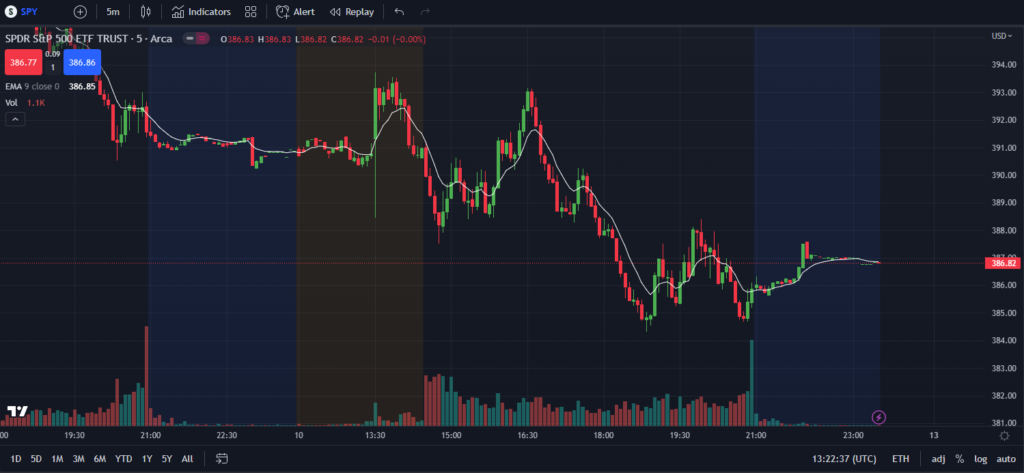
Don’t be scared by the price of the futures contracts! We are going to explain later in this article how you can trade futures with even less starting capital than you would need to trade stocks.
Benefits of Trading Futures vs Stocks
Trading futures, like any financial asset, comes with its own benefits and risks. However, if you’ve decided to take on trading and are willing to accept the risks, there are some major benefits to trading futures:
Futures Trading Leverage
Futures contracts can be traded on margin and are highly leveraged instruments. Due to the high level of liquidity in the futures market, brokers can allow small trading accounts, even as little as $500, to trade with large amounts of margin.
In fact, you can do a lot more with a small futures trading account vs a small stock trading account.
In contrast, you can’t trade $SPY with a $5000 account because stock brokers don’t give enough leverage to make any meaningful money with that little starting capital.
However, if you are trading E-Micros or E-Minis, you have the ability to trade $SPY as if it were a $5.00 per share small cap stock – you can get decent sized positions and take advantage of the volatility each day with a good trading strategy.
Futures Market Liquidity
Futures markets are highly liquid, with large numbers of buyers and sellers and tight bid-ask spreads. This means that traders can easily enter and exit positions, even with large volumes of contracts.
This is why futures trading brokers are able to offer such high leverage – they can be sure to sell you out of your positions without your account slipping into negative numbers, and it protects you from big sudden moves (as long as you use hard stop loss orders).
Futures Trading is Scalable
This is a big perk in futures trading. Due to the high liquidity in the futures market, its highly scalable, meaning that what works with a small amount of contracts, is more likely to work with large numbers of contracts as you grow.
In a market like small caps, for example, its very hard to scale because the liquidity doesn’t always support large positions, and can lead to massive losses when you cant exit a large position in time, or because you have to move the market to exit your large position.
Lower Commissions and Trading Costs
This is a big one. Ever look at your broker statement and feel shocked at how much you spent in borrow costs when shorting stocks? This can add up to be a substantial amount of money in the course of a year.
Futures trading offers extremely competitive commissions compared to stocks. You can trade futures for as little as $0.59 per contract and never have to pay a borrow fee for shorting. This in itself is one of the biggest benefits in trading futures.
Futures Trading Hours
The futures market only closes for one hour per day during the trading week. The CME Group is the world’s largest futures exchange and offers trading in a wide range of futures contracts, including stock index futures, agricultural futures, and energy futures.
The trading hours for CME Group trading hours are Sunday through Friday, from 5:00 PM to 4:00 PM Central Time, with a only a one-hour maintenance break each day from 4:00 PM to 5:00 PM Central Time
This means the extended trading hours can be beneficial to people who work day jobs. While the volume is quite a bit lower outside of regular market hours, the market is still open and there is movement all through the night (or day, depending on which time zone you live in).
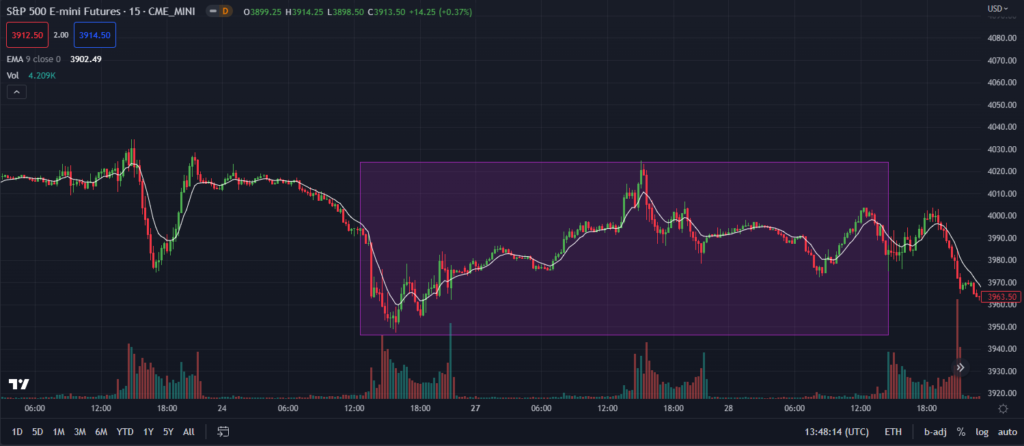
Note the continued action in the image above after normal trading hours. This also means you can keep hard stop losses in the market overnight and don’t have to worry about getting “gapped out” of a position the next morning on $SPY at a larger loss than you planned.
No Pump and Dumps
No one is bigger than the futures market except maybe the influence of the Fed when they speak. Your well-known pump and dumpers on twitter can not manipulate this market or take advantage of followers by front running and dumping stocks. The futures market is far too liquid for that, which is why none of them trade it.
Trade the Same Asset Every Day
Another major benefit for futures traders is that if you trade the same ticker every day, you get used to the price action and understand better how it behaves. Stocks all trade a bit different depending on a number of factors including institutional ownership, volume, float, etc.
If you spend all your time watching and trading $SPY or E-minis each day, you will become very familiar with the way they move and be able to develop a strategy that works really well each day for that asset.
You no longer have the need to pay for scanners or bother scanning the market for in-play stocks, you can make your bread every day from the volatility of $SPY and E-minis.
Automate Your Futures Trading Strategy
Automated futures trading refers to the use of computer algorithms to execute trades in futures markets. These algorithms are designed to analyze market data, identify trends and patterns, and execute trades based on predefined rules and parameters that you set. Here are some key aspects of automated futures trading:
Algorithmic Trading Systems: Automated futures trading is typically done through algorithmic trading systems, also known as trading bots or trading robots. These systems use advanced mathematical models and statistical techniques to analyze market data and generate trading signals.
Speed and Efficiency: Automated futures trading can be faster and more efficient than manual trading, as trading bots can execute trades at a much faster pace and can react to market movements in real-time.
Reduced Emotions and Human Errors: Automated trading can also help reduce emotions and human errors in trading, as the algorithmic trading systems can make decisions based purely on data and predefined rules, without being influenced by emotions or biases.
Back-testing and Optimization: Before deploying an algorithmic trading system, traders can backtest and optimize the system to ensure that it performs well in historical market conditions. This can help improve the system’s performance and reduce the risk of losses.
Risks and Limitations: Automated futures trading also comes with risks and limitations. For example, algorithmic trading systems can be vulnerable to technical glitches, market volatility, and unexpected events that are not accounted for in the system’s rules and parameters. Traders should carefully monitor their automated trading systems and have a plan in place for managing risk.
Futures Trading Tax Benefits
Futures trading can offer several tax benefits to traders compared to other types of investments. Here are some of the tax benefits of futures trading:
Lower Tax Rates: Futures contracts are generally taxed at a lower rate compared to other investments like stocks or real estate. Profits from futures trading are taxed as capital gains, and if the contracts are held for more than one year, they are eligible for long-term capital gains tax rates, which are generally lower than short-term capital gains tax rates.
60/40 Tax Rule: Futures trading is subject to the 60/40 rule, which means that 60% of profits are taxed at the long-term capital gains rate and 40% are taxed at the short-term capital gains rate. This can result in a lower overall tax rate compared to other investments that are subject to ordinary income tax rates.
Loss Carryforward: If a trader incurs losses from futures trading, those losses can be carried forward to offset future gains. This can reduce the trader’s tax liability in future tax years.
Mark-to-Market Accounting: Traders who elect to use mark-to-market accounting can treat gains and losses from futures trading as ordinary income or losses, which can offer greater tax benefits compared to capital gains or losses.
Conclusion
As mentioned earlier in this article, there’s a high degree of risk involved with any type of trading, but if you are already a seasoned trader with good risk management principles, futures trading might be haven you’ve been seeking during the post-covid trading era. Volatility, volume, liquidity, and leverage are what we all seek as traders. The only thing you need is discipline, knowledge, and a well-versed and back-tested trading strategy to employ and you may never look back to day trading stocks again.





















