As we look ahead to 2026, one thing is clear: go-to-market leadership is becoming more complex, not less. Growth-stage companies are operating in an environment shaped by longer sales cycles, more selective buyers, tighter budgets, and rapidly evolving AI capabilities.
The companies that will win are not the ones chasing every new tactic. They are the ones building disciplined, resilient GTM engines that balance efficiency with ambition.
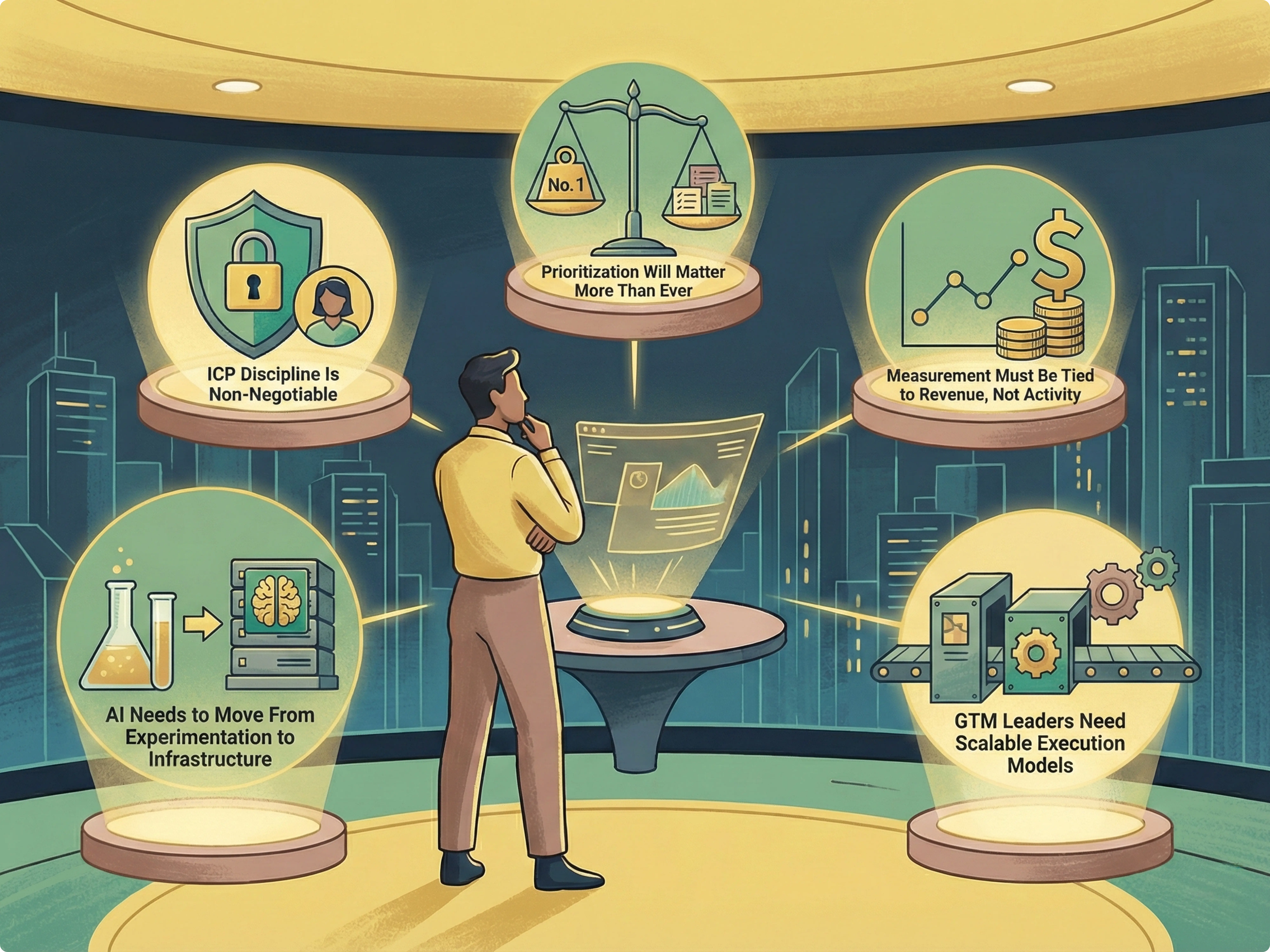
Here are five areas GTM leaders should be focused on now to set themselves up for success in 2026.
1. Prioritization Will Matter More Than Ever
AI has dramatically lowered the cost of experimentation. New campaigns, channels, and ideas can be launched faster than ever before. But speed without prioritization creates noise, not results.
In 2026, the strongest GTM teams will be defined by what they do not pursue.
Leaders should be asking:
Which initiatives directly support our ICP and revenue goals?
What can we pause, simplify, or eliminate?
Where are we spreading resources too thin?
The ability to say no, backed by data, will be one of the most valuable GTM skills in the coming year.
2. ICP Discipline Is Non-Negotiable
As markets tighten, vague or overly broad ICP definitions become expensive mistakes. Growth-stage companies can no longer afford misaligned messaging, sales outreach, or product positioning.
High-performing teams are revisiting their ICPs with rigor:
Who is actually buying and renewing?
Where is expansion happening?
Which segments generate the healthiest unit economics?
This clarity drives everything downstream, from messaging and channel selection to sales enablement and product roadmap decisions. GTM leaders who invest here will move faster with less friction.
3. AI Needs to Move From Experimentation to Infrastructure
Most GTM teams have experimented with AI tools. Far fewer have operationalized them.
In 2026, AI should not live in side projects or one-off workflows. It needs to be embedded into the GTM engine itself. This includes:
AI-supported campaign analysis and optimization
Sales enablement and account research
Forecasting and pipeline intelligence
Automated reporting and insights
Teams that treat AI as infrastructure, not novelty, will gain real leverage. This is an area where experienced partners can help companies move from tools to systems and ensure AI drives measurable outcomes.
4. Measurement Must Be Tied to Revenue, Not Activity
Vanity metrics are easy to generate. Revenue impact is harder to prove.
As boards and investors become more focused on efficiency, GTM leaders will need to clearly connect activity to outcomes. That means:
Understanding which channels create pipeline, not just engagement
Measuring conversion quality, not just volume
Aligning marketing and sales metrics around shared goals
This level of visibility requires clean data, strong attribution, and consistent reporting. Teams that invest in this foundation will make better decisions faster and earn greater trust across the organization.
5. GTM Leaders Need Scalable Execution Models
Many growth-stage companies hit a ceiling not because of strategy, but because execution does not scale with ambition.
In 2026, GTM leaders should be evaluating:
Which functions must be in-house?
Where can specialized partners accelerate execution?
How can technology and process reduce dependency on headcount growth?
Scalable GTM models combine people, process, and technology in a way that supports growth without introducing unnecessary complexity. Companies that get this right will be able to adapt quickly as market conditions evolve.
Looking Ahead
The role of the GTM leader is expanding. It is no longer just about driving demand. It is about orchestrating systems, aligning teams, and making disciplined decisions in an environment full of options.
2026 will reward GTM leaders who are focused, data-driven, and intentional about how they deploy resources. Those who build strong foundations now will not just weather the next cycle. They will define it.