No Result
View All Result
SUBMIT YOUR ARTICLES
  • Login
Saturday, March 21, 2026
TheAdviserMagazine.com
  • Home
  • Financial Planning
    • Financial Planning
    • Personal Finance
  • Market Research
    • Business
    • Investing
    • Money
    • Economy
    • Markets
    • Stocks
    • Trading
  • 401k Plans
  • College
  • IRS & Taxes
  • Estate Plans
  • Social Security
  • Medicare
  • Legal
  • Home
  • Financial Planning
    • Financial Planning
    • Personal Finance
  • Market Research
    • Business
    • Investing
    • Money
    • Economy
    • Markets
    • Stocks
    • Trading
  • 401k Plans
  • College
  • IRS & Taxes
  • Estate Plans
  • Social Security
  • Medicare
  • Legal
No Result
View All Result
TheAdviserMagazine.com
No Result
View All Result
Home Market Research Market Analysis

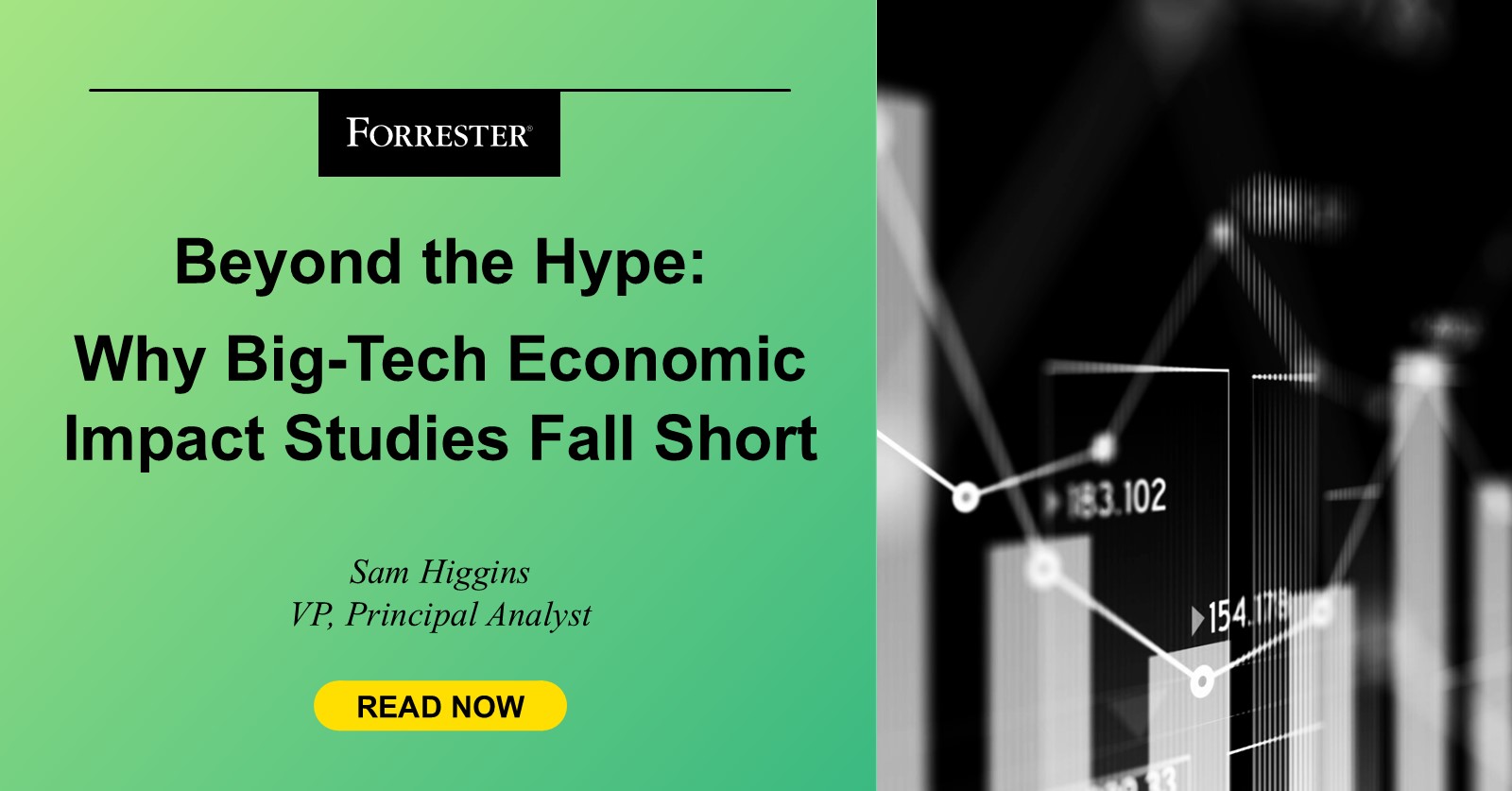
Why Big Tech Economic Impact Studies Fall Short

by TheAdviserMagazine
7 months ago
in Market Analysis
Reading Time: 4 mins read
A A
Why Big Tech Economic Impact Studies Fall Short
Share on FacebookShare on TwitterShare on LInkedIn


Big tech economic impact headlines are engineered for attention. Apple recently announced a staggering US$600 billion investment in US manufacturing over four years — complete with fanfare around domestic chip and glass production. But dig deeper, and you’ll find most of the activity was already planned, funded, or happening. It’s more repositioning than reinvention, as Business Insider and others have pointed out.

Closer to home, we see the same playbook from hyperscalers across APAC when it comes to major infrastructure plays. AWS, Google, and Microsoft frequently announce local region investments tied to promises of billions in GDP uplift, job creation, and workforce development. These are strategic moves, yes. They’re also branding exercises.

The recent announcements as part of AWS’s new data center region launch in New Zealand are another example: NZ$7.5 billion in investment, NZ$10.8 billion in GDP impact, 50,000 people trained, 1,000 jobs created. As I noted in a recent article by iStart, “these headline GDP claims often become rallying cries for market share rather than anything designed to prove the delivery of real or measurable outcomes.”

Don’t misquote me — it’s not just Apple or AWS; name a vendor, and I’ll find you an example. Microsoft’s US$2 billion-plus pledge in Malaysia, Google’s US$1 billion investment in Japan, and Oracle’s planned US$14 billion cloud push in Saudi Arabia all follow the same pattern: headline-grabbing numbers, vague timelines, and economic impact projections that rarely face scrutiny after the press release has been archived.

Economic Impact Studies: All Promise, No Proof

At the core of these big claims are economic impact study (EIS) tools built on input-output models originally developed in the 1930s. They work by applying multipliers to direct spending (for example, construction or wages) to estimate wider economic benefits. But these models often assume:

No supply constraints.
No price changes.
Perfect conversion of spend into local value.

That’s not how economies actually work. Academic reviews by institutions such as Cornell University show that EIS often overestimates benefits by 30–60%, especially when they include indirect effects like supplier activity or worker spending without separating what’s truly new from what would have happened anyway. Or sadly, this can even occur through plain old poor estimation. Worse, these studies are rarely revisited. There’s no formal tracking of whether the jobs, GDP, or upskilling ever materialize. The model looks forward but never backward.

Computable General Equilibrium: Better Economics But Not Built For Speed

There is a more sophisticated alternative: computable general equilibrium (CGE) models. These simulate how changes ripple across the economy over time, adjusting for prices, capacity limits, and behavior. Public sector analysts use CGE for evaluating major policy changes or environmental impacts. CGE isn’t without its own issues, however:

It’s slow, expensive, and opaque.
Its complexity makes it inaccessible to most tech and business leaders.
It can be shaped by hard-to-audit assumptions.

In one comparative study of disaster impacts in Italy, CGE, input-output, and hybrid models delivered up to a sevenfold difference in estimated economic loss. The message? The model you choose shapes the story you tell.

Why Forrester’s TEI Is The Better Middle Ground

At Forrester, we take a different approach with the Total Economic Impact™ (TEI) methodology. Our methodology:

Starts with real customer data. Interviews, cost baselines, and quantified use cases form the foundation.
Adjusts for risk. Every benefit is discounted based on likelihood and implementation risk.
Focuses on what matters to your decision-makers. ROI, net present value, and payback matter — not hypothetical GDP boosts.
Is tailored to your context. TEI doesn’t assume national impact; it shows value based on your workloads, staffing, and strategic goals.

Put simply, the Forrester TEI models what’s real, not what’s hoped. And yes, you can and should measure the actual results. For our clients, we will be at your side and by your side when the actuals roll in.

Don’t Be Seduced By The GDP Halo

There’s nothing wrong with companies investing in digital infrastructure or governments welcoming it. Still, let’s not confuse those investments with a universal good. A new cloud region may unlock value — but not for every organization and not at any cost.

My advice? Organizations evaluating these investments shouldn’t rely solely on sweeping economic claims or fall for the idea that jumping into an onshore cloud automatically contributes to some imagined national benefit. Instead, assess the value based on your own cost structures, workloads, and strategic priorities. By all means, make it a total economic impact! Just make sure it serves you and your outcomes.

Macroeconomic splash statements? More often than not, they serve the branding and demand generation needs of the firms that sponsor them. And the headlines that follow? They’re just the sugar coating.



Source link

Tags: bigeconomicFallimpactshortStudiestech
ShareTweetShare
Previous Post

Breaking Down Why Medicare Part D Premiums Are Likely To Go Up

Next Post

10 Tips to Live Frugally After Retirement

Related Posts

edit post
Agent Control Planes Still Need A Robust Standards Stack

Agent Control Planes Still Need A Robust Standards Stack

by TheAdviserMagazine
March 20, 2026
0

This post is a follow-up to my earlier announcement of our coverage of the agent control planes market. Research questionnaires...

edit post
4 Undervalued Stocks Worth Buying to Navigate 2026 Market Volatility

4 Undervalued Stocks Worth Buying to Navigate 2026 Market Volatility

by TheAdviserMagazine
March 20, 2026
0

The stock market is experiencing increased volatility amid inflation fears, geopolitical uncertainty, and shifting interest rate expectations. Below we highlight...

edit post
The Strategic Guide to Channel Optimization

The Strategic Guide to Channel Optimization

by TheAdviserMagazine
March 19, 2026
0

The average manufacturer loses up to 10% of their annual bottom line simply because they’re managing rebates & incentives through...

edit post
Starbucks’ Loyalty Program Upgrade Felt Like A Downgrade — Here’s Why

Starbucks’ Loyalty Program Upgrade Felt Like A Downgrade — Here’s Why

by TheAdviserMagazine
March 18, 2026
0

Starbucks’ recent rewards program update should have been a brand win, with more ways to earn, clearer tiers, and friendlier...

edit post
The 2026 Guide to Automating Channel Marketing Funds

The 2026 Guide to Automating Channel Marketing Funds

by TheAdviserMagazine
March 18, 2026
0

A staggering 40% of channel marketing funds go unspent every year because the barrier to entry for partners is simply...

edit post
Convenience as the New Consumer Currency

Convenience as the New Consumer Currency

by TheAdviserMagazine
March 18, 2026
0

Convenience is no longer a nice-to-have, but a core value exchange between brands and consumers. Today’s consumers are often operating...

Next Post
edit post
10 Tips to Live Frugally After Retirement

10 Tips to Live Frugally After Retirement

edit post
AI is gutting the next generation of talent: In tech, job openings for new grads have already been halved

AI is gutting the next generation of talent: In tech, job openings for new grads have already been halved

  • Trending
  • Comments
  • Latest
edit post
Foreclosure Starts are Up 19%—These Counties are Seeing the Highest Distress

Foreclosure Starts are Up 19%—These Counties are Seeing the Highest Distress

February 24, 2026
edit post
7 States Reporting a Surge in Norovirus Cases

7 States Reporting a Surge in Norovirus Cases

February 22, 2026
edit post
The Growing Movement to End Property Taxes Continues in Kentucky, And What It Means For Investors

The Growing Movement to End Property Taxes Continues in Kentucky, And What It Means For Investors

March 2, 2026
edit post
Who Is Legally Next of Kin in North Carolina?

Who Is Legally Next of Kin in North Carolina?

February 28, 2026
edit post
Hidden Danger for Seniors: Why Radon Is Building Up in Basements Across 10 States

Hidden Danger for Seniors: Why Radon Is Building Up in Basements Across 10 States

March 17, 2026
edit post
How Age Affects Your Social Security Disability Claim

How Age Affects Your Social Security Disability Claim

March 2, 2026
edit post
Number of passengers allowed on outbound flights increased

Number of passengers allowed on outbound flights increased

0
edit post
How to build strategic advantage with tariff uncertainty

How to build strategic advantage with tariff uncertainty

0
edit post
Eni Bets on Upstream Strength and Transition Growth in 2030 Plan

Eni Bets on Upstream Strength and Transition Growth in 2030 Plan

0
edit post
In the Pink | Mises Institute

In the Pink | Mises Institute

0
edit post
Japan Expected to Greenlight Spot Crypto ETFs by 2028

Japan Expected to Greenlight Spot Crypto ETFs by 2028

0
edit post
OpenClaw demand in China is driving up the price of secondhand MacBooks

OpenClaw demand in China is driving up the price of secondhand MacBooks

0
edit post
Metals to shine? Hindustan Copper, Tata Steel, other stocks plunge up to 14% in one month; what lies ahead?

Metals to shine? Hindustan Copper, Tata Steel, other stocks plunge up to 14% in one month; what lies ahead?

March 21, 2026
edit post
The Global Energy Crisis & The Market Impact Into 2028

The Global Energy Crisis & The Market Impact Into 2028

March 21, 2026
edit post
Behavioral scientists found that people who aren’t genuinely good don’t lack empathy — they possess what researchers call ‘selective empathy’ that activates only when there’s an audience or when feeling someone’s pain serves their narrative

Behavioral scientists found that people who aren’t genuinely good don’t lack empathy — they possess what researchers call ‘selective empathy’ that activates only when there’s an audience or when feeling someone’s pain serves their narrative

March 20, 2026
edit post
These Hidden Mastercard Perks Could Upgrade Your Next Trip

These Hidden Mastercard Perks Could Upgrade Your Next Trip

March 20, 2026
edit post
Chainlink Maxi Shares Why LINK Is A Better Institutional Bet Than XRP

Chainlink Maxi Shares Why LINK Is A Better Institutional Bet Than XRP

March 20, 2026
edit post
Musk misled Twitter investors before 2022 buyout, jury says

Musk misled Twitter investors before 2022 buyout, jury says

March 20, 2026
The Adviser Magazine

The first and only national digital and print magazine that connects individuals, families, and businesses to Fee-Only financial advisers, accountants, attorneys and college guidance counselors.

CATEGORIES

  • 401k Plans
  • Business
  • College
  • Cryptocurrency
  • Economy
  • Estate Plans
  • Financial Planning
  • Investing
  • IRS & Taxes
  • Legal
  • Market Analysis
  • Markets
  • Medicare
  • Money
  • Personal Finance
  • Social Security
  • Startups
  • Stock Market
  • Trading

LATEST UPDATES

  • Metals to shine? Hindustan Copper, Tata Steel, other stocks plunge up to 14% in one month; what lies ahead?
  • The Global Energy Crisis & The Market Impact Into 2028
  • Behavioral scientists found that people who aren’t genuinely good don’t lack empathy — they possess what researchers call ‘selective empathy’ that activates only when there’s an audience or when feeling someone’s pain serves their narrative
  • Our Great Privacy Policy
  • Terms of Use, Legal Notices & Disclosures
  • Contact us
  • About Us

© Copyright 2024 All Rights Reserved
See articles for original source and related links to external sites.

Welcome Back!

Login to your account below

Forgotten Password?

Retrieve your password

Please enter your username or email address to reset your password.

Log In
No Result
View All Result
  • Home
  • Financial Planning
    • Financial Planning
    • Personal Finance
  • Market Research
    • Business
    • Investing
    • Money
    • Economy
    • Markets
    • Stocks
    • Trading
  • 401k Plans
  • College
  • IRS & Taxes
  • Estate Plans
  • Social Security
  • Medicare
  • Legal

© Copyright 2024 All Rights Reserved
See articles for original source and related links to external sites.