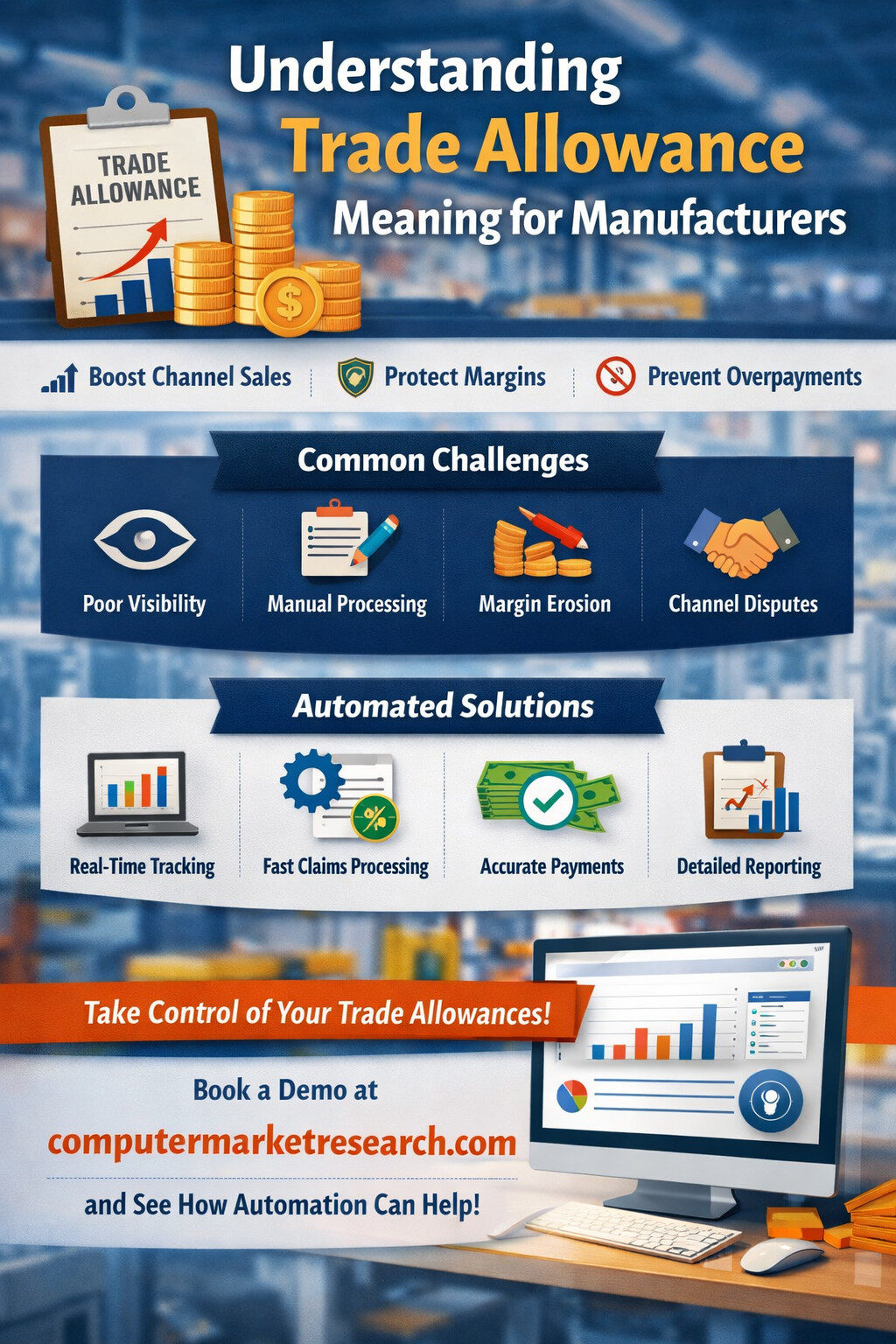
Understanding trade allowance meaning plays a vital role in every manufacturer’s channel strategy. Although trade allowances continue to drive promotions and partner participation, they can quietly destroy margins when teams manage them manually. Therefore, manufacturers must take a smarter, automated approach to protect profitability and improve channel performance.
Let’s break down what trade allowances mean, why they matter, and how automation transforms them into a competitive advantage.
What Is Trade Allowance? (Trade Allowance Meaning Explained)
A trade allowance is a financial incentive that manufacturers offer to distributors, resellers, or retailers in exchange for specific actions. For example, manufacturers use trade allowances to encourage promotional campaigns, bulk purchases, special pricing events, and shelf placement agreements.
Unlike discounts, trade allowances require proof of performance before payment occurs. Consequently, manufacturers must track eligibility, verify compliance, and approve claims accurately.
Common trade allowances include:
Bill-back programs
Off-invoice allowances
Scan-based trading
Volume incentive rebates
Promotional MDF programs
Because allowances directly affect margins, manufacturers must manage them with precision. Therefore, automation becomes essential.
Why Trade Allowances Matter to Manufacturers
Trade allowances influence pricing strategy, partner behavior, and revenue growth. However, as channel programs expand, complexity increases quickly. As a result, manufacturers often struggle to maintain control.
For example, teams must track:
Partner eligibility
Program requirements
Earned amounts
Claim documentation
Payment timelines
Meanwhile, spreadsheets slow everything down and increase error rates. Consequently, manufacturers experience delayed reimbursements, overpayments, disputes, and reporting blind spots.
Fortunately, platforms like computermarketresearch.com centralize allowance programs, simplify claim processing, and provide real-time visibility across the channel.
Common Trade Allowance Challenges Manufacturers Face
Although allowances drive growth, they also introduce risk when systems lack automation.
Poor Visibility
Without centralized reporting, teams lose track of liabilities and budget commitments.
Manual Claim Processing
Manual workflows delay payments, increase labor costs, and create compliance risks.
Channel Disputes
When documentation lives in email threads and spreadsheets, disputes escalate quickly.
Margin Erosion
Over time, small overpayments add up and quietly drain profitability.
Therefore, manufacturers increasingly rely on automated platforms like computermarketresearch.com to protect revenue.
How Automation Transforms Trade Allowance Management
Automation converts trade allowances from a financial liability into a strategic growth tool. Instead of managing claims manually, manufacturers control programs inside one web-based platform.
As a result, teams can:
Launch and approve programs faster
Validate POS data automatically
Process claims in days instead of months
Reconcile payments accurately
Forecast liabilities in real time
Most importantly, automation ensures that payments occur only when partners meet program requirements.
Benefits of Automating Trade Allowances
Once manufacturers implement automated allowance management, performance improves immediately.
Protect Margins
Real-time validations prevent duplicate and invalid claims.
Accelerate Payments
Automated workflows eliminate bottlenecks and speed reimbursement cycles.
Strengthen Partner Trust
Fast, accurate payments improve distributor satisfaction.
Improve Forecast Accuracy
Live dashboards provide financial clarity across every program.
Stay Audit-Ready
Centralized documentation simplifies audits and compliance reviews.
Because of these benefits, manufacturers adopt platforms like computermarketresearch.com to maintain full control of channel spend.
Why Manufacturers Are Abandoning Spreadsheets
Spreadsheets cannot scale with growing channel programs. As allowance programs expand, spreadsheets create version conflicts, reporting gaps, and security risks. Consequently, manufacturers shift to web-based automation to reduce risk and improve financial governance.
Final Thoughts: Turn Trade Allowances into a Profit Engine
Understanding trade allowance meaning represents only the starting point. True success comes from controlling allowances with automation, visibility, and accountability.
Manufacturers that modernize their channel finance operations gain:
Lower risk
Faster payments
Higher margins
Stronger partner relationships
👉 Book a demo of Computer Market Research’s automated channel management platform:https://computermarketresearch.com/channel-management-tools-demo-request/
You’ll see how automation converts trade allowances into a powerful driver of predictable, profitable channel growth.
The post Trade Allowance Meaning: What Manufacturers Need to Know to Protect Margins and Increase Channel Performance appeared first on Computer Market Research.