The SAP-Reltio deal is about who controls your future architecture
We have seen a lot of M&A activity trying to capitalize on AI hype. SAP’s acquisition of Reltio isn’t that. Instead, the acquisition is a strategic, pragmatic shot by SAP to own the master data layer and make the future enterprise architecture more interoperable particularly for CIOs running mixed SAP and non-SAP environments. By strengthening this foundational layer, SAP is positioning itself to enable more seamless data-driven decision-making across the enterprise but at a cost.
Why the SAP-Reltio acquisition matters more than AI messaging
SAP is positioning its acquisition of Reltio as a strategic step to make enterprise data “AI-ready” today and future-proof for tomorrow’s intelligent applications. That framing is understandable, but it is not the most important implication for CIOs running heterogeneous environments.
Instead, this acquisition is fundamentally about control of the enterprise master data layer. Once master data moves from a neutral capability into a vendor-controlled data platform, it quietly reshapes pricing power, interoperability, and future architectural choices. That is the change CIOs need to confront now.
Why this is true
The structural risk created by the SAP-Reltio acquisition is not technical but economic and architectural, because master data becomes a platform control point rather than a neutral capability.
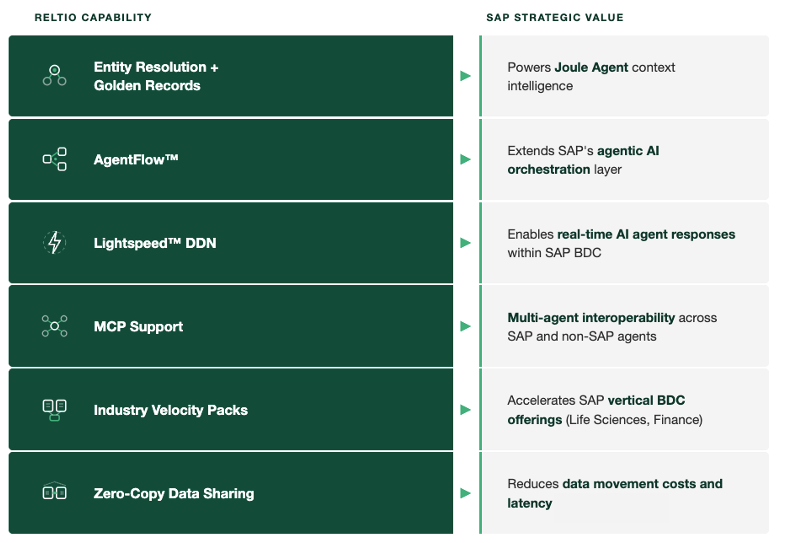
SAP is turning master data into a platform control point. By acquiring Reltio, SAP moves master data management into the core of Business Data Cloud. Platform foundations shape everything that sits on top of them. Once embedded, they are difficult and expensive to unwind. This also lays the groundwork for a semantic layer, making data more connected, consistent, and actionable across the SAP enterprise.
Reltio’s historical value is exactly what is now under pressure. Reltio has been attractive in mixed environments because it works well across SAP and non-SAP systems. Post acquisition, SAP’s commercial incentives will naturally favor SAP-first optimization unless customers actively constrain that drift.
“Standalone for the foreseeable future” is not an operating guarantee. Continuity language appears in every acquisition. What matters is roadmap sequencing, connector investment, and sales behavior. Those signals usually follow platform economics, not customer assurances.
AI enablement follows data architecture and governance, not tooling claims. Agentic AI depends on shared semantics, governed relationships, and cross domain context. Embedding MDM inside Business Data Cloud strengthens SAP’s AI narrative. More importantly, AI outcomes will now hinge on how consistently meaning and context are aligned across SAP and non-SAP systems.
What the SAP-Reltio acquisition changes for CIOs
Master data becomes a strategic commitment, not a tooling choice. Standardizing on BDC plus Reltio reshapes future vendor leverage and exit costs, not just data quality.
Committing to Reltio is a long-term architectural commitment to SAP. Deeper integration with its master data layer embeds SAP at the core of the enterprise architecture, creates a vendor lock-in. This constrains flexibility and centralizes critical data flows in ways that will shape how effectively the enterprise can leverage AI.
Enterprises incur higher pricing risk through bundling. When MDM becomes part of a broader data platform, pricing transparency often declines and total cost tends to rise over time. Forrester survey data confirms this is already a top commercial concern: 21% of enterprise SaaS decision-makers cite total cost exceeding useful-life value, and 21% cite vendor lock-in, making these the leading commercial risks buyers track when committing to a platform model.
Interoperability will be negotiated, not assumed. Non-SAP integrations will continue, but their priority and depth increasingly depend on customer pressure and contract terms.
The leverage window is short. CIO influence is highest before Reltio is deeply embedded into BDC workflows. After that point, switching costs rise sharply.
What CIOs should do next
Force clarity before committing. Require SAP, in writing, to deliver an MDG coexistence or migration roadmap, clear Business Data Cloud pricing with Reltio embedded, and explicit non-SAP connector parity commitments.
Pause long-horizon SAP MDG investments. Continue only MDG work with sub-12-month payback until SAP publishes a binding roadmap that clarifies MDG’s future role relative to Reltio.
Make the commit or compose decision explicit. Model two futures now: commit to BDC plus Reltio as the MDM backbone, or compose with an independent MDM layer, and quantify 24 -month cost, exit cost, and loss of optionality.
Protect non-SAP outcomes contractually. Lock in connector parity, SLA parity, roadmap transparency, and remedies so interoperability survives post-acquisition commercial pressure.
Stop or pivot if SAP sunsets MDG without a funded migration path, BDC pricing becomes opaque through bundling, or non-SAP connector investment visibly slows after close.
Signals to watch over the next 6–18 months
SAP publishes a clear MDG coexistence or migration roadmap.
Business Data Cloud pricing becomes harder to benchmark year over year.
A release cadence is built out for Salesforce, Oracle, ServiceNow, and Workday connectors.
Sales motions shift toward mandatory BDC attach for Reltio deals.
Renewal behavior of large non-SAP-Reltio customers uncovers trends.
CIOs, let’s connect
Treat SAP’s Reltio move as a strategic choice, not a tooling upgrade.
If you run a mixed SAP and non-SAP estate and are being asked to expand Business Data Cloud or standardize on Reltio, schedule a guidance session with Shylaja Nathan or me.
We can help you frame the commit versus compose decision, define the guardrails, and set clear stop or pivot triggers before the architecture hardens.