I cover smart manufacturing at Forrester, which includes esoteric topics like digital twins, digital product passports, physical or embodied AI (robots), the internet of things (IoT), extended reality and autonomous vehicles. You therefore probably wouldn’t expect me to have much professional interest in the Consumer Electronics Show (CES) filling Las Vegas’ halls and hotels this week, but this is yet another event with a name that no longer does its’ breadth justice.
Siemens
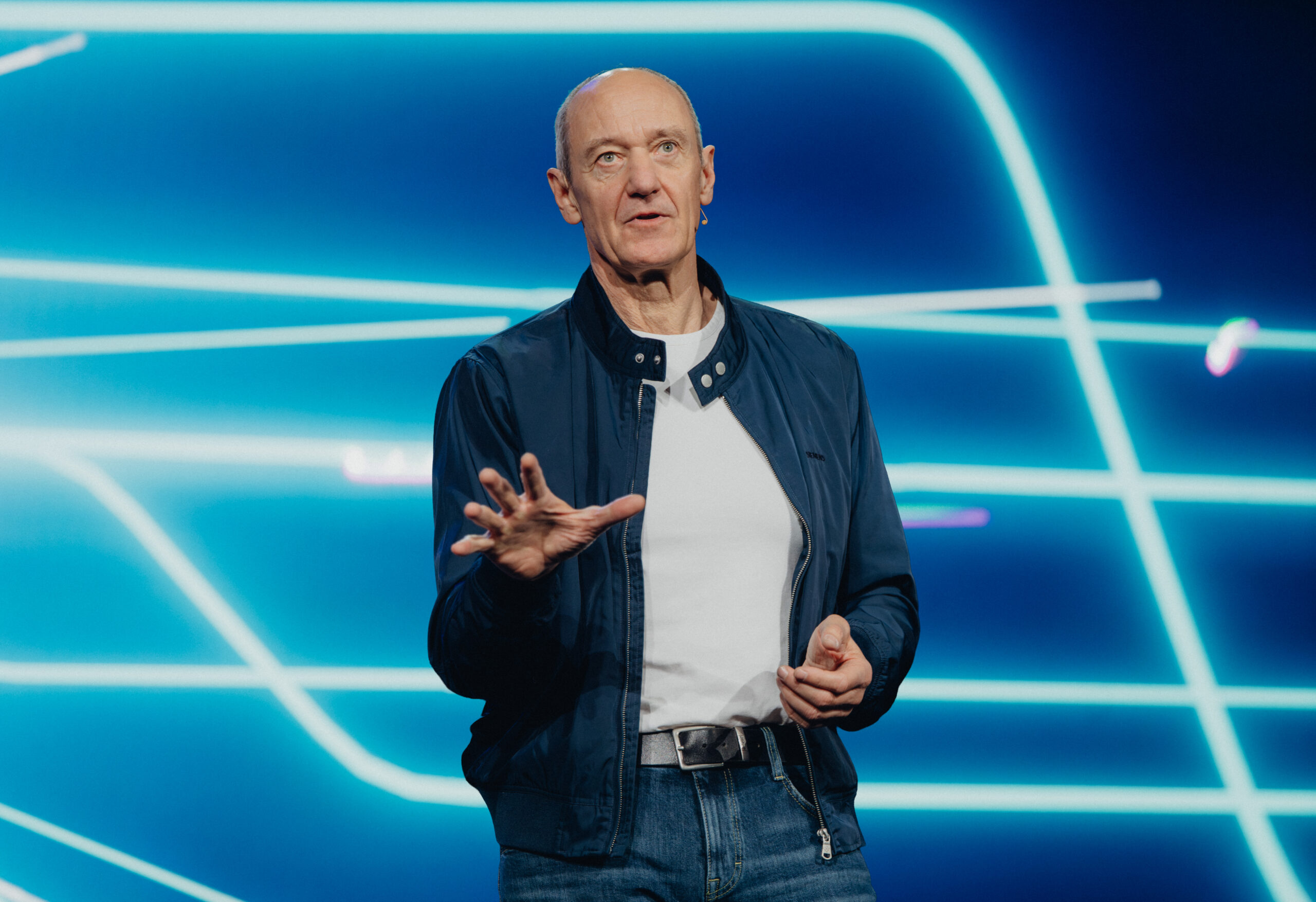
Siemens CEO Roland Busch delivered one of the event’s anchor keynote presentations for the second time. Of six advertised keynote sessions for 2026, two (Siemens’ Busch and Caterpillar CEO Joe Creed) were from leaders of major manufacturers.
While Busch’s last CES keynote, in 2024, hammered the ‘industrial metaverse‘ message a little too hard, this year’s tale of industrial AI was clearer, stronger, and more believable. NVIDIA CEO Jensen Huang, fresh from his own stage show presenting our physical AI future the previous day, joined Busch to talk about the growing partnership between Siemens and NVIDIA: things quickly got philosophically cyclical, with Siemens software designing NVIDIA chips that power Siemens software that designs better NVIDIA chips.
Siemens’ most significant product announcement was the company’s Digital Twin Composer, which should be commercially available later this year. It builds on previous work to integrate Siemens’ software and IoT capabilities with NVIDIA’s Omniverse platform to deliver rich 3D models of products, processes, and plants. While Forrester continues to argue (and I suspect that my friends at Siemens would probably agree) that a digital twin doesn’t always need a pretty 3D visualization, Digital Twin Composer is a nice example of making digital twins easier to build, maintain, and use.
Busch announced a partnership with Sony back in 2024, pairing Siemens industrial design software with Sony’s high resolution extended reality headset to support immersive engineering workflows for designers. These devices, and others like them, remain invaluable for specialised extended reality work, but they’re not for everyone. Like so many others in the industry, Siemens also embraces more lightweight and affordable wearables: Pulling a pair from his pocket, Busch announced that Meta’s Ray-Ban AI Glasses now interact with Siemens’ AI tools to talk engineers through routine maintenance tasks, right on the shop floor. In environments where proper safety glasses must often be worn, it will be interesting to see how well this specific integration can be used in practice, but it illustrates what’s possible as AI-augmented devices proliferate.
Siemens was quick to launch its Industrial Copilot, in partnership with Microsoft and launch customer Schaeffler, back in November 2023. Siemens has continued to launch new AI copilots to support a growing set of tools and workflows, as have many of its competitors. Microsoft CEO Satya Nadella appeared in a video, speaking to the strength of the Siemens/Microsoft relationship, before Busch announced the addition of nine new industrial copilots. These AI tools address specific problems in useful ways, but the ‘copilot’ metaphor is increasingly in danger of breaking. As I commented after last year’s Hannover Messe industrial trade show, the cockpit is getting very crowded: with all these copilots, where’s the (human) pilot meant to sit? As the broader industry thinks more creatively about agents and agentic workflows, shouldn’t one copilot be the interface between a human operator and multiple (largely invisible) agents?
Bosch
Another pillar of German manufacturing, Robert Bosch, used CES to announce an expected investment of $2.9 billion into AI research and development over the next two years.
Like Siemens, Bosch is doubling down on an existing relationship with Microsoft: AI agents, and agentic AI, are a big piece of what Bosch calls manufacturing co-intelligence.
A lot of the Bosch R&D money will support further work around embodied or physical AI, taking the sensors and controls the company has sold to the automotive sector for decades and using AI to make them better able to observe and respond to the real world. A partnership with self-driving truck company, Kodiak AI, offered one example of Bosch’s ambitions in this area.
NVIDIA
As well as joining Roland Busch for Siemens’ Tuesday keynote, NVIDIA’s Jensen Huang delivered his own presentation on Monday. Alongside the chips for which NVIDIA is well known, Huang spent a lot of time talking about the models used to train and control physical automota. The company’s Cosmos world model helps train robots, while the new Alpamayo family of models and tools is intended to help autonomous vehicles adapt to the real-world environments in which they find themselves: this video shows some of what the system is capable of. NVIDIA’s models and tools are typically released under open source licenses, and they are among the most frequently downloaded physical AI models and training datasets on platforms like GitHub and HuggingFace: developers freely using an NVIDIA training data set are likely to spend on NVIDIA chips to power their work.
And the rest
Similar themes resonated across press releases and exhibition booths from other manufacturers, too. South Korean car maker Hyundai used time on stage to formally announce that, by 2028, the Atlas humanoid robot being developed by Hyundai subsidiary Boston Dynamics will take on some tasks in Hyundai’s factory in the US state of Georgia. Hexagon announced a collaboration with Microsoft to help scale the deployment and use of Hexagon Robotics’ AEON humanoid robot.
Many of the announcements, including those mentioned above, featured the same strategic partner for public cloud or AI foundations: Microsoft. Despite also having compelling offerings and strong capabilities, neither AWS nor Google managed to reach the same prominence. Continental’s old automotive division, now spun off as Aumovio, announced a collaboration with AWS focused on accelerating deployment of self-driving trucks and other vehicles at scale. BMW announced tighter in-car integration of Amazon’s AI assistant, Alexa+. Materials science firm 3M launched an AI-powered assistant built on AWS tools. Siemens (the firm that had Microsoft’s CEO join their keynote by video!) collaborated with AWS on a “Live from CES” livestreamed series of interviews and panels. Chip maker Qualcomm announced an expansion of the existing relationship with Google, supporting customers’ software defined vehicle development work, making it easier to integrate Google’s in-car software and more straightforward to tap the power of Google’s cloud outside the car.
The shift from grease to code was clear to see at CES 2026
We really launched our current coverage of smart manufacturing at Forrester back in 2018, highlighting the need for makers of physical things (like Siemens) to embrace digital tools and ways of working. As I wrote at the time, “Industrial giants rose to dominance by making high-quality physical objects. Lower-cost competition and increasingly complex multistakeholder ecosystems mean this old route to success is no longer sufficient. To survive, industrial firms must move faster, deliver new value to new stakeholders, and respond to the shifting expectations of both their customers and their customers’ customers.” AI, robots, digital twins, and close partnerships with the likes of Microsoft and NVIDIA are not a nice-to-have. They’re not part of business as usual. They’re part of a fundamental — and essential — change in the way industrial firms win, serve, and retain customers. The shift is far from done, but the news from CES shows how some of the sector’s leaders are grasping the opportunity — and the challenge — with both hands.
There’s plenty more to come on these topics from Forrester in 2026. In the next few weeks, I’ll publish new research on digital industrial platforms, digital product passports, and the importance of physical or embodied AI. Our planned research tool tracks the current plans for all our analysts, although it may change a bit over the next few weeks as teams finalize their plans for 2026.
As always, if you have solutions or stories of your own to share, please schedule a briefing and tell me all about them. If you’re a client who wants to dig more deeply into any of these ideas, please schedule an inquiry or guidance session.