Renewed conflict in the Middle East is first and foremost a humanitarian crisis, creating fear, disruption, and loss for people across the region and beyond.
But for consumers thousands of miles away, the conflict also lands in a very familiar place: the everyday economy. When global uncertainty rises, households tend to ask the same practical questions: Will prices go up? Will essentials get more expensive? Should I change how I spend?
This blog looks at how and why events in the Gulf can filter through to consumers in the US and Europe, what that means for sentiment and spending behaviour, and what Mintel’s outlook is as this situation evolves.
Consumers are already in “caution mode.” Years of stacked shocks have normalised worst‑case thinking and value-first routines in Western markets. This latest shock will further entrench behaviours.
Supply chains – especially energy – are the pressure point. The Strait of Hormuz is central to global oil and gas flows; prolonged disruption would most clearly show up through energy costs and broader pricing, then through knock-on impacts in areas like fertiliser.
Brands win by reducing uncertainty. The most effective response is not hype – it’s clarity on value, transparency, and practical reassurance. The “polycrisis” mindset means new events can amplify anxieties, increasing demand for products and services that help people switch off and feel more secure.
The Economic Transmission: Energy, Fertiliser and the Strait of Hormuz
If you want to understand how conflict in the Gulf can affect consumers, you don’t start with supermarket shelves, you start with shipping lanes.
The Strait of Hormuz is essential to the flow of oil and gas exports from the Gulf: 20 million barrels of oil pass through the strait each day, representing around 20% of global supply. When that kind of volume is exposed to heightened risk, markets react, and global prices increase, and ultimately, consumers feel it most clearly through energy costs.
More expensive energy raises manufacturing costs and transport costs, and those pressures can ripple outward into broader pricing. However, do not assume a repeat of earlier crises. Some of the immediate reaction is the same, including immediate increased prices for gas, oil, and fertiliser due to the importance of the region in extraction and production. However, this is unlikely to be a repeat of the impact we saw from the Ukraine conflict: Iran’s trade footprint is more limited in Western economies, and as things stand, the primary channel of impact is energy and supply-chain disruption rather than a sweeping, permanent, reworking of supply chains.
Households are likely to feel nervous about their own bills, and about what more expensive energy does across the economy, at a time in the US and Europe where inflation has just started to consistently trend downward. In other words, energy is not just a line item; it’s a signal that can reset consumer expectations.
Conflict increases uncertainty. Uncertainty raises the risk of disruption. Disruption puts energy and supply chains in the spotlight. And once energy becomes a household worry again, confidence can wobble.
The Impact on Consumer Sentiment: How Consumers Feel
A shared “crisis fatigue” mindset
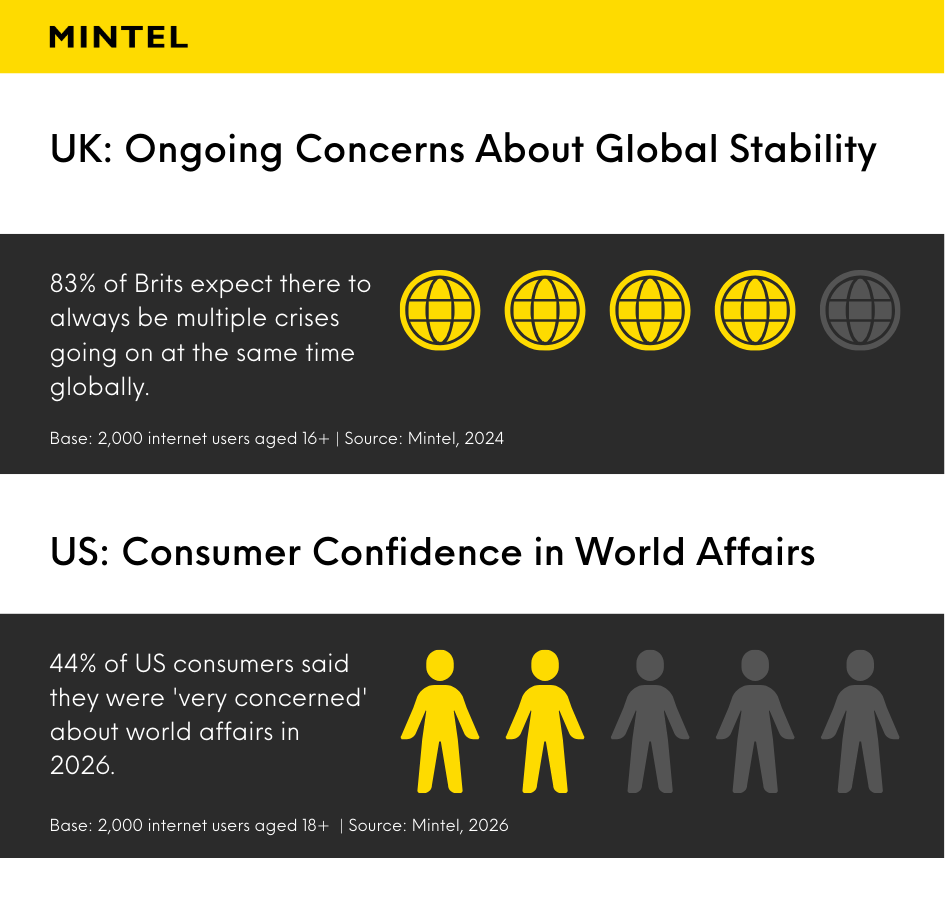
One of the clearest common traits across the US and Europe is exhaustion. Consumers have lived through a stream of overlapping shocks, and that repetition changes how people interpret new headlines.
Europe: concern is real, but many feel prepared (financially)
European consumers are well-equipped to navigate economic fallout, largely because they’ve had to develop budget-stretching behaviours over several years. At the same time, a disconnect remains between macro indicators and consumer perceptions: many still feel like they’re in a cost-of-living crisis mindset even as inflation falls.
Crucially, though, most are getting by and heading into this latest period of instability, often “surviving, not thriving” – but with enough wriggle room to make choices. Confidence varies across the continent: the UK stands out as more confident in personal finances than most of its European peers, but confidence can be volatile and susceptible to knee‑jerk responses to current events.
Europeans also have heightened sensitivity to supply chain disruption. Consumers can find supply chains abstract in normal times, but concern rises when media attention increases and when price or availability changes become visible.
US: “Two consumer realities” shape sentiment
In the US, consumer sentiment is strongly shaped by inequality in financial resilience. Financial stability differs dramatically, and the gap between the “haves” and “have‑nots” is expanding.
This matters because it explains why broad improvements, like easing inflation, don’t automatically lift optimism: many lower- and middle-income households are still carrying significant strain, so relief doesn’t feel like relief. As the conflict adds geopolitical anxiety, it doesn’t replace financial worries; it simply stacks on top of them.
The Impact on Consumer Behaviour: What Consumers Actually Do
Common across markets: value-first routines
Consumers in both territories as well‑versed in caution by now. When households feel uncertain, behaviour tends to follow a well‑worn path: delay non-essentials, trade down, search harder for deals, and prioritise the basics.
In Europe, value-focused spending is long entrenched, and consumers have a robust set of budget-stretching behaviours ready to deploy if inflation ticks up again. In the US, price-sensitive behaviours are expected to deepen as rising gas prices and renewed inflationary pressures take hold.
Europe: localism and wellbeing to be entrenched as coping tools
In Europe, localism and wellbeing have emerged as key coping responses when the global system feels fragile. Following trade uncertainty triggered by tariffs in 2025, European consumers embraced localism, both to support local workers/economy and to secure access to goods. If shipping lanes reroute and delays rise, local provenance becomes more than a nice-to-have claim; it starts to feel like a form of reassurance.
Consumers in Europe have learnt to deal with ‘the polycrisis period’ financially better than psychologically, and new anxieties can increase demand for products and services that help people switch off from the concerns of the wider world.
US: Exacerbating the wealth divide
In the US, as price pressures rise, financially tight households are hit first and hardest, but even financially healthy consumers are increasingly price-alert and becoming less loyal. This creates a two-speed market:
Essentials-only for many: rising costs and uncertainty push more households into strict prioritisation decisions and deferred non-essential spending.
Stability for some: higher-income consumers continue to drive a disproportionate share of activity, and continued (even increased) spending isn’t out of the question for these households.
Some crisis behaviours, like stockpiling, spike and then revert, but value-seeking and financial caution tend to persist longer, especially when crises stack. Consumers are entering yet another period of uncertainty, making a full psychological return to “normal” increasingly difficult.
Mintel’s Outlook: What to Watch, and How Brands Should Respond
The watch point: duration and the Strait of Hormuz
Disruption in the Strait of Hormuz is the critical determinant of how far and how fast the economic fallout spreads. A short conflict with minimal escalation will, to a degree, insulate the shock to consumers. But a longer conflict will create significant disruption, putting pressure on manufacturing and the ability for companies to absorb additional costs, heightening the inflation risk.
The takeaway is: energy is the lever, and uncertainty around energy is what keeps consumers cautious even if the news cycle moves on.
Consumers won’t reset quickly
We are not in a clean-slate moment. Consumers are carrying the residue of previous shocks, and that residue changes how they respond now. Consumers in Europe face an ever-lengthening consumer recovery, where households retain cautious, value-focused spending habits. In the US this most recent conflict will entrench worst‑case mindsets and defensive routines that can outlast the crisis itself.
The behaviour changes that matter most: deal seeking, switching, and prioritising essentials – are already embedded, and volatility gives consumers a reason to keep using them.
What brands should do (without overreacting)
Across both markets, brands win by reducing uncertainty and making value easy to recognise.
Lean into value and stability (not just low price). Reinforce functional value and consistency/transparency in pricing, so consumers feel more in control during strain. Consumers have well-defined strategies to cope, and they’ll keep moderating spending; brands that help shoppers navigate that calmly will be better placed.
Prepare for ongoing volatility. Build scenario plans for energy-driven price spikes that will shift sentiment. A longer conflict requires clear communication about why prices are rising, so consumers understand pricing adjustments aren’t opportunistic.
Support wellbeing, because the psychological load is rising. Consumers need help switching off, and brands should consider wellbeing claims across categories, not only in obvious “self-care” spaces. Even when budgets are tight, emotional respite can be a compelling form of value -especially in uncertain times.