Consumers are increasingly feeling the strain of an always-on digital world. Constant notifications, algorithm-driven feeds and the pressure to stay connected across work, social and entertainment platforms have created a new challenge: digital fatigue.
For brands, this shift represents both a risk and an opportunity. Consumers are not abandoning digital channels altogether; however, they are rethinking how, when and why they engage with them.
As consumers begin seeking healthier relationships with technology, brands that prioritise human-centric communication, authentic messaging and meaningful experiences will be best positioned to build lasting connections.
Read on as we unpick the key drivers of digital fatigue and examine how consumers are responding. At Mintel, we consider these insights as essential for CPG marketers aiming to remain relevant in an increasingly crowded digital landscape.
Why Consumers’ Digital Fatigue is Escalating at Speed
Digital fatigue is driven by a combination of constant connectivity, algorithmic uniformity and information overload.
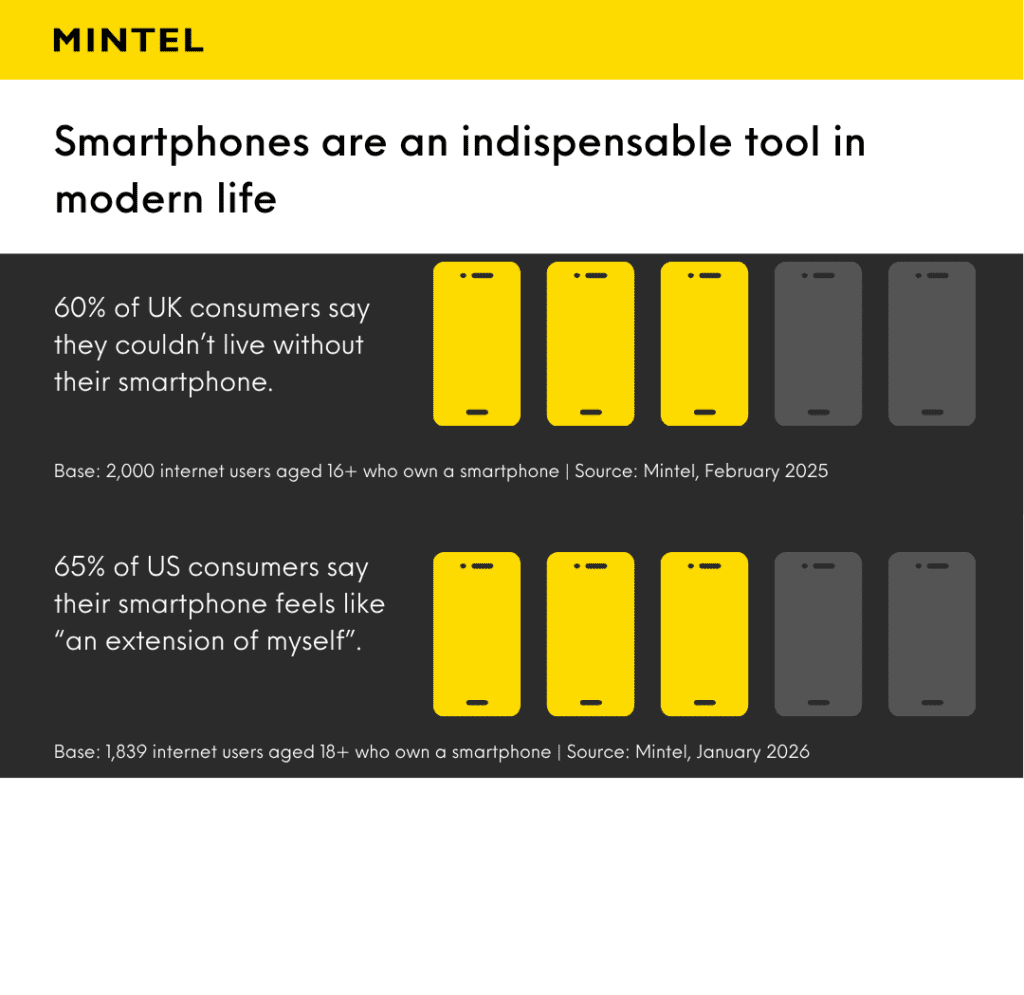
Smartphones have become both a life tool and a source of stress. While they remain indispensable in modern life, their central role is also creating tension. Six out of ten Brits say they couldn’t live without their smartphone, and nearly two-thirds of US consumers see their smartphone as an extension of themselves, highlighting the deep reliance on these devices.
However, this connection is accompanied by a growing desire to step back and regain control, with two-fifths of UK consumers saying they feel overwhelmed by the amount of digital activity in their lives.
Younger consumers feel this strain even more strongly, with this number rising to three-fifths of Younger Millennials feeling digital overwhelm, highlighting how even digital-native audiences are increasingly aware of the downsides of constant connectivity.
Algorithms are creating “content monotony”
Beyond volume, the nature of digital content is also contributing to fatigue.
Algorithms designed to maximise engagement and get results quickly often surface similar content repeatedly, reducing novelty and discovery, eventually leading to disengagement. In Germany, 67% of social media users say content from different personalities is becoming increasingly alike, reinforcing perceptions of algorithm-driven uniformity.
The rise of mindless scrolling
Mindless scrolling and even doomscrolling remain common rhetoric as consumers stay addicted to their screens. Algorithms have been intentionally developed to keep consumers locked within a pattern or routine, but this leaves little room for users to pause or absorb content meaningfully.
Over a third of social media users in the US say they mindlessly scroll. With infinite feeds fostering passive consumption, brands often struggle to achieve genuine engagement.
This creates a paradox: algorithms meant to capture attention frequently undermine meaningful interaction, leaving users feeling mentally exhausted rather than inspired.
Growing awareness of these patterns is leading consumers to question and challenge them, a behavioural trend known as algorithmic resistance. In response, many consumers are now establishing deliberate boundaries with their devices, aiming to regain a sense of control in a digital landscape engineered to capture attention.
How Demographics Experience Digital Fatigue Differently
Younger consumers: the most connected and the most overwhelmed
Younger generations are among the heaviest users of digital platforms, yet they are also the most likely to question their digital habits.
In the UK, only 56% of Gen Z and younger Millennials say they are happy with their smartphone usage, compared with 80% of consumers aged 45 and over.
Similarly, in Germany, 57% of consumers aged 16–24 are concerned about the long-term mental health impact of their digital habits, compared with 32% across all age groups.
This growing awareness signals a generation that values technology but also wants greater balance and moderation in their digital habits.
The contrasting perspectives between younger and older smartphone users highlight the importance of brands making use of age-centric strategies when addressing smartphone usage concerns and promoting digital wellbeing.


Parents: prioritising offline family connection
For parents, digital fatigue often manifests through concerns about screen time and family connection.
In the UK, nearly 7 in 10 parents with children under 18 say smartphones interfere with quality family time.
As a result, many families are prioritising offline activities to foster both physical and emotional wellbeing in children. In the US, a third of parents participate in outdoor recreation or sports specifically to connect with their children and minimise screentime.


A similar feeling is felt in Germany, as spending time outdoors is a preferred way for parents to connect with their children and escape digital distractions. Notably, almost three-quarters of German parents who worry about the mental health effects of excessive screen use choose outdoor activities as their go-to solution.
For brands, this shift presents a compelling opportunity to develop products and experiences that support parents in fostering real-world connections that serve as an antidote to heavy screen use, positioning themselves as champions of family wellbeing and quality time.
Women: heightened awareness of digital overload
Women are more likely than men to express concern about excessive digital activity, with a quarter of UK women aged 25–44 feeling their smartphone usage is excessive. A similar sentiment shows up in Germany, almost half of female Gen Z worry about being too dependent on technology, compared to over a third of their male counterparts.
This highlights an opportunity for brands to develop wellbeing-led messaging and supportive digital experiences, particularly in categories linked to lifestyle, beauty and self-care. By placing women’s wellness at the centre of communication and product development, brands can create offerings that speak to mental clarity and positive digital behaviours.
Download our ‘Winning the Wellness Consumer’ Report Preview Now
The wellness landscape is evolving fast. What will truly drive sustainable growth?
Download Report Preview
How Consumers Are Responding: Coping Mechanisms and Digital Boundaries
Rather than abandoning technology altogether, consumers are experimenting with ways to regain control over their digital lives.
Small behavioural shifts
In the US, consumers are adopting simple strategies to reduce digital overload and establish phone-free zones, such as:
Alongside this, consumers are also increasingly using built-in smartphone features to track screen time and digital wellbeing apps to monitor usage and encourage breaks.
Offline hobbies as digital fatigue solutions
To counter digital overload, many people are embracing analogue hobbies. Activities involving hands-on experiences and time spent outdoors, including nature walks and camping, are becoming more popular as consumers seek healthier routines and relaxation.
These behaviours illustrate a broader shift toward intentional consumption and mindful leisure.
Strategies for Brands to Connect with Consumers in the Era of Digital Fatigue
Digital fatigue does not necessarily mean consumers want fewer brand interactions; it means they want better ones.
Brands can play a meaningful role here. The ones that succeed will prioritise authentic connection over constant visibility and will help to normalise digital boundaries to help reduce cognitive clutter.
1. Human-centric communication over algorithm-first marketing
Consumers increasingly value genuine, relatable storytelling rather than highly optimised content designed purely for algorithmic reach.
Campaigns that celebrate real moments and support consumers to manage their stimulus in a more structured way. One example is KitKat’s “Phone Break” campaign that cleverly reimagines its iconic “Have a break” slogan to address modern screen fatigue. The campaign swapped smartphones with KitKat bars in everyday scenarios to tap into the cultural desire to disconnect. By inviting people to swap their phone for a KitKat, it encouraged offline experiences and positioned being offline as a conscious, beneficial choice.


For CPG brands, these approaches succeed because they echo a simple truth: consumers seek both connection and space.
Key learnings for CPG brands:
Authentic messaging that fosters long-term trust
Relatable, real-life moments
Storytelling that celebrates offline experiences
2. Products and services that help regulate screen time
Considering that 37% of US consumers admit they sometimes miss out on real-life experiences because they are absorbed in mobile entertainment, brands are also innovating with solutions that help consumers manage their digital lives more effectively.
One standout innovator addressing this challenge is the Steppin app. Steppin blocks social media access until users achieve their daily step goals, directly linking physical activity with digital rewards, which motivates users to be more active and present in the real world before engaging with their devices.
Key learnings for CPG brands:
Incorporate reward-based mechanisms or gamification that encourage positive offline behaviours.
Develop tools or partnerships that blend physical activity or wellness with digital engagement.
Position products or messaging as enablers of healthier digital habits, reinforcing the brand’s role in supporting overall wellbeing.
3. Ride the (new) wave of smartphone innovation
Given their integral role in modern life, most people cannot entirely forgo smartphones, however, there is increasing demand for practical tools that support healthier digital habits. Notably, one in four UK consumers who have tried to reduce screen time are now considering a basic mobile phone as an alternative to a smartphone.


One innovator in this space is Brick. Unlike typical app blockers, which can often be bypassed, Brick offers a physical solution involving a compact device used with a companion app. By tapping the phone against the physical Brick, access to selected applications is restricted, and restored only in the same way. This offline barrier introduces meaningful friction, helping to discourage passive scrolling and encouraging more intentional engagement with technology.

Key learnings for CPG brands:
Integrate “basic mode” features into packaging or product experiences. For example, F&D brands could include QR codes or app integrations that encourage device-free moments, such as unlocking recipes or challenges.
Position your brand as an advocate for intentional technology use and use your marketing messaging to highlight the benefits of balanced digital engagement.
4. Experiences that encourage real-world connection and community
Brands across sectors are creating offline experiences to help consumers who seek real-world experiences and connection with others. This shift can be seen in the travel and hospitality sector, where over half of UK potential travellers are interested in holidays featuring a digital detox, such as mobile-free zones and activities focused on mindfulness and relaxation.
In response, brands are innovating with wellness retreats, remote eco-cabins equipped with phone lockboxes, instant cameras, books, and games, as well as Wi-Fi-free hostels that foster an off-grid, immersive environment.
Beyond travel, brands are facilitating authentic relationships through community events, pop-ups, and group wellness activities, like one truly unique group called ‘Scream Club’ that hosts group scream sessions in Chicago.

This trend is prompting brands to create experiential spaces and products designed to encourage unplugging from screen-based interactions and nurture genuine connections.
Key learnings for CPG brands:
Design experiences or products that promote device-free engagement, such as meal kits for tech-free dinner parties or self-care prescriptions.
Sponsor offline experiences to support communal wellbeing.
Launch community-driven activations and launch events that foster real-world connections.
Develop packaging or campaigns that encourage shared, device-free moments among consumers.
Turn Digital Fatigue into a Brand Opportunity with Mintel
Digital fatigue does not represent an outright rejection of technology; instead, it signals a recalibration of how consumers want to interact with it.
Consumers are looking for balance. They want to preserve the convenience offered by digital tools, while also protecting their wellbeing and nurturing their relationships.
Brands that embrace this transition can distinguish themselves by delivering authentic, human-centric communication, offering products and services that streamline digital life, and enabling offline experiences as well as meaningful connections (not solely driven by the algorithm!).
If you’re a CPG brand trying to keep up with changing consumer habits around tech and wellness, explore Mintel’s latest Wellness Platform for insights, fresh ideas and practical tips on how to strengthen consumer engagement. Or, subscribe to Mintel Spotlight to receive free trend insights and expert analysis.
Download our ‘Winning the Wellness Consumer’ Report Preview Now
The wellness landscape is evolving fast. What will truly drive sustainable growth?
Download Report Preview