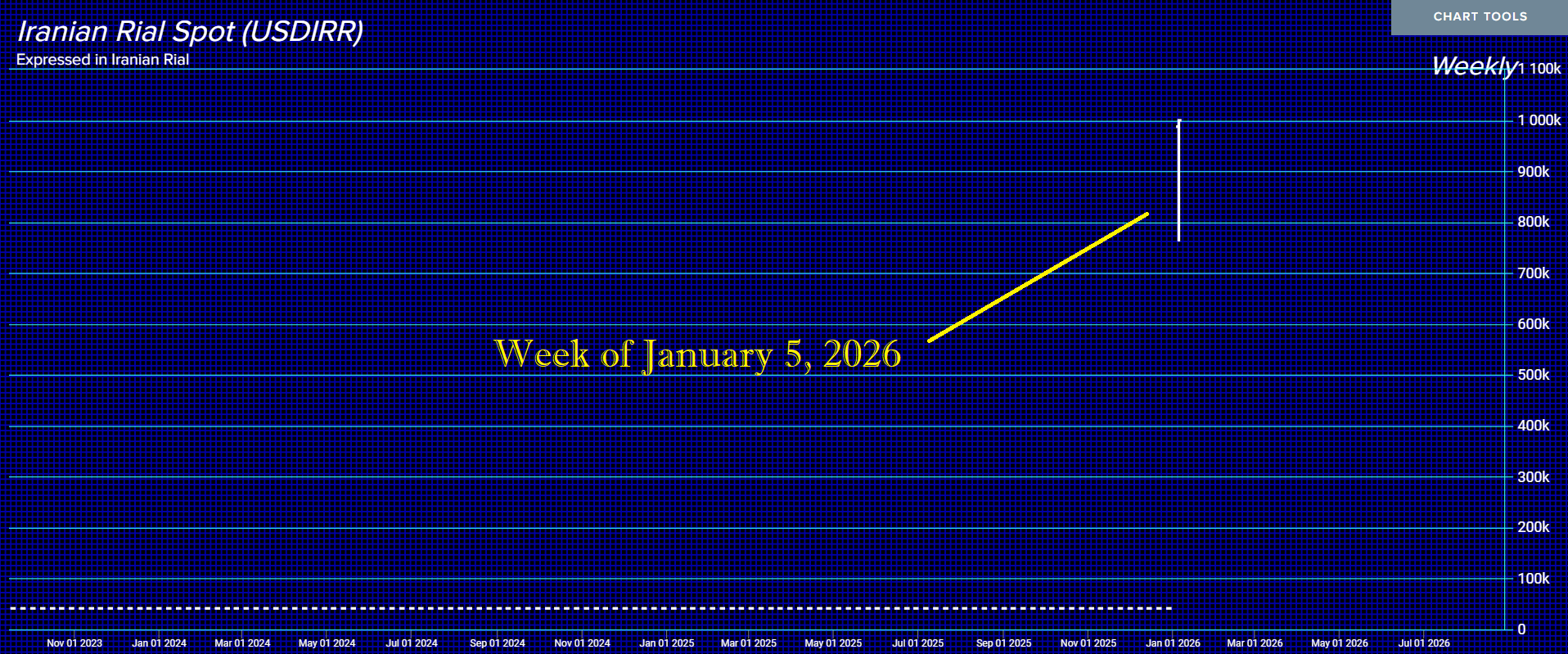
In the past few days, Iran has experienced the biggest protests against the ruling Islamic Republic since it crushed the 2022. The rial has fallen by more than 90%—but that dramatically understates the disaster. The real decline is closer to 97-98% depending on your baseline. The regime is the weakest it has ever been. All its proxies, from Hezbollah to the Assad regime in Syria, have been shattered across the Middle East. Tehran and much of the rest of the country are running out of water; the economy is in sharp decline; and more Iranians are going hungry, especially members of what was once the middle and upper-middle classes.
Empires Fall in Economic Crisis
The most recent protests were triggered by deteriorating economic conditions, but they are the most recent manifestation of deeper-rooted public anger against the regime. The immediate trigger for these protests appears to have been a budget bill, rejected by parliament, in which the government proposed removing the preferential exchange rate (285,000 rials to the U.S. dollar)—a mechanism widely viewed as a rent distribution channel. Regime-connected networks profit from the spread between official/preferential rates and the open market. While the preferential rate is widely viewed as a corrupt insider deal for regime-connected networks, many households also feared that removing it—without a credible, transparent replacement—would immediately raise prices for basic goods. That mix of rage at corruption and anxiety about inflation turned the debate over the exchange rate into a trigger for protest.
The rapid depreciation is compounding inflationary pressures, pushing up prices for food and other daily necessities and further straining household budgets, a trend that could be intensified by a gasoline price change introduced in recent days. Currency traders in Tehran quoted the dollar above 1.3 million rials, underscoring the speed of the decline since Dec. 3, when the rial hit what was then a historic low. The timeline of collapse unfolded with accelerating momentum:
December 3, 2025: Rial hit what was then considered a historic lowDecember 13, 2025: New gasoline pricing system implementedDecember 14, 2025: Dollar breached 1.2 million rialsDecember 16, 2025: Dollar reached 1.31 million rialsDecember 31, 2025: The Iranian Rial breached a catastrophic psychological barrier. It reached a record low of 1.45 million rials to one US dollarJanuary 7, 2026: The US dollar quoted at about 1.47 million rials
The historical record is brutal: no government has survived intact when their currency collapsed by 90% or more in a month. The pattern is absolutely consistent across history. When you look at the worst hyperinflations in history, government survival or legitimacy becomes impossible.
Weimar Germany (1923): By late 1923, prices were rising over 30,000% per month, doubling every few days, and this hyperinflation completely wiped out the currency—it had to be replaced with a new Rentenmark to restore stability. This economic turmoil fostered extreme political movements and ultimately played a role in the rise of Adolf Hitler and the Nazi Party The National Interest. The Weimar Republic didn’t survive—it was replaced by the Nazi dictatorship.
Zimbabwe (2007-2009): Zimbabwe’s peak month of inflation is estimated at 79.6 billion percent month-on-month in mid-November 2008, when a $100 trillion banknote could not pay for a simple bus fare Explorable. Between 2000 and 2008 output contracted by 40%, while government budget revenue fell from more than 28% of GDP to less than 5%, resulting in the almost total collapse in public services. Mugabe’s regime clung to power through authoritarianism, but the government effectively ceased to function as a government.
Yugoslavia (1993-1994): Yugoslavia’s rate of inflation hit 5×10^15% cumulative inflation, with one novi dinar eventually equal to 1×10^27 pre-1990 dinars. The country literally ceased to exist—it broke apart into multiple nations.
Venezuela (2013-2018): Venezuela entered hyperinflation in 2013, with inflation rates exceeding 1,000,000% by 2018. In Venezuela, millions fled to neighboring countries, creating one of the largest refugee crises in recent history. The Maduro regime survives only through authoritarianism and recent military intervention.
Why Governments Cannot Survive
The mechanics are rather straightforward. When a country’s currency “dies,” the government becomes unable to borrow from financial markets or tax its own citizens and must either turn to its central bank to finance its deficit or default on its obligations. Governments lose legitimacy when they can’t provide basic economic stability. When citizens witness their savings evaporate due to rapid price increases, frustration and anger can lead to civil unrest and demands for political change.
The currency collapse destroys the government’s ability to function. Tax revenues become worthless before they’re collected. Public employees can’t be paid. The military and police lose loyalty when their salaries buy nothing. Hyperinflations have generally occurred in nations with rampant corruption, war, regime change, a ceding of monetary sovereignty, output collapse or other extreme exogenous factors.
The Only “Survivors”
The regimes that technically survived did so by only one of two options. First is the complete currency replacement. The Reserve Bank of Zimbabwe re-priced the currency, pegging it to the US dollar Before Newton. This isn’t survival—it’s admitting defeat and abandoning your own currency. However, Zimbabwe under Mugabe and Venezuela under Maduro both were able to maintain power ONLY through force, not legitimacy. This necessitates the support of the army. I have stated often that when the army abandons the government, it falls. We saw that in Ukraine, but we also saw that in Russia during 1991.
In Zimbabwe, Mugabe was ousted, but the economic misery continues. Venezuela faces the same outlook—even if Maduro’s successor follows his policies it all depends on the support of the military. In both cases, it typically takes decades to repair the damage.
External Intervention
Most cases ended either through regime change or complete economic restructuring imposed from outside. From our cyclical perspective, this confirms what you’d expect: once confidence is lost, it cannot be restored by the same government that destroyed it. Monetary hyperinflation typically results in the complete psychological rejection of the sovereign currency. When the psychology breaks, the government typically breaks with it. Thus, the survivability of the immediate Iranian government rests in the hands of the military.
The regime’s response to the protests has already been violent and sometimes lethal, but it has ample capacity to escalate rapidly if it decides that the moment requires it. The appointment of Ahmad Vahidi as the deputy commander of the Islamic Revolutionary Guard Corps (IRGC)—the regime’s most powerful security and paramilitary force—may be a warning to the public, as Vahidi is not a regular bureaucrat; he is a hard-line security figure and one of the system’s longtime architects of repression. It will take authoritarianism with a strong hand to retain power.
The Islamic Republic is the weakest that it has ever been. But that does not mean that regime change in Iran is imminent—at least, not the type of regime change that would improve the lives of ordinary Iranians and lead to a more stable and prosperous Middle East.

Is Gold the Answer?
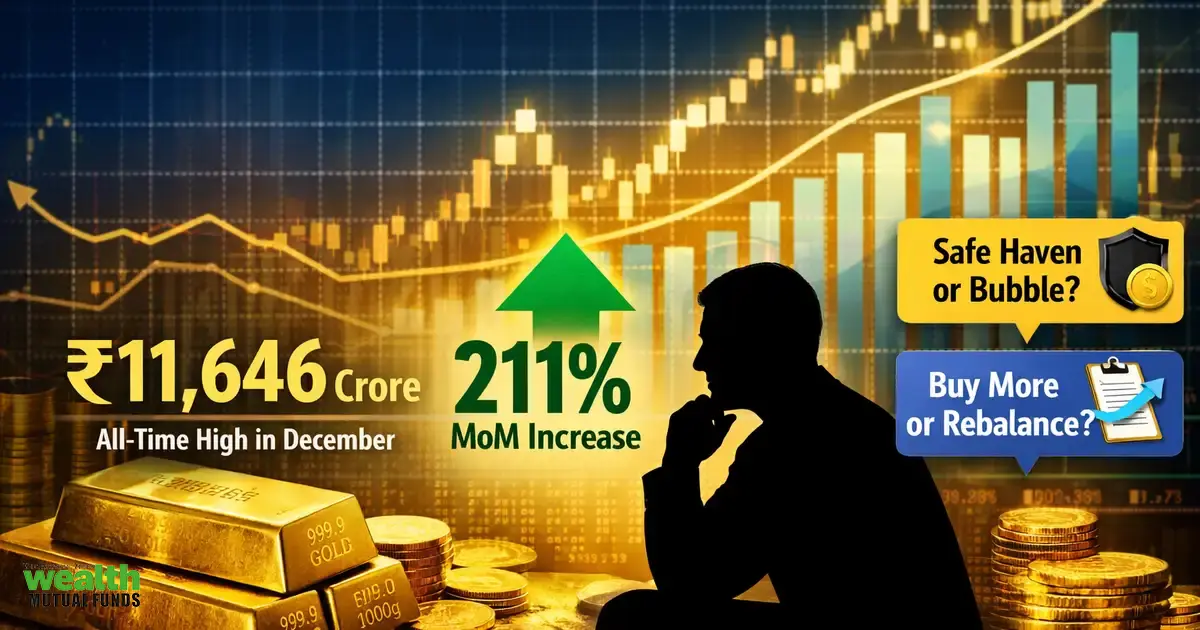
Iran has gold—and they’ve been aggressively accumulating it as economic insurance against Western sanctions and potential military conflict. The regime understands what Venezuela learned too late: when your currency and oil revenues are under attack, gold becomes your lifeline. What we’re talking about is one of the most sophisticated sanctions-busting operations in modern history—a scheme that moved billions of dollars through gold transactions while implicating the highest levels of the Turkish government, including President Erdogan himself.
Iran operates with multiple exchange rates and a massive black market for both currency and gold. As the Rial loses value, Iranians rush to convert their savings into dollars, gold, or cryptocurrencies, further depleting the Rial’s liquidity. This has combined with the rise in demand for gold because of the prospects of war in Europe.
According to the World Gold Council, Iran ranked as the 5th largest gold consumer globally in the first nine months of 2025, trailing only China, India, the US, and Turkey. This is remarkable given Iran’s economic collapse.
The Obama administration knew about the scheme but deliberately allowed it to continue. Why? It’s possible that the Obama administration’s decision had less to do with Turkey, and more to do with coaxing Iran into signing a nuclear deal. The backchannel negotiations with Iran reportedly began in July 2012—exactly when the gold trade was accelerating.
In the one-year period between July 2012 and July 2013, the Obama administration’s non-enforcement of its own sanctions reportedly provided Iran with $6 billion worth of gold. That windfall may have been an American olive branch to Iran—extended via Turkey—to persuade its leaders to continue backchannel negotiations.
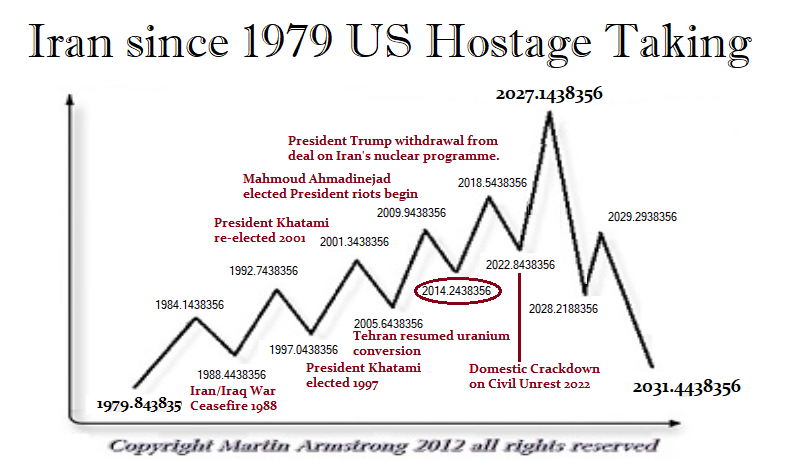
If Iran replaces the currency with a gold-backed version, they may be able to cling to power byt that does not appear to extend beyond 2027.
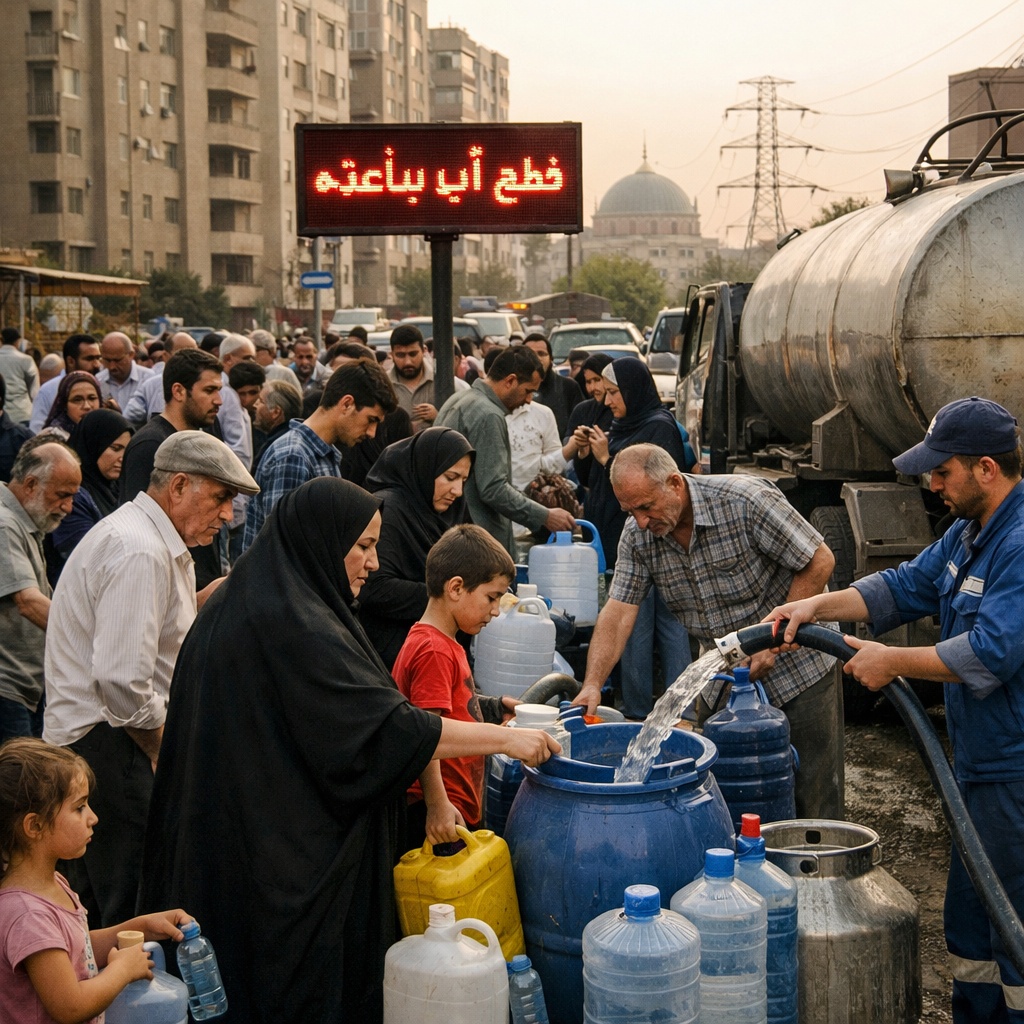
Meanwhile, parts of Tehran are facing hour-long water rationing while other districts are hit by rolling electrical blackouts. For most people, the problem is no longer just that living is expensive—it’s that life is becoming increasingly precarious. By Jan. 8, protests and strikes had spread nationwide, with reports of demonstrations across all 31 provinces—many already battered by 2025 water shortages and years of poverty—alongside widening internet disruptions and periodic blackouts aimed at choking coordination and visibility.
Beyond the headlines, Iran faces an existential environmental crisis. Twenty provinces suffered through the country’s worst drought in more than 40 years. President Pezeshkian has openly proposed evacuating Tehran to ease strain on dwindling water supplies. Think about that statement—the president is discussing abandoning the capital city. This is not a problem that can be solved with monetary policy or military force. Climate cycles interact with political cycles, and Iran is caught in a vice between both.
The ancient Persian invention of qanats (underground aqueducts) over 3,000 years ago is a testament to Iran’s long-standing struggle with aridity and its ingenious adaptation to water scarcity. Historians argue that the decline of some ancient Iranian cities and civilizations may be linked to climatic shifts and droughts. The Qanat system represents an ingenious ancient solution to the challenge of water scarcity in this region. These were underground aqueducts, comprising a network of well-like vertical shafts interconnected by gently sloping tunnels, harnessed groundwater to sustain communities.
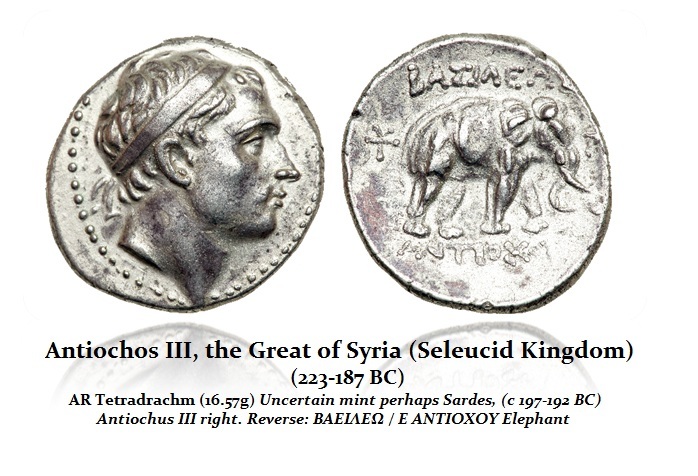 Naturally, the Global Warming zealots are attributing this to CO2 without any evidence ever. The historian Polybius (c. 200–118BC) in his Histories, recorded a severe drought and famine in Persia around 220BC during the reign of the Seleucid king Antiochus III. He describes it as a major catastrophe affecting livestock and people. Cassius Dio (c. 155–235AD) in his Roman History, mentions a devastating drought in Parthian Persia around 36AD that caused widespread famine and weakened the kingdom. These two events were 256 years apart. If we look back 256 years from today, sure enough we see the most well-documented crisis in this period was the Great Famine of 1770-1772 (approximately 1184-1186 AH).
The drought directly caused a devastating famine in modern recorded history between 1770-1772. Historical chronicles describe extreme suffering with a drastic reduction in the population. Some contemporary reports indicate that in regions like Isfahan, the mortality was so high that there were not enough people left to bury the dead. There were also reports of cannibalism and starvation in cities like Shiraz, the Zand capital, are recorded by historians of the period. The famine caused a major demographic setback, depopulating villages and disrupting agriculture and trade for years. It severely weakened the stability and resources of the Zand dynasty.
This event is noted in several Persian chronicles of the Zand and later Qajar eras (like Ruznama-ye Mirza Mohammad Kalantar and Mojmal al-Tawarikh), as well as in the accounts of European travelers and East India Company agents stationed in the Persian Gulf. Modern historians like John R. Perry have analyzed these sources to confirm the famine’s scope.