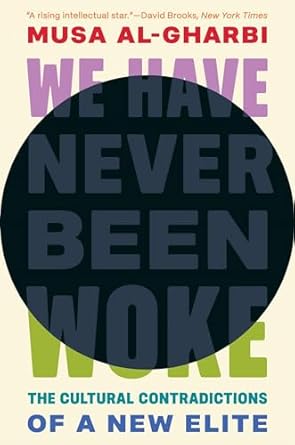
The previous post in this series touched on Musa al-Gharbi’s identification of a class of people as “symbolic capitalists,” his contention that wokeness is the dominant ideology of this group, and that members of this group tend to be most predisposed to amplifying woke ideas. There are multiple “alternative names for symbolic capitalists” used by other writers, such as “the professional-managerial class, the new class, the creative class, the aspirational class,” among others. But regardless of the term one uses, what is a symbolic capitalist, exactly? According to al-Gharbi,
symbolic capitalists are professionals who traffic in symbols and rhetoric, images and narratives, data and analysis, ideas and abstraction (as opposed to workers engaged in manual forms of labor tied to physical goods and services). For instance, people who work in fields like education, science, tech, finance, media law, consulting, administration, and public policy are overwhelmingly symbolic capitalists. If you’re reading this book, there’s a strong chance you’re a symbolic capitalist. I am, myself, a symbolic capitalist.
That is to say, the world of symbolic capitalists is more about ideas, data, and intangible outputs, compared to workers whose work is focused on physical, tangible outputs. At one point in the book, he uses this as a way of distinguishing medical practitioners from symbolic capitalists:
The amount of money symbolic capitalists take home every year is higher than for virtually anyone else in society. The only competitive nonsymbolic occupational group is “health-care practitioners and technicians”…
Even though medical professionals are a highly educated, high status group, and the work they do requires substantial knowledge, they generally don’t fall into the category of symbolic capitalists because their work involves efforts to “directly intervene on physical bodies.” (Recently, I had a doctor inject a large amount of cortisone into a tendon sheath on my wrist – I can confirm that the work this doctor did was not in any sense a form of symbolic output.)
As the name symbolic capitalist suggests, the stock and trade of such people is symbolic capital. Following the work of the sociologist Pierre Bourdieu, al-Gharbi says,
In contrast with more traditional resources associated with wealth, material assets, and so on, Bourdieu defined symbolic capital as the resources available to someone on the basis of honor, prestige, celebrity, consecration, and recognition…According to Bourdieu, the roles people are assigned to on the basis of their symbolic capital (or lack thereof) may actually be more important that more conventional economic forces in determining how power is arranged within a society.
Symbolic capitalists, according to Bourdieu, make their living by “three forms of symbolic capital: cultural, academic, and political.” These are very valuable social assets, al-Gharbi says:
Collectively, these different forms of symbolic capital serve as the basis for defining others as insiders or intruders, experts or amateurs, leaders or brutes, authentic or posers, geniuses or hacks, sincere or cynical, worthy or unworthy, and so forth.
Each of these forms of symbolic capital is defined. First, political capital:
Political capital includes the trust, goodwill, relationships, and institutional authority that can be used to mobilize others in the service of particular goals. One’s formal title within an organizational hierarchy, one’s perceived credibility, reliability, efficacy, experience, and virtue – these are all resources that can be drawn on to convince others to throw their lot in with someone, to trust their vision, to run with their plan, to pursue their priorities.
Next is academic capital:
Academic capital, on the other hand, is about getting others to defer to one’s judgment based on special knowledge, intellect, skill, or expertise. Academic capital is mainly derived from one’s credentials, degrees, formal training, and such.
Lastly, we have cultural capital:
Finally, cultural capital is about demonstrating oneself as interesting, cool, sophisticated, charismatic, charming, and so on. People reveal their cultural capital through how they talk, how they carry themselves, their dress, their manners, their tastes and expressed opinions – all of which provides strong cues as to one’s level of education, socioeconomic background, ideological and political alignments, place of origin, and so forth. Of these three main forms of symbolic capital, it is cultural capital that is least accessible to nonelites.
Cultural capital is key in another way – because it’s the biggest barrier keeping the “normies” distinguished from the elites, “wokeness has become a key source of cultural capital among contemporary elites – especially among symbolic capitalists.” And this helps explain why the activities, perceptions, priorities, and policy preferences of woke social justice activists seem so disconnected from the people these activists claim to be representing:
The idiosyncratic understanding of social justice and attendant dispositions and modes of engagement colloquially referred to as being “woke” are popular almost exclusively among people like us. Those who are genuinely vulnerable, marginalized, disadvantaged, or impoverished don’t think or talk in these ways. And that’s part of the point. Among symbolic capitalists, wokeness has come to serve as a sign that someone is of an elite background or well-educated. Through espousing woke beliefs, symbolic capitalists (and aspirants to the symbolic professions) demonstrate that they are the kind of people who “play ball” – they are aware of, and are willing and able to competently execute, the appropriate scripts in response to various cues. That is, wokeness is increasingly a means of identifying who is part of “the club” – and it provides a basis for deeming those who are not part of the club unworthy of symbolic capital (i.e., people who fail to embrace elite conceptions of “social justice” are held to be undeserving of honor, fame, prestige, deference, etc.).
By expressing concern for the well-being of the poor and powerless in a particular way, one also distinguishes oneself from the poor, powerless, and vulnerable, and demonstrates oneself to be a member of the elite in good standing. This is why on the one hand, surveys have found that among Black Americans who live in low-income areas, the overwhelming majority wanted the level of police presence in their neighborhood to be at least as high as it currently is or even higher. On the other hand, among members of the highly educated, wealthy, mostly white elites living in gated communities protected by private security, it was a great display of cultural capital to express enthusiasm for defunding or even abolishing the police. By expressing your concern for the poor and downtrodden in a way completely separate from the actual ideas or desires of that group, you signal the fact that you are wealthy, well-educated, and culturally sophisticated – you shouldn’t be mistaken for one of the plebs.
However, al-Gharbi points out that symbolic capitalists are not a pure monolith in political leanings:
All said, contemporary symbolic capitalists are overwhelmingly and increasingly aligned with the Democratic Party and the “cultural left.” However, there is a right wing among them. They amount to a relatively small share of symbolic capitalists overall yet exert a disproportionate impact in virtue of being highly organized, well funded, and quite skilled at eliciting strong (outraged) reactions both from mainstream symbolic capitalists and against mainstream symbolic capitalists—often in alliance with “anti-woke” peers.
Yet the actively anti-woke segment of symbolic capitalists isn’t so much the opposite of the woke. They just have a different focus:
What generally separates these symbolic capitalists from most others is that they are symbolically conservative: patriotic, religious, nondisdainful toward U.S. history, culture, and traditions. On the one hand, these are significant differences—ones that align right-leaning symbolic capitalists more closely with most other Americans… The primary grievance of these symbolic capitalists in the “culture wars” is that the abstractions they cherish are being denigrated, villainized, marginalized, and neglected as a result of their peers’ widespread embrace of an alternative symbolic paradigm—one that purports to unsettle the symbolic boundaries between men, women, nature, humanity, and God. Yet they share with mainstream symbolic capitalists a sense that this fight over language, ideas, history, and cultural artifacts is of deep importance—world-historical importance even—to the point where more practical problems that most “normies” confront in their day-to-day lives should take a back seat.
Despite these differences, the modes of analysis al-Gharbi applies to woke symbolic capitalists also apply to anti-woke symbolic capitalists:
Anti-wokes share mainstream symbolic capitalists’ worldview with the importance of the symbolic struggles: this is what gives their own campaigns perceived urgency and meaning. Materially speaking, they do similar types of work, and live similar lifestyles in similar places, relative to their woke peers. Consequently, virtually everything that follows applies just as much to the anti-woke as to mainstream symbolic capitalists. For our purposes, there is no significant difference between them.
Because symbolic capitalists are vastly more likely to be woke and progressive, al-Gharbi places most of his focus on that group:
This book will be focused intensively on the Left because symbolic capitalists are overwhelmingly aligned ideologically with the Left and politically with the Democratic Party.
But granting that symbolic capitalists are likely to be progressive and woke, what made wokeness the dominant philosophy among symbolic capitalists? This isn’t mere happenstance, says al-Gharbi. Yet it’s not a result of the woke coming to these views as a result of deeply studying the academic literature – as al-Gharbi has mentioned, the views they espouse are often somewhere between unrelated to or the exact opposite of the actual contents of the scholarship they cite as inspiration. Nor is it due to a heightened awareness of the values and preferences of the downtrodden communities they claim to support – again, because the policy preferences of the woke tend to be out of step with of the expressed views of those very people. So what, then, explains the tendency of the elites to embrace wokeness? Or, perhaps more precisely, how did wokeness come to signal one is a member of the elite? We’ll look at al-Gharbi’s answer to that question in the next post.