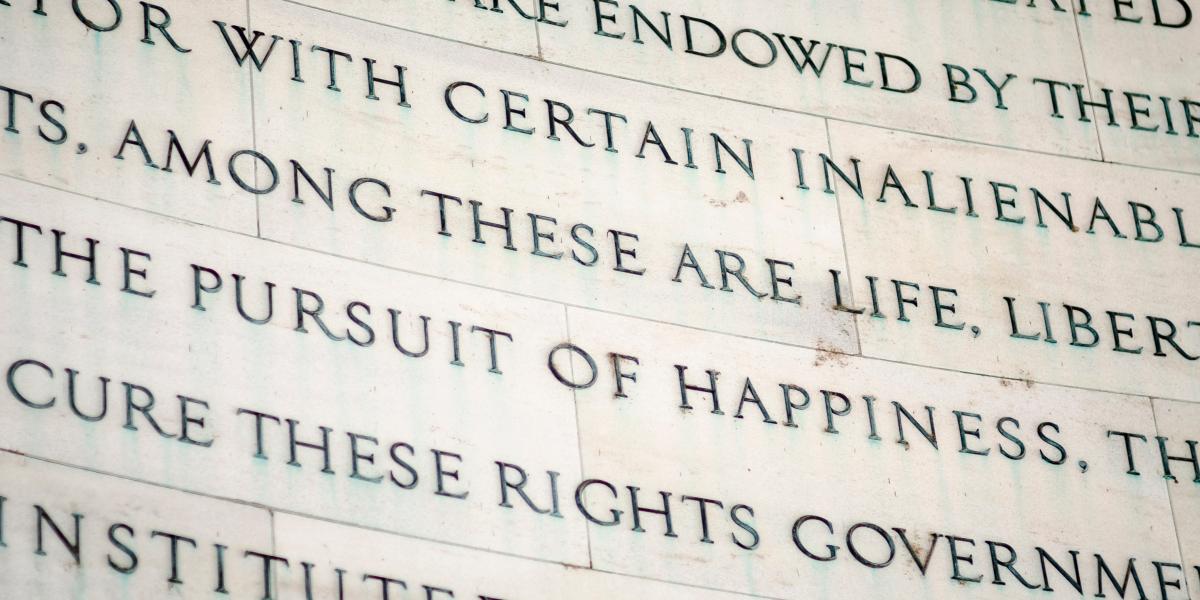
On Independence Day Americans tend to celebrate “America” in some way. What that means to people, of course, varies significantly depending on the person’s ideology and level of education. Many Americans are not sure what the Declaration of Independence is, or what century it was written in. Some can’t distinguish between the Declaration and the US Constitution. Many rarely think about it at all, if ever.
Regardless of what average modern Americans may know about it, the history of the Declaration and its legacy remains a matter of fierce contention. Why? Because historians and public intellectuals understand that our view of historical events shapes our ideology.
Supporters of the regime and status quo tend to define the Declaration as something that is safe, bland, and vague. We often hear about the Declaration in terms that reflect the ideology of average modern-day American intellectuals and pundits. They tell us the Declaration is about “equality” and “freedom.” They tell us that the only thing that justified the Declaration’s revolutionary agenda was the fact that the American colonists endured “taxation without representation”—and the Declaration was therefore ultimately about “democracy.” In other words, this interpretation neatly and conveniently supports the current agenda of most American mainstream political parties and ideological movements.
Fortunately, though, the real purpose and ideological underpinning of the Declaration of Independence is something far more radical and oriented against all state authority. The Declaration does not, as we are told, advocate for equality, democracy, or freedom within an established political order. The Declaration does not meekly ask the ruling regime for reform. Rather, the Declaration works from the assumption that the British state exercises no legitimate authority within the colonies. The Declaration assumes that secession and the abrogation of the British state within the colonies were both guaranteed by natural right and could not be forbidden by the British state. The Declaration of Independence was not calling for negotiations. It was simply describing the new reality in which the colonies were politically independent. Certainly, the Declaration explains why the colonies were seceding from the empire, but that was only—as we might say in modern parlance—”good public relations.”
The reality of the Declaration is that it was far more radical than its critics are generally willing to admit. The Declaration advocated for an act of unilateral and illegal secession. Clearly, modern-day defenders of the regime attempt to downplay this whenever possible. Moreover, the language and ideals of the Declaration communicate a general disregard for ideals of political unity or loyalty to political institutions, in spite of British propaganda to the contrary.
Thus, to act in the Spirit of the Declaration of Independence today is to reject calls for loyalty, unity, or respect for the regime’s so-called “rule of law.” Rather, the Declaration of Independence represents disloyalty, disunity, and a disregard for the law as laid down by the political ruling class.
Yes, It Was Secession
In an effort to conceal the radicalism of the Declaration, many conservative and other pro-establishment pundits insist that the colonies’ secession from the British empire wasn’t really secession. They’ll claim, for example, that secession isn’t secession if it occurs as a type of decolonization. (Many modern opponents of secession invent arbitrary criteria such as the “salt water rule” stating that secession is only permissible if there is a body of salt water between the mother country and the seceding colony.)
Such claims strain the limits of credulity, however, and for this reason, serious scholars simply admit that the American secession was exactly that. Historian David Armitage, for example, flatly describes the Americans’ efforts to “dissolve” its political bands with Britain as an effort to “secede.”
The idea that the American separation was indeed secession isn’t even controversial among actual scholars of secession and separatist movements. Only among some American ideologues is it rather ridiculously maintained that the unilateral secession of the American colonists wasn’t actually secession.
It Wasn’t about Democracy
In an effort to place strict limits on what secession is “allowed,” regime apologists will fall back on claims that secession was only acceptable in 1776 because there was “taxation without representation.” By this way of thinking, secession can only be justified if there is no “democracy.”
The Declaration itself, however, does not make this argument. The Declaration does mention taxation “without our consent,” but that is only one reason for political independence among more than two dozen other reasons. For example, the Declaration also declares the Americans’ secession was justified by restrictions on trade, restrictions in immigration, underuse of trial by jury, abusive government agents being shielded from prosecution, and the crown’s overriding of laws passed by local legislatures.
Clearly, there was a lot more going on here other than simply taxation without representation.
But let’s say, for the sake of argument, that the British state agreed to offer “representation” to the Americans. How is this to be defined? What counts as democracy is never actually defined by those who claim that “democracy” renders secession unnecessary. Would it be democracy if the Americans were granted ten or twenty seats in Parliament in London? At the time, Parliament had more than 500 members. That would hardly change the political realities of the colonies. Political “representation” means next to nothing if the “represented” group remains forever in the minority. More importantly, who gets to decide how much political representation is enough? The colonists had no interest in playing these games and simply opted for self-determination.
On this matter of what political representation means in practice, the purveyors of the “democracy” argument rarely offer a response. For similar reasons, modern supporters of the regime avoid the issue of representation. We are told that a Congress of a few hundred millionaires somehow “represents” 330 million Americans, most of whom have virtually nothing in common with your average member of Congress.
For its part, the Declaration is uninterested in the idea that democracy—in whatever form—voids the natural right to secession and political self-determination.
The Radicalism of the Declaration of Independence
Part of the Declaration’s radicalism stems from the fact that the Declaration does not make a legal argument in favor of secession. Rather, the Declaration states that the right of separation stems simply from natural rights of self-determination that do not depend on legal or constitutional authority.
This is not surprising given the views of the Declaration’s author, Thomas Jefferson, who was a committed follower of John Locke. Locke, after all, did not himself regard secession as limited by legal restrictions. For Locke, the right of secession was a natural right that could be put forward by a wide variety of organizations and groups of people without permission from any higher legal authority.
[Read More: “Thomas Jefferson Still Supported Secession Forty Years After the Declaration of Independence“]
We can see the radicalism of this view if we contrast it with the conservative views of later American theorists who limited the right of secession to legal—rather than natural—origins. John C. Calhoun, for example, justified secession on legal contracts rather than on natural rights. Compared to the broader Jeffersonian and Lockean views of secession, Calhoun’s legalistic justification is weak tea, indeed.
And then, of course, there is the fact that the Declaration respected no demand for loyalty to the crown, to parliament, or to any other British political institution. Instead, the Declaration was a statement of contempt for the established legal order. British propaganda at the time, much like American propaganda today, sang the praises of political unity while encouraging an emotional bond between the ordinary subject and the ruling executive. Fortunately, the American secessionists saw such things for the absurdities that they were and have always been.