If you ask any American libertarian who the worst presidents of all time were, you are likely to receive the same answers, though in different order. Abraham Lincoln invaded the South and led the greatest slaughter of Americans in history, including targeted attacks against civilians. Woodrow Wilson created the Fed and got us into World War I. Franklin Roosevelt established the New Deal, bankrolled the Soviet Union, caused the Cold War, and staffed his administration with communists. Lyndon B. Johnson escalated Vietnam, amplified the welfare state, and greatly magnified the civil rights regime.
I do not seek to answer who committed the worst crime in this article. Rather, I would like to look at Franklin Roosevelt, who shaped the modern US the most out of these four, and his motivations for total war. It is not secret that Roosevelt viewed Germany as the greatest threat to his ideals and sought its permanent crippling under the Morgenthau Plan (relenting only with public backlash). However, most people do not know that Roosevelt’s teutonophobia has its origins in the teachings of Silas Marcus MacVane.
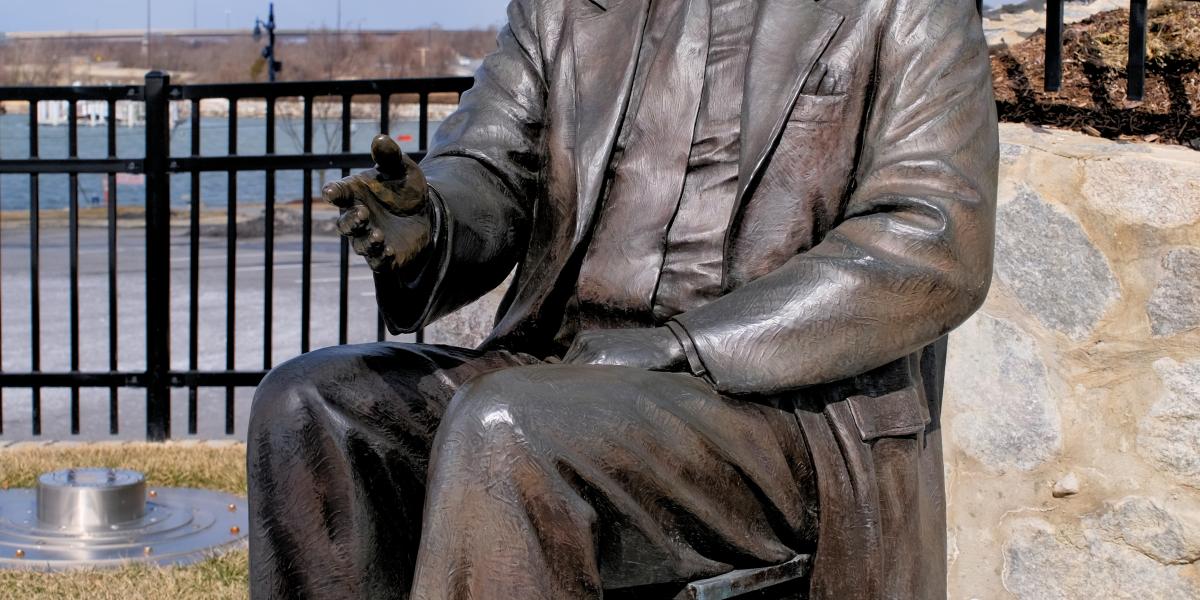
MacVane and Roosevelt at Harvard
According to Dr. Michael S. Bell—whose exquisitely-detailed dissertation is the main source of this article—FDR was a C student at Harvard (this is before grade inflation, when C’s actually denoted that a student was average rather than poor at the subject). The exception was in MacVane’s history classes, in which FDR demonstrated his enthusiasm by consistently scoring B’s.
For context, Silas Marcus MacVane was born to Scottish Highland immigrants on Prince Edward Island in Canada. After receiving his bachelors, he studied in Berlin and later became an instructor of economics at Harvard. MacVane would switch to teaching history after a few years, being a full professor by the time that FDR would study under him. Historians of economic thought and Austrian economists will recognize that this is the same MacVane who criticized Böhm-Bawerk’s capital theory. MacVane also had rather radical political beliefs through which he viewed history. Dr. Bell writes:
The “truth” that Macvane imparted to his students portrayed the history of Europe as the constant struggle between the friends of progress and the forces of reaction. Clearly an adherent of the Whig school of historical interpretation, Macvane portrayed history as the emergence of Anglo-Saxon civilization and liberty as a result of the alliance between Protestants and Whigs and despite the obstructionism of Catholics and Tories…. In keeping with his whiggish perspective, Macvane noted that “it is best to devote attention mainly to the course of affairs in England—the history of the continental states being on the whole rather arid.”
MacVane’s Anglo-progressivism found fertile soil, as the young FDR was already rather progressive himself. Indeed, he was primarily interested in the discipline of history as a means of constructing his own family’s hagiography, and he was convinced that the Roosevelt family—long established in New York—succeeded because of their progressiveness and “democratic spirit.” In fact, one can easily make the connection between MacVane’s radically progressive reading of history and FDR’s own rhetoric and policies.
Regarding the French Revolution,
Macvane’s portrayal of the period of the French Revolution and First Empire continued his established theme. Macvane considered the French Revolution “a social upheaval against the state of affairs” created by the Catholic Church and the monarchy… In Macvane’s lectures there was no recognition that the revolution ever went to excess, no terror. Instead, with an apparent air of Anglo-Saxon superiority, Macvane argued that the Republic failed because the people “w[oul]d not take advice from [the] example of Eng[land].”
And his views regarding 1848 and later upheavals are equally as biased:
Macvane’s view of the course of European history after Napoleon is found in a book that he published in 1900… The book was a heavily edited and revised translation of a European political history survey by French republican Charles Seignobos. The work provided “an explanatory history of political evolution” in Europe by emphasizing a cyclic, recurring pattern of revolution followed by “long periods of conservation.” It was an interpretation that reflected Seignobos’s, as well as Macvane’s, “preference for a liberal, unclerical, democratic, Western government.”
….In Macvane’s narrative, France’s “progressive party” opposed monarchy and clericalism and with the Revolution of 1848 it “converted France into a democracy.” Paris, Macvane argued, was the center of the French yearning for democracy because in both 1830 and 1848 “the revolution made in Paris was passively accepted by the rest of the nation.”
While France was imperfectly liberal—plagued by factionalism and their non-Britishness—Germany presented a different story. To MacVane, Germany was full of liberals, but was tragically chained down by the Prussian monarchy, which to MacVane represented the old absolutist and clerical regimes of Europe. The republicans and socialists were locked into a struggle against the pro-church monarchists over deciding the character and future of Germany. To MacVane’s dismay, Germany developed according to a compromise between democracy and monarchy. He therefore “warned that the German Empire was ‘a daughter of Borussia,’ the barbarian land at the southeastern corner of the Baltic sea during the Roman era, ‘not of Teutonia (ancient Germany).’” Per Dr. Bell, FDR—originally a Germanophile—accepted MacVane’s warnings when honeymooning in Germany, bristling against the increasing Prussianization of Germany.
FDR’s Views in Light of MacVane’s
MacVane’s radically progressive view of history would go on to directly shape FDR’s own philosophy:
[FDR’s] ideas reflected the liberal, progressive view of history and world events. In 1912 he observed that “the history of the past thousand years” was the story of “the Aryan races . . . struggling to obtain individual freedom.”… As a function of his perspective, Roosevelt tended to view people and groups as either agents of progress and individual liberty or as a manifestation of the forces of reaction.
It is not hard to see why Roosvelt was such an ardent supporter of the Soviet Union against Germany, as the Soviet Union was the best vehicle now not only for the Russians to achieve progress and democracy, but also the rest of Eastern Europe. The only alternative would be a Europe dominated by the forces of reaction.
It is also clear why Roosevelt was such an uncompromising advocate of the unconditional surrender of Germany and Japan. Both Germany and Japan, in Roosevelt’s mind, were forces of reaction against the march of democracy and progress, avatars of ancient evils. Upon the fall of France earlier in the war, Roosevelt was less than satisfied:
Believing that the war was being fought “to cleanse the world of ancient evils,” Roosevelt rejected the notion that any compromise was possible with Hitler. He later wrote, “There never has been – there never can be – successful compromise between good and evil.” Already skeptical about the state of leadership in France, the armistice convinced Roosevelt that the forces of reaction had seized power and that their actions served Hitler either directly or indirectly.
Roosevelt had also surrounded himself with advisors of a similar mind, and the advice all pointed towards applying MacVane’s theories, by destroying any worldwide enemy of progress. Frank Knox convinced FDR that peace with Germany, outside of surrender, was not an option. Adolf Berle—upon reviewing Woodrow Wilson’s speeches from the First World War—concluded that the truly liberal Germany was taken hostage by the reactionary Prussians. Therefore, the way to guarantee peace was to liberate Germany and destroy Prussia. Wilson’s speeches also singled out the Pope as a force of reaction, having favored a compromise peace to end World War I instead of the total destruction of the Prussian reactionaries. Echoing the strategy of Churchill’s starvation blockade in World War I, John Franklin Carter advocated a strict blockade to “use food as a weapon.” Even if Hitler was replaced or if the party collapsed, Carter maintained that:
…the forces of German conservatism and militarism would continue to thrive… Rather than setting the conditions for a liberal regime to succeed Hitler, however, the prediction was that the failure of the German army to achieve a strategic breakthrough against the Soviet Union would result “in a collapse of the Hitler Regime with the almost immediate removal of Hitler, Georing[sic], Goebels, Himmler et al with the German Army generals taking over the Government reins.”
So, if MacVane’s philosophy was to be applied, FDR not only had to ensure the total surrender of Germany and the destruction of Prussia, but also the restrengthening of liberal Germany. America was now responsible for defeating and occupying Germany, destroying and dismantling Prussia, and for reconstructing and cementing German liberalism as the dominant ideology of the country.
This explains FDR’s support of the Morgenthau Plan—a scheme to dismember Germany after the war, abolish Prussia, ethnically cleanse non-German lands of Germans, and deindustrialize all German rump states. The Wikipedia article on the Morgenthau Plan runs cover for FDR, claiming that he approved of it and later distanced himself, but the writings of Morgenthau tell a different story:
I met at 12:00 today with Roosevelt, Churchill, Eden and the Under Secretary for Foreign Affairs… Then Churchill, turning to Lord Cherwell and myself, said, “Where are the minutes on this matter of the Ruhr?” and according to our agreement we said that we didn’t have them. The reason we didn’t have them was because I felt, when I read the minutes which Lord Cherwell had written, that it presented much too weak a case, and I thought that we could get Churchill to go much further… When Churchill read our very short memorandum, he said, “No, this isn’t what I want.” Then he started to talk and dictate to us, and I said, “I don’t know what the rules of the game are, but is there any reason why we can’t have a stenographer present?…
…Roosevelt’s important contribution, while Churchill was dictating, was that when he got talking about the metallurgical, chemical and electric industries, Roosevelt had him insert the very important words “in Germany”. What Roosevelt meant was—because it came up later—that he didn’t have in mind just the Ruhr and the Saar, but he had in mind entire Germany, and that the matter we were talking about, namely, the ease with which metallurgical, chemical and electrical industries in Germany can be converted from peace to war, does not only apply to the Ruhr and the Saar, but the whole of Germany, which of course is terribly important.
FDR did publicly distance himself from the plan at a later date, particularly after the estimated death toll of implementing the plan became known. Since he died before the end of the war, though, we will never know if he was genuine or not. His personal philosophy definitely leads one to believe the latter.
The Consequences of Wrong Education
I have heard many analyses of FDR, the New Deal, and progressivism from many Austro-libertarians, but I don’t recall having seen an article that traces FDR’s progressivism to his education, much less to a prominent critic of the Austrian School.
While this article is heavy in historical detail, I believe the main takeaway for our present time is the importance of education and the dangers of teaching the wrong ideology. The history of the world was irreparably changed for the worse due to progressive ideologies being imparted to students at Harvard, and most of it can be traced to one economics and history professor. Should anyone think that progressivism in the schools is a minor issue, may this historic episode dissuade him.