No Result
View All Result
SUBMIT YOUR ARTICLES
  • Login
Sunday, March 15, 2026
TheAdviserMagazine.com
  • Home
  • Financial Planning
    • Financial Planning
    • Personal Finance
  • Market Research
    • Business
    • Investing
    • Money
    • Economy
    • Markets
    • Stocks
    • Trading
  • 401k Plans
  • College
  • IRS & Taxes
  • Estate Plans
  • Social Security
  • Medicare
  • Legal
  • Home
  • Financial Planning
    • Financial Planning
    • Personal Finance
  • Market Research
    • Business
    • Investing
    • Money
    • Economy
    • Markets
    • Stocks
    • Trading
  • 401k Plans
  • College
  • IRS & Taxes
  • Estate Plans
  • Social Security
  • Medicare
  • Legal
No Result
View All Result
TheAdviserMagazine.com
No Result
View All Result
Home Market Research Economy

The Cost of “Free” | Mises Institute

by TheAdviserMagazine
7 days ago
in Economy
Reading Time: 3 mins read
A A
The Cost of “Free” | Mises Institute
Share on FacebookShare on TwitterShare on LInkedIn


Over the past weekend, from February 12 until February 15, Polymarket—in conjunction with the Food Bank For NYC—organized a pop-up grocery store in NYC that offered groceries entirely free of charge. Although the event was a short-term promotional stunt by Polymarket, it drew public praise from Mayor Zohran Mamdani, who has pitched similar interventionist ideas for grocery stores before. More importantly, this event serves as a recent and practical example of how such interventions disrupt the natural dynamics of supply and demand in a free market. The goods are not truly “free”; the cost is simply shifted away from clear and voluntary prices into less transparent and more restrictive forms.

In a free market, every individual has their own subjective value, and are able to decide what they are willing to trade for each and every additional unit of a good. When these individual decisions are aggregated together across thousands or millions of buyers and sellers, they form the familiar supply and demand curves that are constantly adjusting toward a price equilibrium.

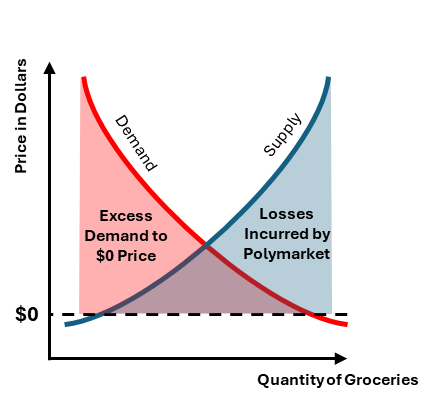
We can illustrate this with an example, using groceries on the horizontal axis and price in dollars on the vertical axis. For simplification, “groceries” represent a general basket of food items rather than any single product.


This represents the natural state of a free market: a widely-distributed interaction between consumers and producers, where prices continually adjust toward a level that equalizes supply and demand.

The free grocery store—along with countless historical examples—shows what happens when this process is disrupted. In terms of the supply and demand curve, two things occur:

The price of groceries is artificially set to $0. Since the cost of producing groceries exceeds $0, no rational supplier would provide goods at this price, as doing so would guarantee a loss. In this case, the store was supported through Polymarket, meaning those losses were absorbed by them. This leads to the second effect.A gap emerges between demand and readily-available supply. At a cost of $0, demand is no longer constrained by price and surges toward infinity. With no price signal to moderate demand, the resulting gap must be resolved through other means, which we will explore shortly.

These two effects lead to a broken supply-demand curve that looks something like the following. There is excess demand with price set to $0 and the supply that is provided is provided at a loss, covered by Polymarket.


Price helps coordinate and modulate the relationship between supply and demand. Because groceries carry a monetary cost, consumers do not visit the store endlessly or purchase unlimited quantities. Prices provide structure to the market; they create a dampener for unchecked demand.

The instinctive response is to assume that, without price, consumers could simply obtain as much as they need, especially for essential goods like food. But lowering the price of groceries, or any good, to free does not remove cost; it merely shifts it elsewhere. When price is eliminated, new barriers emerge.

In the case of the free grocery store, two new costs became apparent:

In effect, consumers were required to sacrifice productive time to stand in line, only to face reduced selection and externally-imposed rations. The cost did not disappear; it changed form. In a free market, individuals can apply their labor to earn money and exchange it for the goods they value most. Instead, time and free choice were sacrificed for an inferior return.

While the idea of a free grocery store may appear compassionate, especially for those who are struggling, the underlying cost is merely obscured, not eliminated. It is also not sustainable; the cost of groceries cannot be absorbed indefinitely. This is evident in the fact that the promotional event lasted only a few days.

This lesson applies to more than promotional grocery stores. Markets that face intervention simply find that the costs are simply shifted elsewhere. Free roads suffer heavy traffic and deterioration; free beaches, rivers, and lakes become overused and polluted. The lesson here is that there is absolutely nothing more expensive than “free.”

Source link

Tags: CostFreeInstituteMises
ShareTweetShare
Previous Post

Oil worries and Iran war hammer Asian stocks, with Korea’s KOSPI taking the biggest hit

Next Post

Rupee may slip further if Middle East tensions persist: Naveen Mathur

Related Posts

edit post
Oil & Religion | Armstrong Economics

Oil & Religion | Armstrong Economics

by TheAdviserMagazine
March 15, 2026
0

QUESTION: Marty, looking at Socrates, it does not show that this release of 400 million barrels of oil will do...

edit post
Iran – The Next Afghanistan & Vietnam

Iran – The Next Afghanistan & Vietnam

by TheAdviserMagazine
March 15, 2026
0

QUESTION: Marty; I was rereading the Middle East report from the 2023 WEC. You had everything pointing to this starting...

edit post
Liquidity Crisis 2026 | Armstrong Economics

Liquidity Crisis 2026 | Armstrong Economics

by TheAdviserMagazine
March 14, 2026
0

QUESTION: Marty, I want to thank you for your warning about Blackrock. I took out 90% with the October high...

edit post
PRIVATE BLOG – Iran = Vietnam 2.0: Will Middle East War Turn Nuclear?

PRIVATE BLOG – Iran = Vietnam 2.0: Will Middle East War Turn Nuclear?

by TheAdviserMagazine
March 14, 2026
0

Blog Iran PRIVATE BLOG – Iran = Vietnam 2.0: Will Middle East War Turn Nuclear? Posted Mar 14, 2026 by...

edit post
How Medical Licensing Serves Big Pharma at the Expense of Public Health

How Medical Licensing Serves Big Pharma at the Expense of Public Health

by TheAdviserMagazine
March 14, 2026
0

We’re supposed to believe that medical licensing exists to protect healthcare consumers from “quacks” and “charlatans.” The purpose, we’re told,...

edit post
Wheat Has Toppled More Empires Than Gunpowder

Wheat Has Toppled More Empires Than Gunpowder

by TheAdviserMagazine
March 14, 2026
0

COMMENT: I am very disappointed in the Trump Administration. He promised to stop the endless wars and has done the...

Next Post
edit post
Rupee may slip further if Middle East tensions persist: Naveen Mathur

Rupee may slip further if Middle East tensions persist: Naveen Mathur

edit post
Why AI and Big Data Cannot Plan an Economy

Why AI and Big Data Cannot Plan an Economy

  • Trending
  • Comments
  • Latest
edit post
Foreclosure Starts are Up 19%—These Counties are Seeing the Highest Distress

Foreclosure Starts are Up 19%—These Counties are Seeing the Highest Distress

February 24, 2026
edit post
Gasoline-starved California is turning to fuel from the Bahamas

Gasoline-starved California is turning to fuel from the Bahamas

February 15, 2026
edit post
7 States Reporting a Surge in Norovirus Cases

7 States Reporting a Surge in Norovirus Cases

February 22, 2026
edit post
Where Is My 2025 Oregon State Tax Refund

Where Is My 2025 Oregon State Tax Refund

February 13, 2026
edit post
2025 Delaware State Tax Refund – DE Tax Brackets

2025 Delaware State Tax Refund – DE Tax Brackets

February 16, 2026
edit post
The Growing Movement to End Property Taxes Continues in Kentucky, And What It Means For Investors

The Growing Movement to End Property Taxes Continues in Kentucky, And What It Means For Investors

March 2, 2026
edit post
The Cost of “Free” | Mises Institute

The Cost of “Free” | Mises Institute

0
edit post
Top airline CEOs plead with Congress to restore DHS funding and pay airport workers

Top airline CEOs plead with Congress to restore DHS funding and pay airport workers

0
edit post
XRP Faces Systematic Rigging, Major Holder Says

XRP Faces Systematic Rigging, Major Holder Says

0
edit post
The people who thrive after 40 without burning out almost always let go of these 7 things in their thirties

The people who thrive after 40 without burning out almost always let go of these 7 things in their thirties

0
edit post
Key Trends, Growth Opportunities, and Why Businesses Are Buying Market Reports

Key Trends, Growth Opportunities, and Why Businesses Are Buying Market Reports

0
edit post
The “Super Catch-Up” Math: How to Add 3,000 to Your Nest Egg in 4 Years

The “Super Catch-Up” Math: How to Add $143,000 to Your Nest Egg in 4 Years

0
edit post
The people who thrive after 40 without burning out almost always let go of these 7 things in their thirties

The people who thrive after 40 without burning out almost always let go of these 7 things in their thirties

March 15, 2026
edit post
Top airline CEOs plead with Congress to restore DHS funding and pay airport workers

Top airline CEOs plead with Congress to restore DHS funding and pay airport workers

March 15, 2026
edit post
Latam Insights: Paraguay Adds Stringent Crypto Reporting Rules, Argentina Blocks Peso Stablecoin

Latam Insights: Paraguay Adds Stringent Crypto Reporting Rules, Argentina Blocks Peso Stablecoin

March 15, 2026
edit post
The Hidden Risk in Aging‑in‑Place Gadgets: Why Some Amazon Products Don’t Meet Safety Standards

The Hidden Risk in Aging‑in‑Place Gadgets: Why Some Amazon Products Don’t Meet Safety Standards

March 15, 2026
edit post
The closed Strait of Hormuz is testing Asia’s energy security. The answer lies in Canada

The closed Strait of Hormuz is testing Asia’s energy security. The answer lies in Canada

March 15, 2026
edit post
The “Super Catch-Up” Math: How to Add 3,000 to Your Nest Egg in 4 Years

The “Super Catch-Up” Math: How to Add $143,000 to Your Nest Egg in 4 Years

March 15, 2026
The Adviser Magazine

The first and only national digital and print magazine that connects individuals, families, and businesses to Fee-Only financial advisers, accountants, attorneys and college guidance counselors.

CATEGORIES

  • 401k Plans
  • Business
  • College
  • Cryptocurrency
  • Economy
  • Estate Plans
  • Financial Planning
  • Investing
  • IRS & Taxes
  • Legal
  • Market Analysis
  • Markets
  • Medicare
  • Money
  • Personal Finance
  • Social Security
  • Startups
  • Stock Market
  • Trading

LATEST UPDATES

  • The people who thrive after 40 without burning out almost always let go of these 7 things in their thirties
  • Top airline CEOs plead with Congress to restore DHS funding and pay airport workers
  • Latam Insights: Paraguay Adds Stringent Crypto Reporting Rules, Argentina Blocks Peso Stablecoin
  • Our Great Privacy Policy
  • Terms of Use, Legal Notices & Disclosures
  • Contact us
  • About Us

© Copyright 2024 All Rights Reserved
See articles for original source and related links to external sites.

Welcome Back!

Login to your account below

Forgotten Password?

Retrieve your password

Please enter your username or email address to reset your password.

Log In
No Result
View All Result
  • Home
  • Financial Planning
    • Financial Planning
    • Personal Finance
  • Market Research
    • Business
    • Investing
    • Money
    • Economy
    • Markets
    • Stocks
    • Trading
  • 401k Plans
  • College
  • IRS & Taxes
  • Estate Plans
  • Social Security
  • Medicare
  • Legal

© Copyright 2024 All Rights Reserved
See articles for original source and related links to external sites.