[Originally published by the Institutional Risk Analyst.]
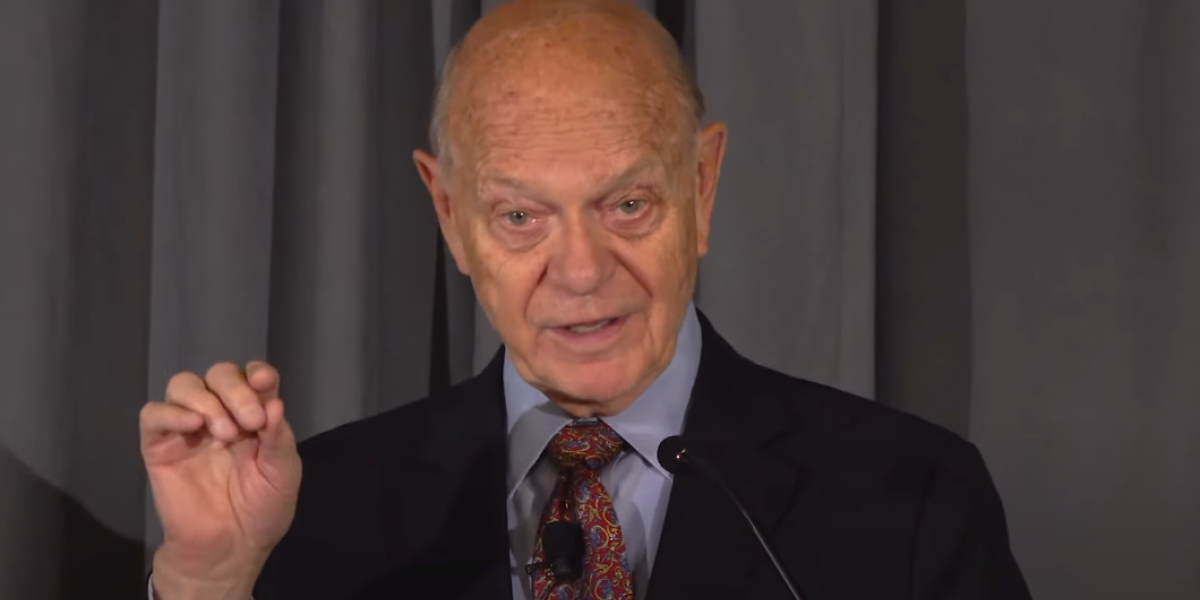
In this special edition of The Institutional Risk Analyst, we feature a discussion with Alex Pollock, Senior Fellow at the Mises Institute. Alex provides thought and policy leadership on financial issues and the study of financial systems. He was president and CEO of the Federal Home Loan Bank of Chicago from 1991 to 2004. We spoke with Alex from his home in Lake Forest, Illinois.
The IRA: Alex, thank you for taking the time to speak with us today. We were at the Lotus Club yesterday talking about Inflated: Money, Debt and the American Dream. One of our former colleagues from Bear, Stearns attended.
Pollock: Know something you and I have in common?
The IRA: Tell us.
Pollock: You worked for Bear Stearns. I worked for Continental Illinois. Two firms that are no longer with us. Educational experiences.
The IRA: We were looking at the FINRA record while doing CE. It now lists JPMorgan as our first employer instead of Bear, Stearns. Well, so technically we worked for Jamie Dimon once upon a time. Thank you for sending over your latest testimony on the Federal Reserve, “How Congress Should Oversee the Federal Reserve’s Mandates.” It provides an interesting counterpoint to the essay by Treasury Secretary Scott Bessent in The International Economy about reforming the Fed. We don’t think that anything will happen on reforming the central bank before the Republic has another financial crisis, but there you are. We are very happy to be living in Westchester County, though, instead of New York City. Leaving Gotham in 2021 was a good move and cut our living expenses by more than half.
Pollock: I feel the same about Lake County, Illinois.
The IRA: Despite the political and fiscal troubles in Chicago, we see that the developers are all scurrying back into greater Chicago. This despite the carnage for the banks. Developers must do development or they’ll be out of business. Somebody just took Bank OZK (OZK) out of their misery in Lincoln Yards. But we digress. Let’s spend a little bit of time talking about the Fed and then we can switch gears and talk about gold if that works for you. Or maybe we’ll just talk about gold.
Pollock: Two highly related topics.
The IRA: What questions and comments did you get from the Financial Services Committee members when you were up on the hill talking about the Fed? Do you think any of them understood some of the points you made in your excellent testimony?
Pollock: The testimony was to a task force of the Financial Services Committee. We got some very good questions, including questions on what is the chief thing the Fed is supposed to do. I like the idea that the guiding fundamental principle should be that the first responsibility of the central bank is to provide a sound currency. I recommended that the Financial Services Committee in the House and the Banking Committee in the Senate should both have subcommittees devoted solely to the Fed. The monetary system is so overwhelmingly important that that would make a lot of sense. And then you would get a focus and a buildup of expertise over time. Members of Congress, if they serve on a committee long enough, become quite knowledgeable. Incidentally, the hearing last month was held in the Wright Patman room…
The IRA: Oh, of course. Rep Wright Patman (D-TX) was a long-serving and populist politician from Texas. Known as a “fiscal watchdog,” he served in the House for 24 consecutive terms, from 1929 until his death in 1976. Henry Reuss (D-Wisconsin) succeeded Patman in 1975. We can recall appearing before another great Texas populist, Chairman Henry B. Gonzalez (D-TX), years later. Gonzalez, who thought there was gold hidden below the Federal Reserve Board, became chairman in 1989. Chairman Gonzalez was responsible for discovering the secret FOMC transcripts.
Pollock: Wright Patman chaired what was then the Committee on Banking and Currency for 12 years. He was a big believer in the responsibility of Congress to oversee and direct the Fed. It was the Democrats in those days who thought that Congress should watch the Fed’s operations closely. Did you enjoy my quote from former Democratic Senator Paul Douglas to William McChesney Martin? –the one about, “I’ve typed out your saying that the Fed is an agency of the Congress. I’m giving you a piece of scotch tape so you can tape this up on your bathroom mirror and look at it every morning.” I got a big kick out of that.
The IRA: Does the Congress really have any operations? I thought they were delegating all of the operational aspects of government to the executive branch.
Pollock: The Fed should and does have oversight and policy guidance from Congress. Congress does not need to operate the central bank. Congress instructs their agency, the Fed, which as is often said, comes under the money power, the constitutional money power under Article One, Section 8. As you know, the Constitution says “coining” money, which we read these days metaphorically.
The IRA: In those early days of the Republic, it was an acute need for an exchange medium that drove the Framers to give Congress power over money. Americans used barter for most exchanges and Spanish “pieces of eight” and pounds sterling for money in the 1700s.
Pollock: The Constitution then says “and regulate the value thereof.” Well, regulate the value of money is a congressional duty, in my view, not just a power. It is a duty under the Constitution and overseeing the Fed as part of that. That power is solely a congressional power and not an executive branch power.
The IRA: The central bank is clearly a peculiar institution because of the Constitutional empowerment regarding money, something that was extremely controversial at the end of the 18th Century. The fact that the Framers gave Congress this first mandate does not receive enough attention and supports your call for greater congressional oversight.
Pollock: Congress ought to want to take it seriously, the way Wright Patman and Henry Gonzalez did in their day. But the Democrats flipped and said, well, we ought to let the Fed do whatever it wants. It’s very historically interesting, that flip. Anyway, there’s another power though that’s very relevant and that is the taxing power. The power of taxation under the Constitution is given solely to the Congress, in that same article of the Constitution. Inflation is a tax. Inflation is simply taking purchasing power away from the people and giving it to the government. The Fed creates inflation. The Fed is taxing. The Fed is responsible to Congress for its taxing activity.
The IRA: As Robert Eisenbeis of Cumberland Advisors taught us years ago, the Fed is always an expense to the Treasury when you net out all of the cash flows. The Fed gives the Treasury back its own money earned from securities, less operating expenses. And you are correct that the Fed is a taxing unit, an instrument of financial repression. But the Bernanke Fed onward with QE expropriate the assets of the Treasury without congressional authority and proceeded to lose money on their speculations! They also mismanage the Fed’s assets and liabilities.
Pollock: Those losses are also a tax. When the Fed created a giant savings and loan type balance sheet on its own books, and has now lost $242 billion as a result, that is taxation, that is spending the taxpayer’s money in a fiscal action without authorization of Congress. It comes right out of the remittances to the Treasury.
The IRA: Ben Bernanke and Alan Greenspan before him figured that Congress had no idea so better just do what is necessary to keep the ship moving forward. But Alex, don’t you think the evil goes back to 1935 when FDR created the Board of Governors and brought all of this to Washington? Since the New Deal, the Fed has taken on the role of a state planning agency like the Soviet GOSPLAN. Bernanke creates quantitative easing, where the Fed buys trillions in Treasury securities and also mortgage bonds, driving up home prices. And this is all done under the rubric of the Elastic Clause in Article I, Section 8, “necessary and proper”. The Fed is basically free riding on that part of the Constitution.
Pollock: The 1935 Banking Act centralized the power of the Fed under FDR. Senator Carter Glass (D-VA) in his day used to ask witnesses before the Senate Banking Committee if the United States had a central bank. The answer he wanted was, “No, it does not. It has a federal system of regional reserve banks.” That was the Jeffersonian idea of Glass until 1935. And as you are saying, they flipped this around and centralized the power in the Board of Governors in Washington–the name was changed as a symbol of the power shift. The heads of the regional reserve banks were originally called “governor,” the Governor of the Federal Reserve Bank of New York or Chicago or whatnot. Also, Congress created the Federal Open Market Committee as a statutory body in 1935. It was originally a committee of the Federal Reserve banks themselves.
Read the full interview at The IRA.