

The F-35 fighter jet is the most expensive weapons program in U.S. history, but one of its biggest failures isn’t in the air — it’s on the ground. The Pentagon’s Autonomic Logistics Information System (ALIS), conceived as an ambitious plan to revolutionize fighter jet maintenance and logistics, collapsed under the weight of bad design, poor coordination, and perverse incentives that reward failure as readily as success. Its troubled successor, the Operational Data Integrated Network (ODIN), has stumbled out of the gate, revealing a deeper, recurring syndrome in U.S. government technology programs — a systemic incapacity to deliver on large-scale, high-cost projects, where failure is not just common but structurally baked into the process. This article uses the rise and fall of ALIS, and ODIN’s faltering replacement effort, to illustrate how that syndrome operates and why it persists.
ALIS in blunderland
ALIS’s collapse was not the result of a single flaw but of compounding failures that undermined it from conception to deployment. Conceived as the digital nervous system of the F-35 program, ALIS was meant to track parts and maintenance in real time, streamline repairs, predict failures before they happened, and connect a global fleet with seamless efficiency. In reality, it became a sprawling, brittle, and chronically unreliable burden. Software updates routinely broke existing functions, maintenance crews spent as much time troubleshooting the system as servicing the aircraft, and pilots were grounded not by enemy action but by bad data and system errors. What was billed as a force multiplier instead became an expensive liability — a case study in how poor architecture, weak oversight, and skewed incentives can cripple even the most critical capabilities.
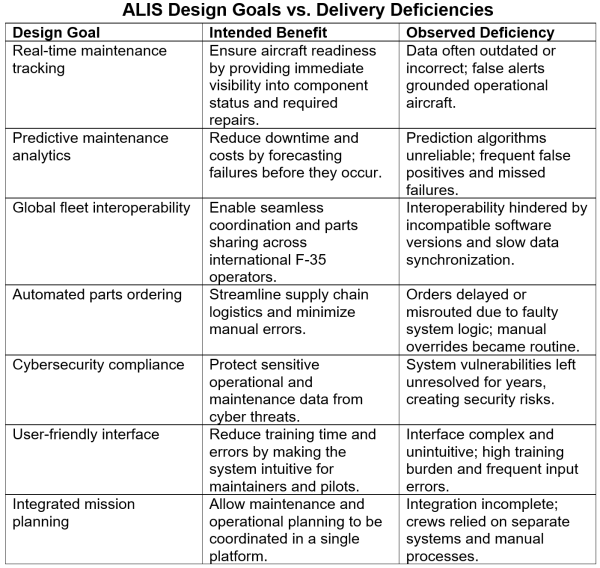
Israel Says No to ALIS
Perhaps the most telling indictment of ALIS came not from a congressional hearing or a Pentagon audit, but from the operational choices of one of America’s closest military partners. In 2016, when Israel received its first F-35I “Adir” fighters, it declined to connect them to the global ALIS network at all. Instead, the Israeli Air Force built its own independent logistics, maintenance, and mission systems to support the jets. Officially, this decision was framed as a matter of sovereignty and cybersecurity — Israel wanted to ensure that no foreign entity could monitor or interfere with its aircraft operations. Unofficially, it was also an acknowledgment that ALIS, as delivered, could not be relied upon for timely, accurate, or secure sustainment.
For a program whose central selling point was a globally integrated logistics backbone, one of its earliest foreign customers effectively voted “no confidence” and walked away, creating a precedent that other partners quietly noted. The Pentagon’s answer to such mounting dissatisfaction was ODIN — a fresh start in name, but as events would quickly show, a system fated to inherit many of the same flaws that doomed ALIS.
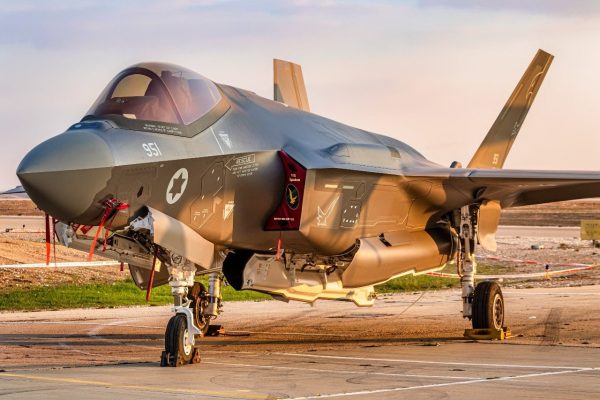
Israeli F35I Adir – Don’t ask ALIS
ODIN: The Replacement That Stumbled
In 2020, the Pentagon announced that ALIS would be phased out and replaced by the Operational Data Integrated Network (ODIN), a “modern, cloud-native” system promising faster updates, stronger cybersecurity, and a leaner, modular design. But almost immediately, ODIN began exhibiting the same flaws it was meant to fix. Hardware shortages delayed initial deployment, integration with legacy F-35 data pipelines proved more complex than anticipated, and shifting requirements coupled with uncertain funding caused repeated schedule slips. Most tellingly, ODIN’s reliance on a patchwork of government, Lockheed Martin, and subcontractor teams recreated the fractured accountability that had hobbled ALIS from the start.
By 2023, the Department of Defense quietly acknowledged that ODIN would not fully replace ALIS for years, and in some cases, the two systems would operate in parallel indefinitely. This hybrid setup perpetuated the very inefficiencies ODIN was supposed to eliminate — maintainers still had to wrestle with multiple interfaces, inconsistent data, and duplicated workflows. In effect, ODIN became less a clean replacement than an ongoing patchwork, weighed down by inherited design flaws, bureaucratic inertia, and the same perverse incentives that rewarded visible activity over actual capability.
The Consequences of Failure
Despite roughly $1 billion spent on ALIS and hundreds of millions more on ODIN, the F-35 fleet’s mission-capable rate remains stuck at about 55%, far below the 85–90% target. ALIS’s failures—and ODIN’s slow rollout—have contributed to chronic maintenance delays, inflated sustainment costs, and reduced operational availability, undermining the F-35’s ability to meet its core mission requirements.
From ALIS to the Bigger Problem: Government Project Sandbagging
The ALIS debacle — and ODIN’s halting attempt at redemption — is not an isolated failure but part of a recurring pathology in large U.S. government technology programs. This broader failure syndrome, which can be called project sandbagging, thrives in environments where perverse incentives reward slow progress, extended timelines, and budget inflation over timely, effective delivery. In such programs, failure rarely harms the contractors or agencies involved; instead, it becomes a pretext for additional funding, prolonged contracts, and diluted accountability. The very complexity that justifies massive budgets also shields programs from scrutiny, allowing delays and underperformance to be reframed as the inevitable costs of “managing risk” in ambitious projects. Too often, progress is measured in notional milestones and funding appropriations rather than delivered capability. ALIS is simply a particularly vivid example of how sandbagging erodes readiness, wastes resources, and normalizes failure — a fate shared by other major Defense Department technology projects.
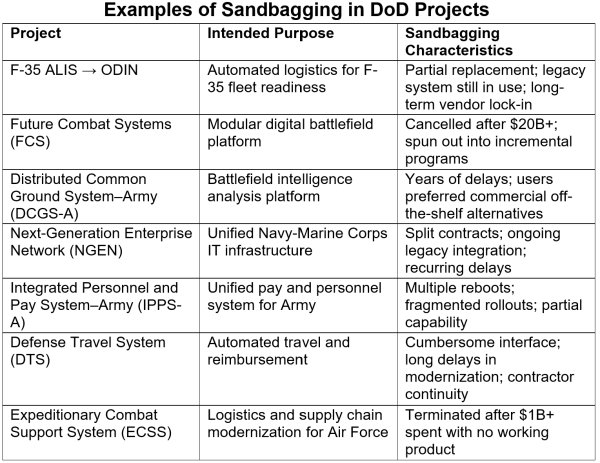
When the Sandbags Are Removed: SpaceX vs. NASA
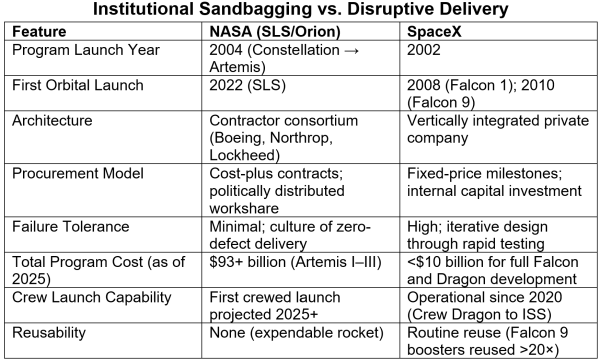
The gap between SpaceX and NASA’s congressionally directed SLS/Orion/EGS program is a rare natural experiment in incentives. Under fixed-price, milestone-based Space Act Agreements, SpaceX fielded Falcon 9/Heavy and Crew Dragon and built multiple Starship prototypes on rapid cycles; NASA, by contrast, has spent over $55 billion on SLS, Orion, and ground systems through the planned Artemis II date, with per-launch production/operations estimated at about $4.1 billion—a cadence and cost structure widely flagged as unsustainable.
SpaceX’s COTS/CRS/Commercial Crew work tied payments to verified, operational outcomes (e.g., ISS cargo and crew delivery), with NASA’s own OIG estimating ~$55 M per Dragon seat versus ~$90 M for Starliner. In contrast, Congress required NASA to build SLS with Shuttle/Constellation heritage and legacy contracts — locking in cost-plus dynamics, fragmented accountability, and low competitive pressure. While SLS is designed for deep-space crewed missions and thus faces higher safety margins, its cost and schedule gulf with SpaceX still reflects a stark disparity in structural incentives: one path rewards delivery and efficiency, the other sustains delay and budget growth under the banner of “managing risk.” That disparity is the essence of project sandbagging — a system where progress is measured in notional milestones and funding appropriations, not delivered capability.
Conclusion
The failure of ALIS is not a rare mishap — it is a case study in a chronic U.S. government failure mode. It reflects a recurring pattern: fragmented accountability, contractor dominance, risk-averse governance, and illusory milestone-driven progress that substitutes process for performance. Like many federal IT programs, it was built under cost-plus contracts, insulated from disruptive innovation, and allowed to persist despite user distrust and operational dysfunction.
The slow, incomplete transition to ODIN has not resolved these flaws — it has entrenched them. ALIS’s legacy is more than the logistical hobbling of the F-35 program; it is a warning that without structural reform in procurement, oversight, and incentives, critical technology projects will continue to sandbag transformation while consuming vast public resources. If future programs — including those now on the drawing board — are to avoid the same fate, the cost of inaction must be understood as measured not just in dollars, but in lost capability.
Curbing the entrenched practice of project sandbagging will require reforms that change both the incentives and the accountability structures that sustain it. The following measures address the pattern of incentive and oversight failures that doomed ALIS and now hinder ODIN:
Tie contractor profit to operational outcomes, not just deliverables.Move away from cost-plus contracts toward milestone payments linked to verified, in-service performance. This makes profit contingent on the system actually working as promised.
Enforce independent technical audits at multiple project stages.Mandate third-party verification of progress, functionality, and readiness before approving further funding. Auditors should report directly to Congress or another oversight body, bypassing the program office’s chain of command.
Adopt modular, open-architecture requirements.Design programs so that components can be upgraded or replaced independently. This reduces lock-in to flawed subsystems and encourages competitive sourcing.
Institute “sunset clauses” for underperforming programs.Set predefined thresholds for cost, schedule, and readiness; if breached, the program must be re-competed, restructured, or terminated. This makes failure a risk for the implementers, not just the warfighters.
By shifting incentives toward timely, functional delivery, these measures would make it harder for stakeholders to profit from delay and under-performance. The F-35’s ALIS and ODIN experience demonstrates what results when such guardrails are absent: costly, drawn-out efforts that erode readiness while delivering far less than promised. That is the central lesson of ALIS and ODIN, and why systemic reform is mission-critical. Until the sandbags are removed, the United States will keep mistaking motion for progress — and paying a premium for failure.











-1024x683.jpg "Judge Who Helped Violent Illegal Alien Evade ICE Faces New Test")



-1024x683.jpg "Montana Puts Democrats in a Bind as Senate Hopes Fade")










