This is Naked Capitalism fundraising week. 532 donors have already invested in our efforts to combat corruption and predatory conduct, particularly in the financial realm. Please join us and participate via our donation page, which shows how to give via check, credit card, debit card, PayPal, Clover, or Wise. Read about why we’re doing this fundraiser, what we’ve accomplished in the last year, and our current goal, supporting the commentariat.
For the first time in more than 50 years, the world’s two largest nuclear powers operate without a single binding limit on the size of their arsenals. The Strategic Arms Reduction Treaty (START I) and its successor frameworks, START II and New START, were the backbone of U.S.–Russian nuclear restraint, placing ceilings on deployed warheads and creating the most robust verification system in arms-control history. As the clock runs out on New START’s final extension in February 2026, the structure that anchored global strategic stability is dissolving. Its disappearance marks not only the lapse of a treaty, but the erosion of a philosophy: that nuclear powers can manage arms competition through transparency, predictability, and law. This article describes the background and characteristics of the START treaties and the likely consequences of abandoning them.
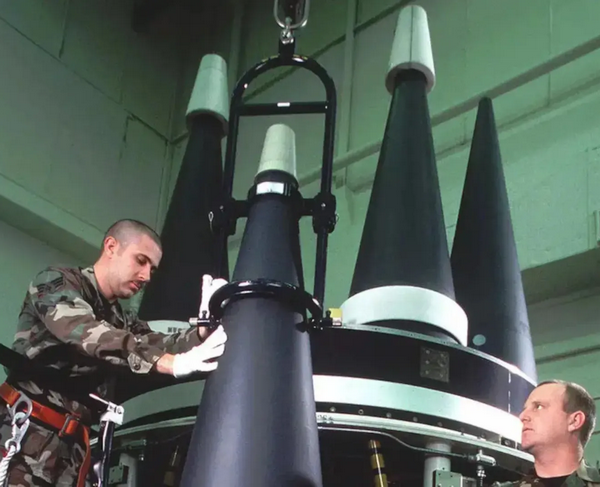
MIRV nuclear warheads – The fewer the better
Origins and Evolution of START
START emerged from the late Cold War recognition that an unconstrained arms race was both unaffordable and perilous. START I, signed in 1991 and entering into force in 1994, required each side to cut deployed strategic warheads to 6,000—a dramatic reduction from Cold War peaks—and introduced on-site inspections, telemetry sharing, and detailed data exchanges. A follow-on, START II (1993), sought deeper cuts and a ban on multiple-warhead land-based missiles (MIRVs) but never took effect after Russia withdrew in protest of the U.S. exit from the Anti-Ballistic Missile Treaty. The spirit of restraint revived in 2010 with New START, limiting each side to 1,550 deployed warheads on 700 launchers and modernizing verification procedures. Extended once by mutual consent in 2021, New START now stands as the last surviving U.S.–Russian arms-control accord—and it is expiring with no replacement in sight.
Why START Mattered
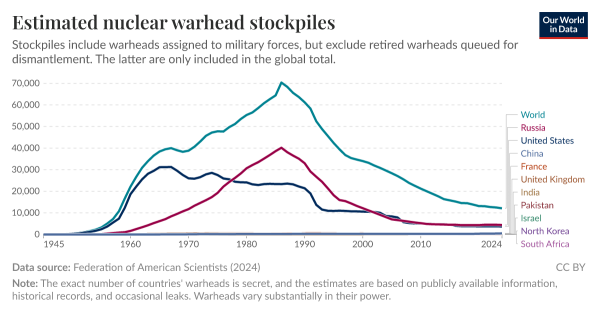
Major reduction in warheads. Under the START treaties, the number of nuclear warheads worldwide declined substantially from over 50,000 to around 10,000.
Predictability. By mandating regular data exchanges, START replaced speculation with facts. Each side knew the other’s arsenal size and composition, removing incentives to plan against inflated threats.
Verification. The treaty’s inspection regime, including over 18,000 on-site visits since 1994, became the gold standard for confidence building. Inspectors verified missile serial numbers, launch-tube counts, and base inventories, confirming declared reductions.
Crisis Stability. Quantitative ceilings narrowed the benefits of a first strike and fostered a stable deterrence balance. Leaders could calculate, not speculate, in moments of tension.
Symbolic Power. START proved that adversaries could negotiate in good faith. Its success lent credibility to the Non-Proliferation Treaty (NPT) and inspired parallel efforts such as the Intermediate-Range Nuclear Forces (INF) Treaty. Arms control was not charity; it was strategic insurance.
The Rise and Fall of Nuclear Arms Control
The Cuban missile crisis led to a willingness to engage in arms control diplomacy between the U.S. and the USSR. Beginning with the Nuclear Test Ban Treaty in 1963, a series of treaties succeeded in reducing tensions among the nuclear powers and inhibiting arms racing. Only a few of these treaties are still in force.
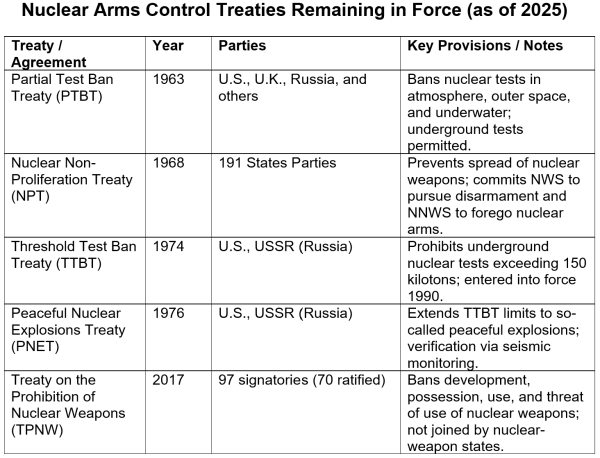
Beginning in 2002, increasing tensions between the U.S. and Russia led to the abrogation or lapsing of the most important nuclear arms control treaties. Perverse incentives of political expediency and military aggrandizement resulted in the removal of these important safeguards against nuclear war and moved the doomsday clock closer to midnight. New START, the last of the nuclear arms reduction treaties, will lapse in February of 2026.
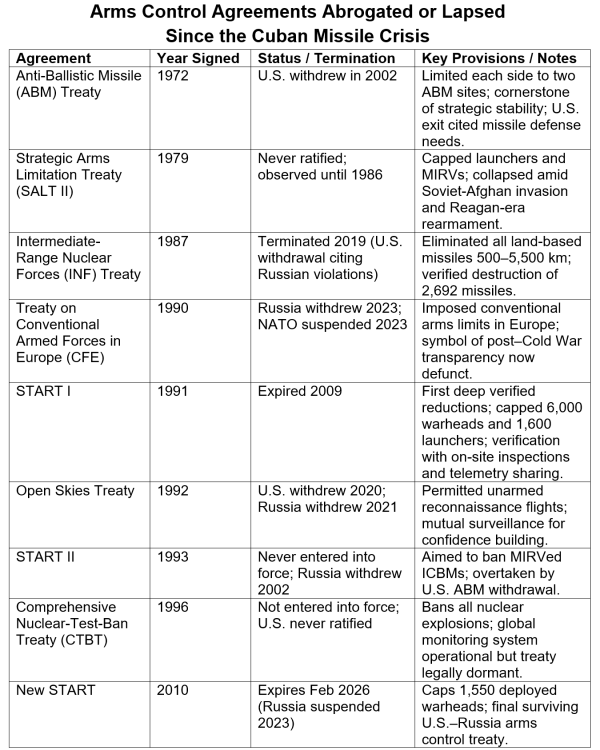
The unraveling of the START treaties began with deteriorating trust after 2014, when Russia’s annexation of Crimea and subsequent sanctions froze broader dialogue. COVID-19 halted on-site inspections in 2020 and they never fully resumed. In February 2023, Moscow suspended participation in New START, citing Washington’s “hostile actions” and NATO expansion. The United States accused Russia of noncompliance for refusing inspections and data updates. With war raging in Ukraine and bilateral diplomacy at its lowest ebb since the early 1980s, neither capital is preparing a successor treaty. As the 2026 deadline approaches, START is technically alive but functionally defunct. Putin recently proposed a one-year extension of New START, but there has been no reply from the Trump administration.
Consequences of New START Expiration
Return of the Arms Race. Without ceilings, both powers are free to expand their arsenals of deliverable warheads. The United States is modernizing every leg of its triad: the Sentinel ICBM, B-21 bomber, and Columbia-class submarines. Russia is fielding new systems such as the Sarmat heavy missile and Avangard hypersonic glide vehicle. Lacking mutual limits, planners will assume worst-case growth, inviting a costly and destabilizing buildup reminiscent of the 1960s. Both the U.S. and Russia could bring their MIRV missiles up to full deliverable warhead capacity by adding warheads from existing inventories.
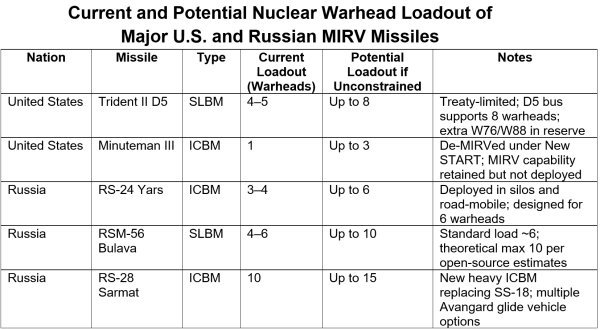
Collapse of Verification. Once inspections end, intelligence estimates must fill the gap. Satellite imagery can count silos but not warheads; telemetry can be spoofed. The disappearance of verified data will force each side to hedge with excess capacity, compounding mistrust.
Crisis Instability. In a confrontation between nuclear powers, leaders will operate with greater risk. Uncertainty about force survivability may push both sides toward launch-on-warning postures, shrinking decision time and raising the odds of miscalculation.
Global Ripple Effects. Great-power restraint has underpinned the Nuclear Non-proliferation Treaty (NPT) bargain: non-nuclear states renounce weapons in exchange for nuclear powers’ commitment to disarmament. If Washington and Moscow abandon limits, Beijing, New Delhi, Islamabad, and Pyongyang gain precedent to expand unchecked. Allies under the U.S. umbrella may question extended deterrence, spurring calls for independent capabilities.
Breakdown of Nuclear Diplomacy. Since SALT I (1972), multiple treaties have affirmed that nuclear excess is dangerous and reversible. Their collective erosion, with INF dead, Open Skies withdrawn, now START expiring, signals a new era of diplomatic nihilism, where power alone dictates numbers.
China’s Nuclear Deterrent and a Three-Body Problem
Perhaps the worst consequence of the abandonment of START would be the increased incentive for China to build up its nuclear forces. Historically, China maintained a “minimum deterrent” (~400–500 warheads, growing toward 1000 by early 2030s, per U.S. DoD estimates). Its doctrine relies on assured retaliation. START’s dissolution would alter this assumption.
If the U.S. and Russia expand beyond 1,550 deployed warheads, the gap between Chinese and other superpower arsenals widens dramatically. Credibility of China’s second-strike deterrent diminishes because U.S. and Russian counterforce capabilities would outpace China’s survivable forces. Not only would China face a growing U.S. nuclear arsenal, it would have to defend against the possibility of a combined strike by the U.S. and Russia. The possibility that each party in a nuclear deterrence triad might confront a joint attack by the other two creates an unstable “three-body problem” because each party’s effort to match the combined arsenal of the other two creates an asymmetry with each of the other two, which drives a self-perpetuating cycle of arsenal growth.
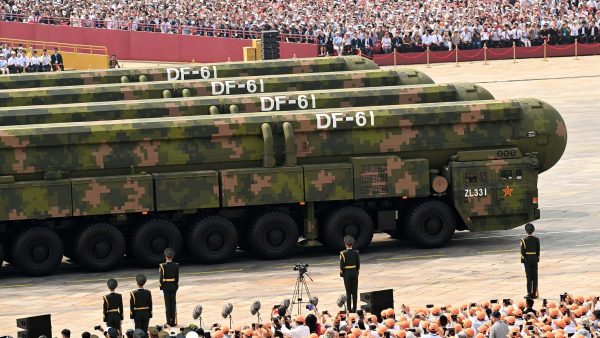
China’s DF-61 ICBM – Big trouble for arms control
Prospects for Renewal or Replacement
Reviving formal arms control faces formidable political headwinds. In Washington, Congress remains wary of treaties amid partisan divides. Moscow, under sanctions and wartime censorship, views strategic arms negotiations as a concession. Still, narrow confidence-building measures are conceivable: limited data-transparency accords, mutual test notifications, and moratoria on new deployment categories (e.g., space-based weapons). Longer term, stability will require tripartite engagement with China, whose arsenal complicates bilateral ceilings. Yet Beijing rejects verification parity until its forces near U.S.–Russian levels. In the absence of a grand treaty, policymakers may settle for informal norms and reciprocal statements, a fragile substitute for legally binding limits.
Conclusion
START’s expiration is more than another lapsed treaty; it is the removal of the last barrier separating structured deterrence from unconstrained rivalry. Without the START verification mechanism, conservative assumptions will rule and a nuclear arms race will resume, leading to growing defense budgets, hair-trigger alerts, and crises threatening catastrophe. Restoring arms control treaties, even at a modest level, is an urgent priority. Transparency is cheaper than rearmament, and treaties, however imperfect, are more reliable than notional deterrence. It is critically important for the safety of mankind that the New START treaty be renewed, and that further arms control agreements be implemented. It took decades to build nuclear trust. Letting START lapse could usher in a perilous new era of nuclear terror.