No Result
View All Result
SUBMIT YOUR ARTICLES
  • Login
Wednesday, July 1, 2026
TheAdviserMagazine.com
  • Home
  • Financial Planning
    • Financial Planning
    • Personal Finance
  • Market Research
    • Business
    • Investing
    • Money
    • Economy
    • Markets
    • Stocks
    • Trading
  • 401k Plans
  • College
  • IRS & Taxes
  • Estate Plans
  • Social Security
  • Medicare
  • Legal
  • Home
  • Financial Planning
    • Financial Planning
    • Personal Finance
  • Market Research
    • Business
    • Investing
    • Money
    • Economy
    • Markets
    • Stocks
    • Trading
  • 401k Plans
  • College
  • IRS & Taxes
  • Estate Plans
  • Social Security
  • Medicare
  • Legal
No Result
View All Result
TheAdviserMagazine.com
No Result
View All Result
Home Market Research Cryptocurrency

Stablecoin yield debate stalls congressional crypto bill progress

by TheAdviserMagazine
7 months ago
in Cryptocurrency
Reading Time: 4 mins read
A A
Stablecoin yield debate stalls congressional crypto bill progress
Share on FacebookShare on TwitterShare on LInkedIn


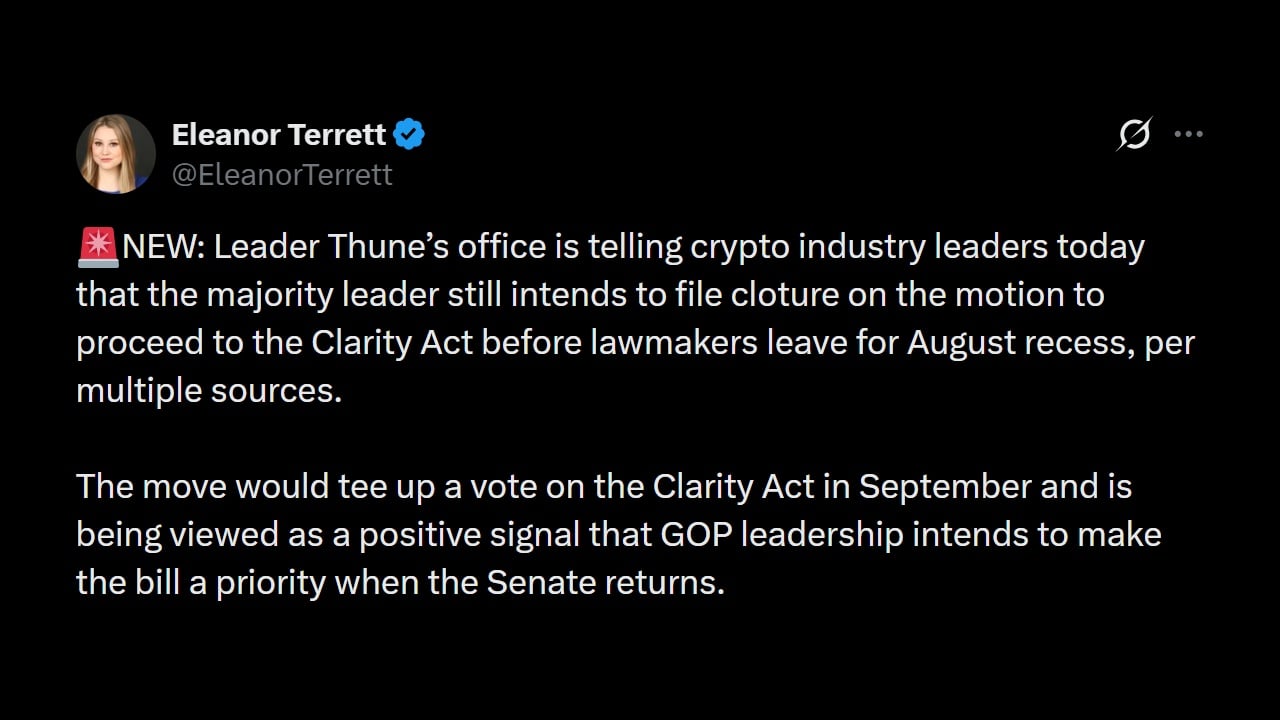
The US Congress is closer than ever to defining federal rules for digital assets, yet the question of whether stablecoins can provide yield has slowed the process more than agency turf battles or token classification.

Notably, the House has already advanced the Digital Asset Market Clarity Act, outlining a path for certain tokens to move from securities regulation to CFTC oversight.

At the same time, the US Senate is shaping a parallel package that divides responsibilities between the Agriculture and Banking Committees.

However, despite substantial areas of agreement, negotiators say the issue of stablecoin yield remains the sticking point.

This debate concerns whether payment stablecoins should be able to pass through some portion of short-term Treasury returns to users, either as explicit interest or as promotional rewards offered by affiliated firms.

Democratic lawmakers argue that yield-bearing structures could accelerate deposit outflows from community banks and raise funding costs. At the same time, Republicans contend that limiting yield would protect incumbent institutions at the expense of consumers.

So, what began as a technical rulemaking question has become a broader discussion about the composition of the US deposit base and the potential for digital dollars to compete with traditional bank accounts.

The $6.6 trillion outflow scenario

The conversation shifted in mid-August after the Bank Policy Institute (BPI) highlighted what it described as a gap in the GENIUS Act, the stablecoin law enacted earlier this year.

The statute prohibits issuers from paying interest but does not explicitly prevent exchanges or marketing affiliates from offering rewards linked to the issuer’s reserve assets.

According to BPI, this structure could allow stablecoin operators to deliver cash-equivalent returns without obtaining a banking charter.

To highlight the concern, the group cited government and central bank scenario analyses that estimate as much as $6.6 trillion in deposits could migrate into stablecoins under permissive yield designs.

Analysts familiar with the modeling stress that the figure reflects a stress case rather than a projection, and assumes high substitutability between traditional deposits and tokenized cash.

Even so, the number has shaped the debate. Senate aides say it has become a reference point in discussions over whether rewards programs constitute shadow deposit-taking and whether Congress must adopt anti-evasion language that covers affiliates, partners, and synthetic structures.

The concern is grounded in recent experience. Deposit betas have remained low at many US banks, with checking accounts often paying between 0.01% and 0.5% despite Treasury bill yields above 5% for much of the past year.

The gap reflects the economics of bank funding. Stablecoin operators that hold reserves in short-term government securities could, in theory, offer significantly higher returns while providing near-instant liquidity.

Considering this, policymakers worry that this combination could draw funds away from lenders that support local credit markets.

A narrow legal question

The yield question turns on how Congress defines “interest,” “issuer,” and “affiliate.”

Under the GENIUS Act, issuers must maintain reserves and meet custody and disclosure standards, but cannot pay interest on circulating tokens.

Legal analysts note that an exchange or related entity offering a rewards program could create a structure in which users receive value that is economically similar to interest while remaining outside the statutory definition.

However, banking trade groups have urged lawmakers to clarify that any return flowing from reserve assets, whether distributed directly or through a separate entity, should fall under the interest prohibition.

Meanwhile, crypto industry stakeholders argue that such restrictions would place stablecoins at a competitive disadvantage compared with fintechs, which already offer rewards programs that approximate yield.

They also note that other jurisdictions, including the United Kingdom and the European Union, are creating pathways for tokenized cash instruments with varying approaches to remuneration.

For them, the policy question is how to support digital-dollar innovation while preserving prudential boundaries, not how to eliminate yield from the ecosystem entirely.

However, Democrats counter that the pace of on-chain transfers creates a different dynamic from traditional bank competition.

Stablecoin balances can move quickly across platforms without settlement delays, and rewards structures tied to Treasury income could accelerate flows during market stress. They cite research indicating that deposit displacement from community banks would have the greatest impact on rural lending, small businesses, and agricultural borrowers.

According to a recent Data for Progress poll, 65% of voters believe widespread stablecoin use could hurt local economies, a view reflected across party lines.

Other issues stalling the crypto bill

Meanwhile, stablecoin yield is not the only unresolved issue.

Democrats have proposed adding ethics provisions that restrict officials and their families from issuing or profiting from digital assets while in office, as well as requirements to maintain full commissioner slates at the SEC and CFTC before delegating new oversight authority.

They are also seeking clearer tools to address illicit finance for platforms that facilitate access by US persons, and a definition of decentralization that prevents entities from avoiding compliance obligations by labeling themselves as protocols.

These additions have narrowed the legislative runway. Senate staff say a markup before the recess is now unlikely, raising the possibility that final negotiations will extend into 2026.

In that case, the GENIUS Act’s ambiguity regarding rewards would remain in place, and the SEC and CFTC would continue shaping the digital-asset market through enforcement actions and rulemaking.


Source link

Tags: billcongressionalCryptoDebateProgressStablecoinstallsYield
ShareTweetShare
Previous Post

Step Inside American’s Newest A321XLR Planes

Next Post

Kestra raises FY26 revenue guidance to $91M while targeting 70%+ gross margins with ASSURE system expansion (NASDAQ:KMTS)

Related Posts

edit post
Breaking: Citigroup Cuts Bitcoin and Ethereum Price Targets

Breaking: Citigroup Cuts Bitcoin and Ethereum Price Targets

by TheAdviserMagazine
July 1, 2026
0

Wall Street giant Citigroup has revised its 12-month price forecasts for Bitcoin and Ethereum. This comes amid massive outflows from...

edit post
XRPL Lending Proposal Opens Door To Institutional Credit On The XRP Ledger

XRPL Lending Proposal Opens Door To Institutional Credit On The XRP Ledger

by TheAdviserMagazine
June 30, 2026
0

Trusted Editorial content, reviewed by leading industry experts and seasoned editors. Ad Disclosure TL;DR XLS-65 (Single Asset Vaults) and...

edit post
Ark Invest Researcher Doubts Open USD Can Beat Circle After 16% Stock Drop

Ark Invest Researcher Doubts Open USD Can Beat Circle After 16% Stock Drop

by TheAdviserMagazine
June 30, 2026
0

Key TakeawaysCircle shares fell 16.5% on June 30, 2026, after Open Standard unveiled the OUSD stablecoin.Coinbase and Blackrock are among...

edit post
DeFi hacks are turning high yields into a hidden liquidity tax

DeFi hacks are turning high yields into a hidden liquidity tax

by TheAdviserMagazine
June 30, 2026
0

DeFi's latest exploit chatter is pointing traders toward a cost that does not appear in pool APYs: the price of...

edit post
Bitcoin Open Interest Surges Into Lows After US Dollar Hits New 40-Year Yen High

Bitcoin Open Interest Surges Into Lows After US Dollar Hits New 40-Year Yen High

by TheAdviserMagazine
June 30, 2026
0

Bitcoin (BTC) fell toward $58,000 around Tuesday’s Wall Street open as the clock ticked down to a brutal quarterly close.Key...

edit post
XRP Holds  Support As Wallet Growth Hits Three-Month High

XRP Holds $1 Support As Wallet Growth Hits Three-Month High

by TheAdviserMagazine
June 30, 2026
0

TL;DR Confirmed XRP network addresses grew at their fastest average pace since March 2026, helping defend the key $1.00 level...

Next Post
edit post
Kestra raises FY26 revenue guidance to M while targeting 70%+ gross margins with ASSURE system expansion (NASDAQ:KMTS)

Kestra raises FY26 revenue guidance to $91M while targeting 70%+ gross margins with ASSURE system expansion (NASDAQ:KMTS)

edit post
Asian stocks: Asian stocks rise at open after S&P 500 hits record high

Asian stocks: Asian stocks rise at open after S&P 500 hits record high

  • Trending
  • Comments
  • Latest
edit post
Mass Fraud in Massachusetts Committed by Illegal Immigrants Discovered

Mass Fraud in Massachusetts Committed by Illegal Immigrants Discovered

June 22, 2026
edit post
New York Seniors: 6 STAR Tax Relief Rules That Could Put a Bigger Check in Your Mailbox

New York Seniors: 6 STAR Tax Relief Rules That Could Put a Bigger Check in Your Mailbox

June 20, 2026
edit post
5 Pennsylvania Rebate Rules Seniors Should Check Before the Property Tax/Rent Deadline

5 Pennsylvania Rebate Rules Seniors Should Check Before the Property Tax/Rent Deadline

June 18, 2026
edit post
Florida Roads Become a Battleground for Illegal Immigration

Florida Roads Become a Battleground for Illegal Immigration

June 9, 2026
edit post
Same Portfolio. Same Retirement. A 10-Mile Move Costs One Couple ,000 A Year

Same Portfolio. Same Retirement. A 10-Mile Move Costs One Couple $10,000 A Year

June 27, 2026
edit post
Louisiana’s Age-Tiered Homestead Exemption: 8 Details About the Proposed 2028 Amendment

Louisiana’s Age-Tiered Homestead Exemption: 8 Details About the Proposed 2028 Amendment

June 15, 2026
edit post
July to Start With Most Student Loan Changes in Decades. What to Know

July to Start With Most Student Loan Changes in Decades. What to Know

0
edit post
*HOT* Oscillating 31″ Tower Fan only .99 (Reg. ), plus more!

*HOT* Oscillating 31″ Tower Fan only $32.99 (Reg. $90), plus more!

0
edit post
Qualcomm buys Israeli co SAM Seamless Network

Qualcomm buys Israeli co SAM Seamless Network

0
edit post
The 22 Largest US Funding Rounds of May 2026 – AlleyWatch

The 22 Largest US Funding Rounds of May 2026 – AlleyWatch

0
edit post
Fruit-and-veg major Orsero enters US

Fruit-and-veg major Orsero enters US

0
edit post
Xi touts China Communist Party’s global influence in speech marking 105th anniversary

Xi touts China Communist Party’s global influence in speech marking 105th anniversary

0
edit post
July to Start With Most Student Loan Changes in Decades. What to Know

July to Start With Most Student Loan Changes in Decades. What to Know

July 1, 2026
edit post
Qualcomm buys Israeli co SAM Seamless Network

Qualcomm buys Israeli co SAM Seamless Network

July 1, 2026
edit post
*HOT* Oscillating 31″ Tower Fan only .99 (Reg. ), plus more!

*HOT* Oscillating 31″ Tower Fan only $32.99 (Reg. $90), plus more!

July 1, 2026
edit post
Fruit-and-veg major Orsero enters US

Fruit-and-veg major Orsero enters US

July 1, 2026
edit post
20 Legit Reasons to Miss Work on Short Notice (and What to Say to Your Boss)

20 Legit Reasons to Miss Work on Short Notice (and What to Say to Your Boss)

July 1, 2026
edit post
Robinhood – HOOD: Rückenwind vom Supreme Court!

Robinhood – HOOD: Rückenwind vom Supreme Court!

July 1, 2026
The Adviser Magazine

The first and only national digital and print magazine that connects individuals, families, and businesses to Fee-Only financial advisers, accountants, attorneys and college guidance counselors.

CATEGORIES

  • 401k Plans
  • Business
  • College
  • Cryptocurrency
  • Economy
  • Estate Plans
  • Financial Planning
  • Investing
  • IRS & Taxes
  • Legal
  • Market Analysis
  • Markets
  • Medicare
  • Money
  • Personal Finance
  • Social Security
  • Startups
  • Stock Market
  • Trading

LATEST UPDATES

  • July to Start With Most Student Loan Changes in Decades. What to Know
  • Qualcomm buys Israeli co SAM Seamless Network
  • *HOT* Oscillating 31″ Tower Fan only $32.99 (Reg. $90), plus more!
  • Our Great Privacy Policy
  • Terms of Use, Legal Notices & Disclosures
  • Contact us
  • About Us

© Copyright 2024 All Rights Reserved
See articles for original source and related links to external sites.

Welcome Back!

Login to your account below

Forgotten Password?

Retrieve your password

Please enter your username or email address to reset your password.

Log In
No Result
View All Result
  • Home
  • Financial Planning
    • Financial Planning
    • Personal Finance
  • Market Research
    • Business
    • Investing
    • Money
    • Economy
    • Markets
    • Stocks
    • Trading
  • 401k Plans
  • College
  • IRS & Taxes
  • Estate Plans
  • Social Security
  • Medicare
  • Legal

© Copyright 2024 All Rights Reserved
See articles for original source and related links to external sites.