A prop firm in Chicago just posted margin, and it wasn’t dollars or Treasuries. Prime Trading delivered USDC to Marex as initial-margin collateral for CFTC-regulated cleared derivatives, the first transaction under a program Marex announced on July 16.
The workflow has now run end to end inside the US clearing system, from a customer posting the stablecoin to an FCM funding the position in dollars.
The transaction also raises a broader question: how does stablecoin collateral actually work, who are the key counterparties, and how solid is the regulatory basis?
1. What did Marex actually announce?
Marex Group (Nasdaq: MRX), the clearing and financial services group, said clients can post USDC, the dollar stablecoin issued by Circle, as initial-margin collateral for cleared derivatives regulated by the CFTC.
Per Marex’s own release, Coinbase provides NYDFS-qualified custody, 1:1 instant fiat-to-USDC conversion, and bespoke reporting infrastructure aligned with CME requirements.
Instead of describing stablecoin margin in general terms, the announcement names three specific components: custody, conversion, and CME-aligned reporting.
2. What is an FCM, and why should a CFD broker care?
A futures commission merchant is the US clearing intermediary: it holds customer margin, guarantees its customers’ trades to the clearinghouse, and sits under some of the strictest client-money rules in American finance.
A CFD broker never touches this plumbing directly. But US regulators test collateral innovation at FCMs first, and what gets normalised in FCM margin today has tended to surface in prime brokerage terms, PSP stacks, and client funding conversations a few quarters later.
3. What did the first transaction actually look like?
Prime Trading LLC, a Chicago proprietary trading firm, posted USDC to Marex as margin collateral. Marex then delivered cash to fund the firm’s positions.
“Stablecoin collateral is moving from concept to production,” said Liz Martin, Coinbase’s VP of Markets, in the release.
The two legs stay separate throughout: USDC serves as the collateral asset an FCM may hold against exposure, while the funding itself stays in dollars.
4. What is initial margin, and why does the collateral type matter?
Initial margin is the good-faith deposit posted when a position opens, as distinct from variation margin, the daily settlement of gains and losses.
What an FCM may accept as initial margin is tightly controlled, because collateral is only useful if it holds its value and can be liquidated fast under stress.
Every new collateral type has to answer the same three questions: how is it valued, how quickly does it convert to cash, and who holds it in the meantime. The Marex-Coinbase workflow maps custody, conversion, and reporting onto exactly those three questions for USDC.
5. What is a CFTC no-action letter?
A no-action letter is a written promise from CFTC staff not to recommend enforcement action, as long as a firm meets stated conditions. Think of it as a nod from the building inspector rather than a building permit.
It carries real weight, but it is not a Commission rule.
It skipped notice and comment, and it binds only the staff who signed it. That is why the market got stablecoin collateral in months rather than years, and why the same relief can disappear just as fast, if a future staff takes a different view, with no formal rule change required.
6. What do Letters 25-40 and 26-05 actually say?
CFTC Staff Letter 25-40, issued on December 8, 2025, took the no-action position that FCMs may accept eligible payment stablecoins and other non-securities digital assets from customers as margin, subject to conditions.
The CFTC reissued it as Letter 26-05 on February 6, 2026, expanding the definition of payment stablecoin to include coins issued by qualifying national trust banks. That widens the field of who may issue collateral-eligible coins beyond the firms already doing so.
7. What conditions come attached?
The letters condition the relief on valuation, haircuts, segregation and reporting requirements. The CFTC’s materials describe an initial three-month period.
During this window, participating FCMs may accept only payment stablecoins, bitcoin and ether as digital-asset collateral. They must also file weekly reports on customer digital-asset holdings to the agency’s Market Participants Division. Any firm relying on the letters is filing those reports from day one, not after some grace period.
8. Is this relief limited to cleared trades, or does it cover more?
It cleared trades only. CFTC staff addressed this directly in FAQs issued on March 20, 2026. Crypto assets, including payment stablecoins, remain ineligible as initial or variation margin for uncleared swaps under Regulation 23.156.
The relief is precise: customer margin, at an FCM, for cleared derivatives. It is not a general licence to treat USDC as cash across a business, and any internal memo that extends this framework to other uses is reading further than the letters actually go.
9. Who does what in the stablecoin collateral chain?
Strip the announcement to functions and you get a checklist any operator can reuse.
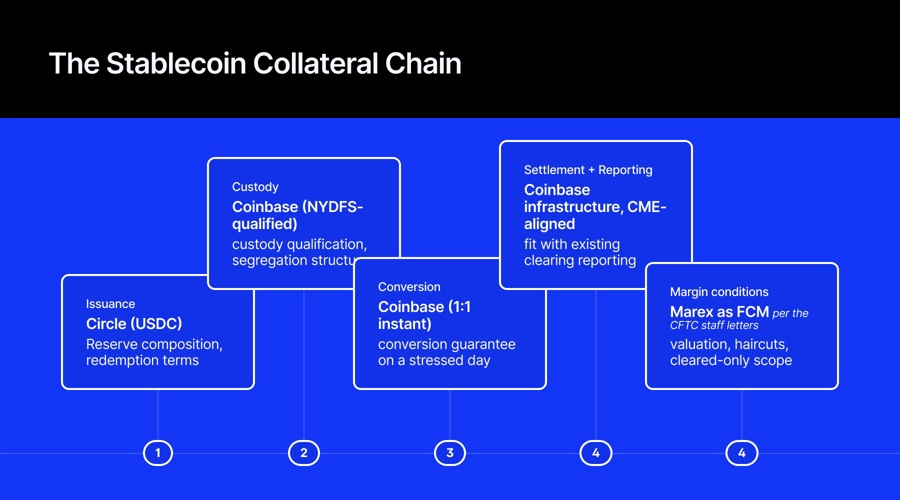
Someone issues the coin (Circle). Someone custodies it to a standard a US regulator recognises and examines (Coinbase, under its NYDFS qualification). Someone guarantees the instant 1:1 conversion path back to dollars (Coinbase again). Someone produces settlement and reporting output that fits existing clearing infrastructure, here aligned to CME requirements.
And the FCM itself (Marex) runs the valuation, haircut and segregation conditions the letters demand. Five functions sit across three firms, with one regulator reading the reports weekly.
10. What does “qualified custody” mean, and why does it matter?
Qualified custody means the assets sit with a custodian supervised and examined under a recognised regulatory regime, in this case New York’s financial regulator, the NYDFS.
For a risk officer, that gives “who holds the crypto” a concrete answer: a named regulator, an examination regime, a legal structure for segregation.
Martin makes the same point in Marex’s release: “The same infrastructure that safeguards assets for the majority of US spot crypto ETFs is now powering collateral workflows in regulated derivatives clearing.”
11. Why does the instant 1:1 conversion guarantee matter so much?
Because a clearing firm cannot wait out a liquidity gap in its own collateral. Margin exists for the day positions move against a client, and on that day the FCM needs dollars, not a token position it still has to sell.
The instant conversion leg is what lets an FCM treat USDC as near-cash rather than as another volatile asset requiring a deep haircut. It also makes the conversion provider a critical counterparty in the chain. If conversion fails under stress, the collateral cannot do its job.
12. Why is nobody in this chain selling the coin itself?
This month’s announcements make the pattern explicit. Coinbase is not the issuer in the Marex workflow; it sells custody, conversion and reporting.
On the same day as the Marex news, Visa launched its Stablecoin Platform, which lets institutions mint, move and manage stablecoins, starting with Open USD, a new coin from Open Standard; the pitch is dual-control approvals, audit logging and allow lists.
“Stablecoins are opening up a new layer of programmable money, but for most institutions the hard part isn’t the concept, it’s the operational reality,” said Jack Forestell, Visa’s Chief Product and Strategy Officer.
Two weeks earlier, on July 2, Standard Chartered became the first G-SIB to offer institutional clients integrated USDC minting and redemption through a single bank onboarding, first from its DIFC operations in Dubai, with clients never opening a Circle account.
Different firm types, same position: sell the controls, not the currency. Circle owns the coin brand; Coinbase, Visa and Standard Chartered are competing to own the layer around it, which is why due diligence belongs on the controls providers, not the issuer.
13. Is this the same as letting clients deposit stablecoins?
No, and this is the distinction to hold onto. Posting stablecoins as margin at an FCM runs under the CFTC letters. Letting clients fund trading accounts with stablecoins is a client-money operation under the broker’s own regulatory regime and banking arrangements, and the letters say nothing about it.
The funding side has its own momentum. Interactive Brokers began letting eligible US clients fund accounts with stablecoins in January 2026, with USDC converting automatically to dollars through Zerohash, and by July had expanded to deposits and withdrawals across USDC, PYUSD and RLUSD, moving outside banking hours.
Fidelity has gone a step further upstream and is preparing its own coin, the Fidelity Digital Dollar, backed by cash and short-term government securities. Same coins, different rulebooks.
14. What does this mean for a broker outside the US?
The read-across is directional, not literal.The infrastructure being normalised in Chicago clearing, the custody-conversion-reporting stack, is close to what a stablecoin deposits-and-withdrawals offering needs. But the regulatory basis has to exist in the broker’s own jurisdiction, and in most jurisdictions it does not yet exist in written form.
For a non-US broker, the practical move now is qualifying the controls providers early and tracking which jurisdictions write the first deposit-side rules, rather than launching ahead of that basis. Treating FCM collateral relief as cover for a client-deposit product is a different regulatory question entirely.
15. What are the risks nobody puts in the press release?
The risks that do not make the press release cluster around dependency rather than the coin itself. The legal basis is staff forbearance, fast to grant and fast to withdraw, so a firm building real operations on it carries that asymmetry on its books.
The stack itself runs through a short list of names, Circle on issuance, Coinbase on custody and conversion, so adopting it means buying dependence on both.
And the firm celebrating a stablecoin rail still needs correspondent banks, some of which still treat crypto-adjacent flows as a reason to ask questions. None of this rules out the model, but none of it disappears either.
16. Would posting USDC actually be cheaper than posting dollars?
Not automatically. The CFTC conditions exist precisely because a stablecoin is not cash, and the valuation and haircut treatment an FCM applies determines the real economics.
A haircut is capital you post but get no credit for, and the conversion round trip is not free. The honest calculation compares the all-in cost of USDC collateral (haircut plus conversion plus operational overhead) against the funding cost of dollars sitting at the FCM.
For firms already holding large USDC treasuries, the answer may well be yes. For a firm that would buy USDC in order to post it, the case is much thinner. Run the number before the memo, not after.
17. What should brokers and prop firms watch next?
The cleanest signal is whether other FCMs replicate the Marex workflow, which could happen quickly if Letter 26-05 holds; a second and third firm would turn one transaction into a standard.
The bigger shift to track is regulatory: a move from staff letter to Commission rulemaking would change the risk calculus more than any product launch.
Issuer credibility is also consolidating on its own timeline, Hong Kong’s Monetary Authority has already begun licensing stablecoin issuers with a deliberately limited first round, and Juniper Research projects B2B stablecoin payments could reach $5 trillion by 2035, from $13.4 billion in 2026.
18. What is the main lesson?
Two questions apply directly to the Marex case and to the FCMs likely to follow it. Is the regulatory basis a rule or a staff letter? A rule survives a change in CFTC leadership; a no-action letter reflects the current staff’s view and nothing more.
And who is the controls counterparty, custodian, conversion provider, reporting vendor, and can that firm be diligenced the way a broker already diligences a PSP or a prime broker?
The issuer’s failure is a market event no counterparty can underwrite. The controls provider’s failure is an operational risk that can actually be assessed, priced and contracted around.
19. Summary: what this means now
A prop firm has posted USDC as margin at a US clearing firm, under CFTC staff forbearance, with Coinbase running custody, conversion and reporting.
The legal ground is real but thin: letters, not rules, cleared trades only, and a three-month supervised window with weekly reports going to the CFTC’s Market Participants Division. Coinbase, Visa and Standard Chartered are now competing on the same layer, custody, conversion, reporting, rather than on the coin itself.
Whether that window narrows to two or three providers, or stays fragmented, is the next data point to watch once the initial three-month reporting period closes.
A prop firm in Chicago just posted margin, and it wasn’t dollars or Treasuries. Prime Trading delivered USDC to Marex as initial-margin collateral for CFTC-regulated cleared derivatives, the first transaction under a program Marex announced on July 16.
The workflow has now run end to end inside the US clearing system, from a customer posting the stablecoin to an FCM funding the position in dollars.
The transaction also raises a broader question: how does stablecoin collateral actually work, who are the key counterparties, and how solid is the regulatory basis?
1. What did Marex actually announce?
Marex Group (Nasdaq: MRX), the clearing and financial services group, said clients can post USDC, the dollar stablecoin issued by Circle, as initial-margin collateral for cleared derivatives regulated by the CFTC.
Per Marex’s own release, Coinbase provides NYDFS-qualified custody, 1:1 instant fiat-to-USDC conversion, and bespoke reporting infrastructure aligned with CME requirements.
Instead of describing stablecoin margin in general terms, the announcement names three specific components: custody, conversion, and CME-aligned reporting.
2. What is an FCM, and why should a CFD broker care?
A futures commission merchant is the US clearing intermediary: it holds customer margin, guarantees its customers’ trades to the clearinghouse, and sits under some of the strictest client-money rules in American finance.
A CFD broker never touches this plumbing directly. But US regulators test collateral innovation at FCMs first, and what gets normalised in FCM margin today has tended to surface in prime brokerage terms, PSP stacks, and client funding conversations a few quarters later.
3. What did the first transaction actually look like?
Prime Trading LLC, a Chicago proprietary trading firm, posted USDC to Marex as margin collateral. Marex then delivered cash to fund the firm’s positions.
“Stablecoin collateral is moving from concept to production,” said Liz Martin, Coinbase’s VP of Markets, in the release.
The two legs stay separate throughout: USDC serves as the collateral asset an FCM may hold against exposure, while the funding itself stays in dollars.
4. What is initial margin, and why does the collateral type matter?
Initial margin is the good-faith deposit posted when a position opens, as distinct from variation margin, the daily settlement of gains and losses.
What an FCM may accept as initial margin is tightly controlled, because collateral is only useful if it holds its value and can be liquidated fast under stress.
Every new collateral type has to answer the same three questions: how is it valued, how quickly does it convert to cash, and who holds it in the meantime. The Marex-Coinbase workflow maps custody, conversion, and reporting onto exactly those three questions for USDC.
5. What is a CFTC no-action letter?
A no-action letter is a written promise from CFTC staff not to recommend enforcement action, as long as a firm meets stated conditions. Think of it as a nod from the building inspector rather than a building permit.
It carries real weight, but it is not a Commission rule.
It skipped notice and comment, and it binds only the staff who signed it. That is why the market got stablecoin collateral in months rather than years, and why the same relief can disappear just as fast, if a future staff takes a different view, with no formal rule change required.
6. What do Letters 25-40 and 26-05 actually say?
CFTC Staff Letter 25-40, issued on December 8, 2025, took the no-action position that FCMs may accept eligible payment stablecoins and other non-securities digital assets from customers as margin, subject to conditions.
The CFTC reissued it as Letter 26-05 on February 6, 2026, expanding the definition of payment stablecoin to include coins issued by qualifying national trust banks. That widens the field of who may issue collateral-eligible coins beyond the firms already doing so.
7. What conditions come attached?
The letters condition the relief on valuation, haircuts, segregation and reporting requirements. The CFTC’s materials describe an initial three-month period.
During this window, participating FCMs may accept only payment stablecoins, bitcoin and ether as digital-asset collateral. They must also file weekly reports on customer digital-asset holdings to the agency’s Market Participants Division. Any firm relying on the letters is filing those reports from day one, not after some grace period.
8. Is this relief limited to cleared trades, or does it cover more?
It cleared trades only. CFTC staff addressed this directly in FAQs issued on March 20, 2026. Crypto assets, including payment stablecoins, remain ineligible as initial or variation margin for uncleared swaps under Regulation 23.156.
The relief is precise: customer margin, at an FCM, for cleared derivatives. It is not a general licence to treat USDC as cash across a business, and any internal memo that extends this framework to other uses is reading further than the letters actually go.
9. Who does what in the stablecoin collateral chain?
Strip the announcement to functions and you get a checklist any operator can reuse.
Someone issues the coin (Circle). Someone custodies it to a standard a US regulator recognises and examines (Coinbase, under its NYDFS qualification). Someone guarantees the instant 1:1 conversion path back to dollars (Coinbase again). Someone produces settlement and reporting output that fits existing clearing infrastructure, here aligned to CME requirements.
And the FCM itself (Marex) runs the valuation, haircut and segregation conditions the letters demand. Five functions sit across three firms, with one regulator reading the reports weekly.
10. What does “qualified custody” mean, and why does it matter?
Qualified custody means the assets sit with a custodian supervised and examined under a recognised regulatory regime, in this case New York’s financial regulator, the NYDFS.
For a risk officer, that gives “who holds the crypto” a concrete answer: a named regulator, an examination regime, a legal structure for segregation.
Martin makes the same point in Marex’s release: “The same infrastructure that safeguards assets for the majority of US spot crypto ETFs is now powering collateral workflows in regulated derivatives clearing.”
11. Why does the instant 1:1 conversion guarantee matter so much?
Because a clearing firm cannot wait out a liquidity gap in its own collateral. Margin exists for the day positions move against a client, and on that day the FCM needs dollars, not a token position it still has to sell.
The instant conversion leg is what lets an FCM treat USDC as near-cash rather than as another volatile asset requiring a deep haircut. It also makes the conversion provider a critical counterparty in the chain. If conversion fails under stress, the collateral cannot do its job.
12. Why is nobody in this chain selling the coin itself?
This month’s announcements make the pattern explicit. Coinbase is not the issuer in the Marex workflow; it sells custody, conversion and reporting.
On the same day as the Marex news, Visa launched its Stablecoin Platform, which lets institutions mint, move and manage stablecoins, starting with Open USD, a new coin from Open Standard; the pitch is dual-control approvals, audit logging and allow lists.
“Stablecoins are opening up a new layer of programmable money, but for most institutions the hard part isn’t the concept, it’s the operational reality,” said Jack Forestell, Visa’s Chief Product and Strategy Officer.
Two weeks earlier, on July 2, Standard Chartered became the first G-SIB to offer institutional clients integrated USDC minting and redemption through a single bank onboarding, first from its DIFC operations in Dubai, with clients never opening a Circle account.
Different firm types, same position: sell the controls, not the currency. Circle owns the coin brand; Coinbase, Visa and Standard Chartered are competing to own the layer around it, which is why due diligence belongs on the controls providers, not the issuer.
13. Is this the same as letting clients deposit stablecoins?
No, and this is the distinction to hold onto. Posting stablecoins as margin at an FCM runs under the CFTC letters. Letting clients fund trading accounts with stablecoins is a client-money operation under the broker’s own regulatory regime and banking arrangements, and the letters say nothing about it.
The funding side has its own momentum. Interactive Brokers began letting eligible US clients fund accounts with stablecoins in January 2026, with USDC converting automatically to dollars through Zerohash, and by July had expanded to deposits and withdrawals across USDC, PYUSD and RLUSD, moving outside banking hours.
Fidelity has gone a step further upstream and is preparing its own coin, the Fidelity Digital Dollar, backed by cash and short-term government securities. Same coins, different rulebooks.
14. What does this mean for a broker outside the US?
The read-across is directional, not literal.The infrastructure being normalised in Chicago clearing, the custody-conversion-reporting stack, is close to what a stablecoin deposits-and-withdrawals offering needs. But the regulatory basis has to exist in the broker’s own jurisdiction, and in most jurisdictions it does not yet exist in written form.
For a non-US broker, the practical move now is qualifying the controls providers early and tracking which jurisdictions write the first deposit-side rules, rather than launching ahead of that basis. Treating FCM collateral relief as cover for a client-deposit product is a different regulatory question entirely.
15. What are the risks nobody puts in the press release?
The risks that do not make the press release cluster around dependency rather than the coin itself. The legal basis is staff forbearance, fast to grant and fast to withdraw, so a firm building real operations on it carries that asymmetry on its books.
The stack itself runs through a short list of names, Circle on issuance, Coinbase on custody and conversion, so adopting it means buying dependence on both.
And the firm celebrating a stablecoin rail still needs correspondent banks, some of which still treat crypto-adjacent flows as a reason to ask questions. None of this rules out the model, but none of it disappears either.
16. Would posting USDC actually be cheaper than posting dollars?
Not automatically. The CFTC conditions exist precisely because a stablecoin is not cash, and the valuation and haircut treatment an FCM applies determines the real economics.
A haircut is capital you post but get no credit for, and the conversion round trip is not free. The honest calculation compares the all-in cost of USDC collateral (haircut plus conversion plus operational overhead) against the funding cost of dollars sitting at the FCM.
For firms already holding large USDC treasuries, the answer may well be yes. For a firm that would buy USDC in order to post it, the case is much thinner. Run the number before the memo, not after.
17. What should brokers and prop firms watch next?
The cleanest signal is whether other FCMs replicate the Marex workflow, which could happen quickly if Letter 26-05 holds; a second and third firm would turn one transaction into a standard.
The bigger shift to track is regulatory: a move from staff letter to Commission rulemaking would change the risk calculus more than any product launch.
Issuer credibility is also consolidating on its own timeline, Hong Kong’s Monetary Authority has already begun licensing stablecoin issuers with a deliberately limited first round, and Juniper Research projects B2B stablecoin payments could reach $5 trillion by 2035, from $13.4 billion in 2026.
18. What is the main lesson?
Two questions apply directly to the Marex case and to the FCMs likely to follow it. Is the regulatory basis a rule or a staff letter? A rule survives a change in CFTC leadership; a no-action letter reflects the current staff’s view and nothing more.
And who is the controls counterparty, custodian, conversion provider, reporting vendor, and can that firm be diligenced the way a broker already diligences a PSP or a prime broker?
The issuer’s failure is a market event no counterparty can underwrite. The controls provider’s failure is an operational risk that can actually be assessed, priced and contracted around.
19. Summary: what this means now
A prop firm has posted USDC as margin at a US clearing firm, under CFTC staff forbearance, with Coinbase running custody, conversion and reporting.
The legal ground is real but thin: letters, not rules, cleared trades only, and a three-month supervised window with weekly reports going to the CFTC’s Market Participants Division. Coinbase, Visa and Standard Chartered are now competing on the same layer, custody, conversion, reporting, rather than on the coin itself.
Whether that window narrows to two or three providers, or stays fragmented, is the next data point to watch once the initial three-month reporting period closes.