Binance, the world’s largest exchange by volume, enters July without EU authorisation. Tether’s USDT has already been delisted across major regulated venues. For the first time, a single regulatory framework covers all 30 EEA states, and most of the old market does not fit inside it.
July 1 Marks the End of Europe’s Transition Period
On July 1, Europe’s crypto market stops running on legacy rules. The grandfathering period built into MiCA expires definitively across all 30 EEA countries.
ESMA confirmed in April that there will be no extensions. Firms that were already operating legally before MiCA came fully into force in December 2024 had up to 18 months to transition.
Some member states shortened that window. Germany ended it in December 2025, the Netherlands a full year before the EU-wide cutoff. July 1 closes the final wave. Those without a licence must either transfer clients to an authorised provider or wind down.
ESMA has been unambiguous that operating without authorisation after the deadline is a breach of EU law, and national regulators in France and the Netherlands have already signalled active enforcement.
Europe’s New Licensed Crypto Market
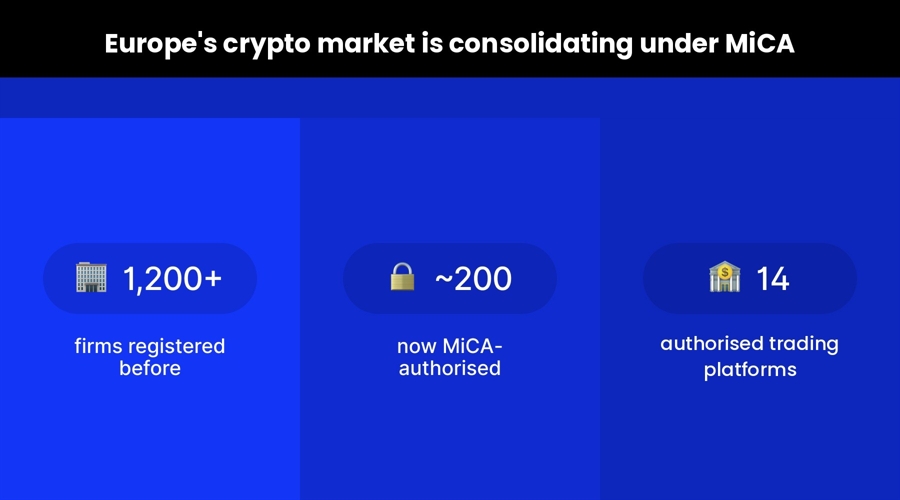
The licensed population runs to around 200 firms, but the exchanges operating at meaningful scale are a much shorter list. By late June, approximately 14 entities held authorisation specifically to operate a trading platform under MiCA – the licence category covering crypto trading venues.
The major names and their regulatory home bases:
ExchangeJurisdictionRegulatorNoteOKXMaltaMFSAFirst major global exchange to receive MiCA authorisation, January 2025Crypto.comMaltaMFSAAlso authorised as EMT issuerCoinbaseLuxembourgCSSFDedicated EU entity (Coinbase Luxembourg S.A.); migrated from Irish structureBitstampLuxembourgCSSFOne of first exchanges to activate EU passportingKrakenIrelandCentral BankMiCA + MiFID II + EMI licenceBybitAustriaFMAEU headquarters in Vienna; 100+ staff committed locallyGeminiMaltaMFSAMiCA + MiFID II — authorised for spot and derivativesBitpandaAustriaFMAFirst MiCA licence in Austria; native EU exchange
Despite the low conversion rate, the licensed platforms already account for an estimated 95% of EU crypto transaction volume, suggesting the market’s centre of gravity was already concentrated before the deadline.
Malta, Luxembourg, and Austria absorbed the majority of major exchange licences. Ireland set a higher bar with no virtual offices, genuine operational presence required. This approach filtered out all but the most committed applicants.
Luxembourg is officially our MiCA home 🇱🇺
We’re looking forward to welcoming users from across the EU to Coinbase. https://t.co/6YiRoJRdJA
— Coinbase 🛡️ (@coinbase) June 24, 2026
The licensed pool also extends beyond crypto natives. BBVA received MiCA authorisation in Spain. Trade Republic and N26 secured German BaFin approvals covering crypto services within their broader platforms. Clearstream and Société Générale–Forge are licensed for institutional asset servicing and stablecoin issuance.
Broker-adjacent fintechs are joining as well: NAGA Group said its CySEC-regulated entity, NAGA X Ltd, received MiCA authorisation on June 24, days before the July 1 cutoff.
The competitive dynamic is already shifting toward the licensed perimeter. OKX is offering EU users migrating from unlicensed platforms a deposit bonus of up to 8%.
The Companies Still Outside the System
Binance is the most consequential unlicensed player. The world’s largest crypto exchange by volume filed its MiCA application with the Hellenic Capital Market Commission in January 2026 through a newly created Greek subsidiary.
In June, Reuters reported that the HCMC was set to reject the application, with separate sources suggesting the ECB had intervened behind the scenes before a formal decision was reached.
On June 21, Binance withdrew the Greek application. The company said Europe remains an important market and expressed confidence in securing a licence “in the coming months.”
Binance is now exploring an application in other European countries, however, no formal submission has been confirmed.
Binance has decided to withdraw its MiCA licence application in Greece and pursue authorisation in another EU Member State.
— Binance (@binance) June 24, 2026
Without a MiCA authorisation, Binance has no clear legal basis to actively serve EU clients. However, as of June 25, the practical consequences of this outcome had not been officially clarified.
The company said it would take steps before July 1 to remain compliant, warned that “some users may be impacted,” and said it remained confident it could secure a MiCA licence “in the coming months.”
In the meantime, we will take the necessary steps before 1 July to remain compliant with applicable requirements. This means some users may be impacted, and we will communicate directly with affected users to provide clear information on next steps.
— Binance (@binance) June 24, 2026
Other major exchanges have said nothing. MEXC, HTX, and Bitfinex have made no public announcements about MiCA applications or exit plans. That absence of communication is itself the answer.
A number of smaller platforms have already acted without announcement, quietly geoblocking EU IP addresses in the weeks before the deadline. In France alone, approximately 90 operators had no MiCA licence as the deadline approached.
For firms that remain outside the regime, the regulatory risk increases sharply after July 1. In France, the AMF has warned that continuing to serve EU customers post-deadline can result in criminal prosecution – up to two years in prison and a €30,000 fine for individuals.
What Will Actually Change for Traders
The most immediate change is likely to be a smaller choice of regulated platforms, and alongside that, a narrower product range on the ones that remain.
For those staying on licensed platforms, the most visible product-level change is stablecoins. USDT is already gone from the major regulated venues. Coinbase, Kraken, Crypto.com, and Binance’s EU entity all delisted it for retail users ahead of the deadline.
Tether has not pursued MiCA authorisation and has no announced plans to do so. The authorised alternatives are USDC and EURC from Circle, plus 18 additional regulated tokens across 14 authorised EMT issuers – 12 euro-denominated, seven dollar-denominated. The choice of regulated stablecoins exists, but it is significantly narrower.
Industry participants say the impact goes beyond token listings. The transition away from USDT will affect payment rails used by brokers, payment providers, and traders across Europe.
Derivatives are a separate issue. MiCA does not cover futures or leveraged products, they fall under MiFID II. Only exchanges holding both a MiCA CASP licence and a MiFID II authorisation can legally offer perpetual futures and leveraged trading to EU retail clients. As of mid-2026, that list is short: Kraken and Gemini are among the few with both.
For most EU retail traders, that effectively limits leveraged crypto trading to a handful of venues. On client protection, MiCA requires asset segregation, formal complaints procedures, and capital requirements – formal guarantees that unlicensed platforms do not provide.
But the risk runs the other way too. Traders unwilling to accept a narrower product range may migrate to offshore exchanges outside MiCA’s reach, where those protections do not apply. It is the same pattern that played out after ESMA’s 2018 CFD intervention, and regulators are aware of it.
Passporting changes how regulated services are delivered across the bloc: a single EU licence now covers all 30 EEA states, meaning a trader in Warsaw or Lisbon accesses the same regulated platform as one in Amsterdam.
What the New Market Will Look Like
The CFD industry offers the closest precedent. After ESMA’s 2018 intervention with leverage caps, binary options ban offshore firms relocated, retail traders partially migrated, and the EU market consolidated around a smaller group of well-capitalised, compliant operators.
The structure of the industry changed permanently. The CFD experience suggests crypto could follow a similar trajectory. Short term: some retail volume migrates to offshore exchanges and DeFi protocols, both of which sit outside MiCA’s scope.
MiCA includes measures intended to limit that outcome, including the explicit prohibition on third-country solicitation and the custody outsourcing ban were designed precisely to close that route. Whether enforcement is effective enough is a different question.
Medium term, the structural shift is already visible in who secured licences. Traditional banks and financial infrastructure firms are now MiCA-authorised alongside the crypto natives.
OKX founder and CEO Star Xu framed the shift in similar terms, arguing that MiCA is not simply a licensing hurdle but a test of whether compliance has real authority inside crypto firms.
That is not incidental. The compliance costs of MiCA – licensing alone runs €500,000 to €2 million, with annual compliance adding €250,000 or more – effectively filter out smaller players and favour firms with existing regulatory infrastructure.
Unlike Banks and large fintechs, most crypto startups do not have that infrastructure. The result is a market that looks increasingly like the rest of regulated European finance: fewer participants, larger average size, more institutional capital, and a competitive dynamic where regulatory access is as important as product quality.
For brokers and institutional players already operating within that framework, that is familiar territory. For the crypto-native firms that built their business on operating outside the regulatory perimeter, July 1 marks a significant narrowing of that space in Europe.
Binance, the world’s largest exchange by volume, enters July without EU authorisation. Tether’s USDT has already been delisted across major regulated venues. For the first time, a single regulatory framework covers all 30 EEA states, and most of the old market does not fit inside it.
July 1 Marks the End of Europe’s Transition Period
On July 1, Europe’s crypto market stops running on legacy rules. The grandfathering period built into MiCA expires definitively across all 30 EEA countries.
ESMA confirmed in April that there will be no extensions. Firms that were already operating legally before MiCA came fully into force in December 2024 had up to 18 months to transition.
Some member states shortened that window. Germany ended it in December 2025, the Netherlands a full year before the EU-wide cutoff. July 1 closes the final wave. Those without a licence must either transfer clients to an authorised provider or wind down.
ESMA has been unambiguous that operating without authorisation after the deadline is a breach of EU law, and national regulators in France and the Netherlands have already signalled active enforcement.
Europe’s New Licensed Crypto Market
The licensed population runs to around 200 firms, but the exchanges operating at meaningful scale are a much shorter list. By late June, approximately 14 entities held authorisation specifically to operate a trading platform under MiCA – the licence category covering crypto trading venues.
The major names and their regulatory home bases:
ExchangeJurisdictionRegulatorNoteOKXMaltaMFSAFirst major global exchange to receive MiCA authorisation, January 2025Crypto.comMaltaMFSAAlso authorised as EMT issuerCoinbaseLuxembourgCSSFDedicated EU entity (Coinbase Luxembourg S.A.); migrated from Irish structureBitstampLuxembourgCSSFOne of first exchanges to activate EU passportingKrakenIrelandCentral BankMiCA + MiFID II + EMI licenceBybitAustriaFMAEU headquarters in Vienna; 100+ staff committed locallyGeminiMaltaMFSAMiCA + MiFID II — authorised for spot and derivativesBitpandaAustriaFMAFirst MiCA licence in Austria; native EU exchange
Despite the low conversion rate, the licensed platforms already account for an estimated 95% of EU crypto transaction volume, suggesting the market’s centre of gravity was already concentrated before the deadline.
Malta, Luxembourg, and Austria absorbed the majority of major exchange licences. Ireland set a higher bar with no virtual offices, genuine operational presence required. This approach filtered out all but the most committed applicants.
Luxembourg is officially our MiCA home 🇱🇺
We’re looking forward to welcoming users from across the EU to Coinbase. https://t.co/6YiRoJRdJA
— Coinbase 🛡️ (@coinbase) June 24, 2026
The licensed pool also extends beyond crypto natives. BBVA received MiCA authorisation in Spain. Trade Republic and N26 secured German BaFin approvals covering crypto services within their broader platforms. Clearstream and Société Générale–Forge are licensed for institutional asset servicing and stablecoin issuance.
Broker-adjacent fintechs are joining as well: NAGA Group said its CySEC-regulated entity, NAGA X Ltd, received MiCA authorisation on June 24, days before the July 1 cutoff.
The competitive dynamic is already shifting toward the licensed perimeter. OKX is offering EU users migrating from unlicensed platforms a deposit bonus of up to 8%.
The Companies Still Outside the System
Binance is the most consequential unlicensed player. The world’s largest crypto exchange by volume filed its MiCA application with the Hellenic Capital Market Commission in January 2026 through a newly created Greek subsidiary.
In June, Reuters reported that the HCMC was set to reject the application, with separate sources suggesting the ECB had intervened behind the scenes before a formal decision was reached.
On June 21, Binance withdrew the Greek application. The company said Europe remains an important market and expressed confidence in securing a licence “in the coming months.”
Binance is now exploring an application in other European countries, however, no formal submission has been confirmed.
Binance has decided to withdraw its MiCA licence application in Greece and pursue authorisation in another EU Member State.
— Binance (@binance) June 24, 2026
Without a MiCA authorisation, Binance has no clear legal basis to actively serve EU clients. However, as of June 25, the practical consequences of this outcome had not been officially clarified.
The company said it would take steps before July 1 to remain compliant, warned that “some users may be impacted,” and said it remained confident it could secure a MiCA licence “in the coming months.”
In the meantime, we will take the necessary steps before 1 July to remain compliant with applicable requirements. This means some users may be impacted, and we will communicate directly with affected users to provide clear information on next steps.
— Binance (@binance) June 24, 2026
Other major exchanges have said nothing. MEXC, HTX, and Bitfinex have made no public announcements about MiCA applications or exit plans. That absence of communication is itself the answer.
A number of smaller platforms have already acted without announcement, quietly geoblocking EU IP addresses in the weeks before the deadline. In France alone, approximately 90 operators had no MiCA licence as the deadline approached.
For firms that remain outside the regime, the regulatory risk increases sharply after July 1. In France, the AMF has warned that continuing to serve EU customers post-deadline can result in criminal prosecution – up to two years in prison and a €30,000 fine for individuals.
What Will Actually Change for Traders
The most immediate change is likely to be a smaller choice of regulated platforms, and alongside that, a narrower product range on the ones that remain.
For those staying on licensed platforms, the most visible product-level change is stablecoins. USDT is already gone from the major regulated venues. Coinbase, Kraken, Crypto.com, and Binance’s EU entity all delisted it for retail users ahead of the deadline.
Tether has not pursued MiCA authorisation and has no announced plans to do so. The authorised alternatives are USDC and EURC from Circle, plus 18 additional regulated tokens across 14 authorised EMT issuers – 12 euro-denominated, seven dollar-denominated. The choice of regulated stablecoins exists, but it is significantly narrower.
Industry participants say the impact goes beyond token listings. The transition away from USDT will affect payment rails used by brokers, payment providers, and traders across Europe.
Derivatives are a separate issue. MiCA does not cover futures or leveraged products, they fall under MiFID II. Only exchanges holding both a MiCA CASP licence and a MiFID II authorisation can legally offer perpetual futures and leveraged trading to EU retail clients. As of mid-2026, that list is short: Kraken and Gemini are among the few with both.
For most EU retail traders, that effectively limits leveraged crypto trading to a handful of venues. On client protection, MiCA requires asset segregation, formal complaints procedures, and capital requirements – formal guarantees that unlicensed platforms do not provide.
But the risk runs the other way too. Traders unwilling to accept a narrower product range may migrate to offshore exchanges outside MiCA’s reach, where those protections do not apply. It is the same pattern that played out after ESMA’s 2018 CFD intervention, and regulators are aware of it.
Passporting changes how regulated services are delivered across the bloc: a single EU licence now covers all 30 EEA states, meaning a trader in Warsaw or Lisbon accesses the same regulated platform as one in Amsterdam.
What the New Market Will Look Like
The CFD industry offers the closest precedent. After ESMA’s 2018 intervention with leverage caps, binary options ban offshore firms relocated, retail traders partially migrated, and the EU market consolidated around a smaller group of well-capitalised, compliant operators.
The structure of the industry changed permanently. The CFD experience suggests crypto could follow a similar trajectory. Short term: some retail volume migrates to offshore exchanges and DeFi protocols, both of which sit outside MiCA’s scope.
MiCA includes measures intended to limit that outcome, including the explicit prohibition on third-country solicitation and the custody outsourcing ban were designed precisely to close that route. Whether enforcement is effective enough is a different question.
Medium term, the structural shift is already visible in who secured licences. Traditional banks and financial infrastructure firms are now MiCA-authorised alongside the crypto natives.
OKX founder and CEO Star Xu framed the shift in similar terms, arguing that MiCA is not simply a licensing hurdle but a test of whether compliance has real authority inside crypto firms.
That is not incidental. The compliance costs of MiCA – licensing alone runs €500,000 to €2 million, with annual compliance adding €250,000 or more – effectively filter out smaller players and favour firms with existing regulatory infrastructure.
Unlike Banks and large fintechs, most crypto startups do not have that infrastructure. The result is a market that looks increasingly like the rest of regulated European finance: fewer participants, larger average size, more institutional capital, and a competitive dynamic where regulatory access is as important as product quality.
For brokers and institutional players already operating within that framework, that is familiar territory. For the crypto-native firms that built their business on operating outside the regulatory perimeter, July 1 marks a significant narrowing of that space in Europe.