No Result
View All Result
SUBMIT YOUR ARTICLES
  • Login
Friday, April 17, 2026
TheAdviserMagazine.com
  • Home
  • Financial Planning
    • Financial Planning
    • Personal Finance
  • Market Research
    • Business
    • Investing
    • Money
    • Economy
    • Markets
    • Stocks
    • Trading
  • 401k Plans
  • College
  • IRS & Taxes
  • Estate Plans
  • Social Security
  • Medicare
  • Legal
  • Home
  • Financial Planning
    • Financial Planning
    • Personal Finance
  • Market Research
    • Business
    • Investing
    • Money
    • Economy
    • Markets
    • Stocks
    • Trading
  • 401k Plans
  • College
  • IRS & Taxes
  • Estate Plans
  • Social Security
  • Medicare
  • Legal
No Result
View All Result
TheAdviserMagazine.com
No Result
View All Result
Home Market Research Cryptocurrency

Crypto Built More Rails, but the Next Battle Is Over How Much Work One Dollar Can Do

by TheAdviserMagazine
1 week ago
in Cryptocurrency
Reading Time: 13 mins read
A A
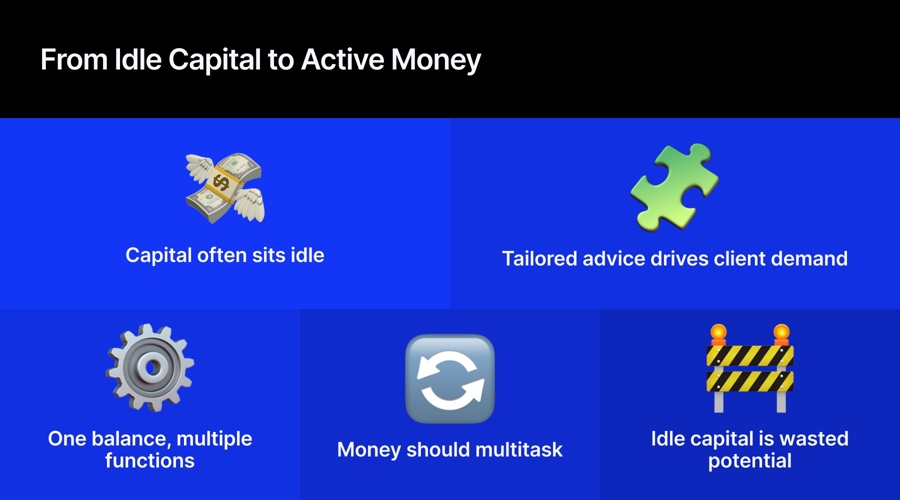
Crypto Built More Rails, but the Next Battle Is Over How Much Work One Dollar Can Do
Share on FacebookShare on TwitterShare on LInkedIn


Most people think the
problem with modern finance comes down to fees, spreads, and slow transfers.
Those are real, but the deeper issue feels quieter.

Your money spends a lot of its life doing one job at a time.

Singapore
Summit: Meet the largest APAC brokers you know (and those you still don’t!).

A balance sits in a wallet waiting for the next move. Collateral sits on an
exchange waiting for a trade. Cash sits in a bank account waiting for a
bill. Even when you chase yield, the money often gets boxed into a single lane,
earning, or collateral, or investment capital.

Every time you move it, you pay in friction. Sometimes that friction looks like
an on-chain fee. Sometimes it looks like opportunity cost. Either way, it acts
like a tax on productivity. Capital that could be doing more gets stuck in
transit, locked up, duplicated across platforms, or simply idle.

Crypto promised to unbundle finance into smarter building blocks. In practice,
many users ended up with a longer checklist. Receive funds here. Bridge there.
Park stablecoins
somewhere else. Keep separate margin on an exchange. Keep long-term holdings in
a different wallet. Track it all in spreadsheets, or just stop tracking and
hope the stack grows.

That journey drains attention as much as it drains value.

When people talk about progress in finance, they often mean capital utility.
More assets, more products, more venues, more chains. Utility matters, and it
expands what people can do.

Productivity matters more. Productivity means one unit of capital doing
multiple jobs at once.
Picture a single, programmable balance that can earn a base yield
Yield

A yield is defined as the earnings generated by an investment or security over a particular time period. This is in typically displayed in percentage terms and is in the form of interest or dividends received from it.Yields do not include the price variations, which differentiates it from the total return. As such, a yield applies to various stated rates of return on stocks, fixed income instruments such as bonds, and other types of investment products.Yields can be calculated as a ratio or as a

A yield is defined as the earnings generated by an investment or security over a particular time period. This is in typically displayed in percentage terms and is in the form of interest or dividends received from it.Yields do not include the price variations, which differentiates it from the total return. As such, a yield applies to various stated rates of return on stocks, fixed income instruments such as bonds, and other types of investment products.Yields can be calculated as a ratio or as a
Read this Term
while also
supporting trading activity and maintaining exposure to a longer-term position.
The same dollar stays active across uses instead of being chopped into separate
piles.

That changes the user’s experience from “choose a lane” to “keep moving without
losing momentum.” It also changes platform competition. A platform that helps
capital do more with fewer moves gives the user a compounding edge. Small
advantages stack up: less collateral sitting dead, fewer transfers, fewer
moments where funds sit waiting for the next step.

Today’s
typical lifecycle still looks like a relay race.

Receive. Hold. Earn. Trade. Invest. Transfer. Spend.

Each leg often means a different app, a different protocol, a different
account, a different set of rules. Users end up duplicating balances to stay
flexible, leaving one pile for yield, another for margin, another for long-term
holdings. The result feels safe, but it carries drag.

A more productive lifecycle feels like a loop instead of a line. Funds arrive
and stay active. Money earns while it waits. Collateral earns while it backs
risk. Transfers
feel like moving a live balance, not pausing everything to pick the money up
and carry it somewhere else.

The phrase “money should work harder” gets used a lot. Here, it has a very
specific meaning: money should keep its optionality while it earns.

Who
Demands This, And Why It Matters

Two groups push this idea forward, and they do it for different reasons.
First come the active traders. Professionals, quants, and sophisticated
on-chain operators tend to follow efficiency, not branding. They care about
execution quality, liquidity
Liquidity

The term liquidity refers to the process, speed, and ease of which a given asset or security can be converted into cash. Notably, liquidity surmises a retention in market price, with the most liquid assets representing cash.The most liquid asset of all is cash itself.· In economics, liquidity is defined by how efficiently and quickly an asset can be converted into usable cash without materially affecting its market price. · Nothing is more liquid than cash, while other assets represent

The term liquidity refers to the process, speed, and ease of which a given asset or security can be converted into cash. Notably, liquidity surmises a retention in market price, with the most liquid assets representing cash.The most liquid asset of all is cash itself.· In economics, liquidity is defined by how efficiently and quickly an asset can be converted into usable cash without materially affecting its market price. · Nothing is more liquid than cash, while other assets represent
Read this Term
, borrow costs, and capital efficiency. They
pressure-test the rails. They turn platform mechanics into real volume. Their
behavior exposes weak points fast.

A margin system that wastes less capital becomes a meaningful draw, especially
when markets turn volatile and the cost of idle collateral becomes painfully
obvious.

Then come the crypto-native capital holders. This
group already lives on-chain, but they have limited patience for complexity.
They hold real positions and want simple wealth management: earning yield,
maintaining exposure, spending when needed, staying inside one ecosystem
without juggling six dashboards.

These users bring assets under management, steady balances, and the kind of
network effects that make a financial product feel like infrastructure. They
also bring everyday expectations: receiving money should feel easy, earning
should feel automatic, spending should feel normal.

DeFi has incredible infrastructure, but the user experience still slows adoption.

With Amadeus, agents live directly inside a platform’s UI, helping users interact with DeFi in real time, without leaving the product.

A shift from tools you operate → to agents that operate for… pic.twitter.com/h9OcsjEbJE

— Amadeus Protocol (@amadeusprotocol) April 7, 2026

The sequence is important since more traders will engage when the system
rewards efficiency. Their volume helps mature the system. Capital holders
arrive when the system feels legible and reliable. Their balances deepen liquidity and reinforce
the same efficiency traders came for in the first place.
That loop creates a flywheel: volume supports better markets, better markets
support better yield and borrowing terms, better terms attract more users, more
users deepen the system again.

The Next Decade Belongs to
Productive Capital

Finance keeps adding instruments. Crypto keeps adding rails. The more
interesting question sits underneath: how much work can one unit of capital do
before the user has to touch it?

The winners will be the platforms and protocols that treat idle money as a
design failure. They will build systems where capital stays active across
earning, trading, investing, transferring, and spending, with fewer forced
pauses between each action.

A future where money keeps moving and keeps earning will feel quietly obvious
once it arrives. The hard part sits in the architecture, getting the
incentives, risk controls, and user experience aligned so productivity becomes
the default behavior of capital.

When that happens, “Where do I put my money?” becomes “Which system helps my
money stay useful every minute it exists?”

Finance is shifting from
fragmented, idle capital to systems where money stays active, multitasks, and
generates value without constant movement.
Most people think the
problem with modern finance comes down to fees, spreads, and slow transfers.
Those are real, but the deeper issue feels quieter.

Your money spends a lot of its life doing one job at a time.

Singapore
Summit: Meet the largest APAC brokers you know (and those you still don’t!).

A balance sits in a wallet waiting for the next move. Collateral sits on an
exchange waiting for a trade. Cash sits in a bank account waiting for a
bill. Even when you chase yield, the money often gets boxed into a single lane,
earning, or collateral, or investment capital.

Every time you move it, you pay in friction. Sometimes that friction looks like
an on-chain fee. Sometimes it looks like opportunity cost. Either way, it acts
like a tax on productivity. Capital that could be doing more gets stuck in
transit, locked up, duplicated across platforms, or simply idle.

Crypto promised to unbundle finance into smarter building blocks. In practice,
many users ended up with a longer checklist. Receive funds here. Bridge there.
Park stablecoins
somewhere else. Keep separate margin on an exchange. Keep long-term holdings in
a different wallet. Track it all in spreadsheets, or just stop tracking and
hope the stack grows.

That journey drains attention as much as it drains value.

When people talk about progress in finance, they often mean capital utility.
More assets, more products, more venues, more chains. Utility matters, and it
expands what people can do.

Productivity matters more. Productivity means one unit of capital doing
multiple jobs at once.
Picture a single, programmable balance that can earn a base yield
Yield

A yield is defined as the earnings generated by an investment or security over a particular time period. This is in typically displayed in percentage terms and is in the form of interest or dividends received from it.Yields do not include the price variations, which differentiates it from the total return. As such, a yield applies to various stated rates of return on stocks, fixed income instruments such as bonds, and other types of investment products.Yields can be calculated as a ratio or as a

A yield is defined as the earnings generated by an investment or security over a particular time period. This is in typically displayed in percentage terms and is in the form of interest or dividends received from it.Yields do not include the price variations, which differentiates it from the total return. As such, a yield applies to various stated rates of return on stocks, fixed income instruments such as bonds, and other types of investment products.Yields can be calculated as a ratio or as a
Read this Term
while also
supporting trading activity and maintaining exposure to a longer-term position.
The same dollar stays active across uses instead of being chopped into separate
piles.

That changes the user’s experience from “choose a lane” to “keep moving without
losing momentum.” It also changes platform competition. A platform that helps
capital do more with fewer moves gives the user a compounding edge. Small
advantages stack up: less collateral sitting dead, fewer transfers, fewer
moments where funds sit waiting for the next step.

Today’s
typical lifecycle still looks like a relay race.

Receive. Hold. Earn. Trade. Invest. Transfer. Spend.

Each leg often means a different app, a different protocol, a different
account, a different set of rules. Users end up duplicating balances to stay
flexible, leaving one pile for yield, another for margin, another for long-term
holdings. The result feels safe, but it carries drag.

A more productive lifecycle feels like a loop instead of a line. Funds arrive
and stay active. Money earns while it waits. Collateral earns while it backs
risk. Transfers
feel like moving a live balance, not pausing everything to pick the money up
and carry it somewhere else.

The phrase “money should work harder” gets used a lot. Here, it has a very
specific meaning: money should keep its optionality while it earns.

Who
Demands This, And Why It Matters

Two groups push this idea forward, and they do it for different reasons.
First come the active traders. Professionals, quants, and sophisticated
on-chain operators tend to follow efficiency, not branding. They care about
execution quality, liquidity
Liquidity

The term liquidity refers to the process, speed, and ease of which a given asset or security can be converted into cash. Notably, liquidity surmises a retention in market price, with the most liquid assets representing cash.The most liquid asset of all is cash itself.· In economics, liquidity is defined by how efficiently and quickly an asset can be converted into usable cash without materially affecting its market price. · Nothing is more liquid than cash, while other assets represent

The term liquidity refers to the process, speed, and ease of which a given asset or security can be converted into cash. Notably, liquidity surmises a retention in market price, with the most liquid assets representing cash.The most liquid asset of all is cash itself.· In economics, liquidity is defined by how efficiently and quickly an asset can be converted into usable cash without materially affecting its market price. · Nothing is more liquid than cash, while other assets represent
Read this Term
, borrow costs, and capital efficiency. They
pressure-test the rails. They turn platform mechanics into real volume. Their
behavior exposes weak points fast.

A margin system that wastes less capital becomes a meaningful draw, especially
when markets turn volatile and the cost of idle collateral becomes painfully
obvious.

Then come the crypto-native capital holders. This
group already lives on-chain, but they have limited patience for complexity.
They hold real positions and want simple wealth management: earning yield,
maintaining exposure, spending when needed, staying inside one ecosystem
without juggling six dashboards.

These users bring assets under management, steady balances, and the kind of
network effects that make a financial product feel like infrastructure. They
also bring everyday expectations: receiving money should feel easy, earning
should feel automatic, spending should feel normal.

DeFi has incredible infrastructure, but the user experience still slows adoption.

With Amadeus, agents live directly inside a platform’s UI, helping users interact with DeFi in real time, without leaving the product.

A shift from tools you operate → to agents that operate for… pic.twitter.com/h9OcsjEbJE

— Amadeus Protocol (@amadeusprotocol) April 7, 2026

The sequence is important since more traders will engage when the system
rewards efficiency. Their volume helps mature the system. Capital holders
arrive when the system feels legible and reliable. Their balances deepen liquidity and reinforce
the same efficiency traders came for in the first place.
That loop creates a flywheel: volume supports better markets, better markets
support better yield and borrowing terms, better terms attract more users, more
users deepen the system again.

The Next Decade Belongs to
Productive Capital

Finance keeps adding instruments. Crypto keeps adding rails. The more
interesting question sits underneath: how much work can one unit of capital do
before the user has to touch it?

The winners will be the platforms and protocols that treat idle money as a
design failure. They will build systems where capital stays active across
earning, trading, investing, transferring, and spending, with fewer forced
pauses between each action.

A future where money keeps moving and keeps earning will feel quietly obvious
once it arrives. The hard part sits in the architecture, getting the
incentives, risk controls, and user experience aligned so productivity becomes
the default behavior of capital.

When that happens, “Where do I put my money?” becomes “Which system helps my
money stay useful every minute it exists?”

Finance is shifting from
fragmented, idle capital to systems where money stays active, multitasks, and
generates value without constant movement.





Source link

Tags: battleBuiltCryptodollarrailswork
ShareTweetShare
Previous Post

Fintech platforms outpace bank brokerages in new survey

Next Post

Is Strait of Hormuz Still Closed Post US-Iran Ceasefire?

Related Posts

edit post
TRX Listing Launches on Binance.US, Advancing U.S. Market Access to TRON

TRX Listing Launches on Binance.US, Advancing U.S. Market Access to TRON

by TheAdviserMagazine
April 17, 2026
0

PRESS RELEASE. Geneva, Switzerland — April 17, 2026 — TRON DAO, the community-governed DAO dedicated to accelerating the decentralization of...

edit post
Record Stocks Highs And Cooling Volatility Spark K Bitcoin Price Target

Record Stocks Highs And Cooling Volatility Spark $88K Bitcoin Price Target

by TheAdviserMagazine
April 17, 2026
0

Bitcoin (BTC) refreshed February highs on Friday as attention focused on the upcoming weekly close and a longer-term rally to...

edit post
Trump signals potential concessions in Iran talks

Trump signals potential concessions in Iran talks

by TheAdviserMagazine
April 17, 2026
0

A senior Gulf official says Trump is signaling potential concessions in Iran talks. The probability of Trump agreeing to Iranian...

edit post
Bitcoin Recovery Fails To Lift Sentiment From Extreme Fear

Bitcoin Recovery Fails To Lift Sentiment From Extreme Fear

by TheAdviserMagazine
April 17, 2026
0

Trusted Editorial content, reviewed by leading industry experts and seasoned editors. Ad Disclosure Data shows the crypto Fear & Greed...

edit post
XRP News: XRPL Validators Vote On New Lending Protocol Update

XRP News: XRPL Validators Vote On New Lending Protocol Update

by TheAdviserMagazine
April 16, 2026
0

Ripple-backed XRP Ledger validators are moving to vote on two new amendments, XLS-65 and XLS-66, leading to XRP news headlines....

edit post
Major Bitcoin Miners Flood Market With BTC to Stay Solvent Amid Rising Costs

Major Bitcoin Miners Flood Market With BTC to Stay Solvent Amid Rising Costs

by TheAdviserMagazine
April 16, 2026
0

Opening-Up eWallets’ Future: The Enduring Value of eWallets in the Trading Space ︳FM Talks x Paysafe Opening-Up eWallets’ Future: The...

Next Post
edit post
Is Strait of Hormuz Still Closed Post US-Iran Ceasefire?

Is Strait of Hormuz Still Closed Post US-Iran Ceasefire?

edit post
Europe MEGC Market: Trends, Drivers, and Competitive Landscape

Europe MEGC Market: Trends, Drivers, and Competitive Landscape

  • Trending
  • Comments
  • Latest
edit post
Massachusetts loses billions in income after millionaire tax

Massachusetts loses billions in income after millionaire tax

March 24, 2026
edit post
Illinois’ Paid Leave for All Workers Act Takes Effect — Every Employee Now Gets Guaranteed Time Off

Illinois’ Paid Leave for All Workers Act Takes Effect — Every Employee Now Gets Guaranteed Time Off

March 27, 2026
edit post
Virginia Permits ADULT MIGRANT MEN To Attend High School

Virginia Permits ADULT MIGRANT MEN To Attend High School

March 30, 2026
edit post
A 58-year-old left NYC for Miami to save on taxes — then retired early thanks to hidden savings. Here’s the math

A 58-year-old left NYC for Miami to save on taxes — then retired early thanks to hidden savings. Here’s the math

March 30, 2026
edit post
Tax Flight Accelerates In Massachusetts

Tax Flight Accelerates In Massachusetts

April 6, 2026
edit post
Property Tax Relief & Income Tax Relief

Property Tax Relief & Income Tax Relief

April 1, 2026
edit post
Cavco Industries Jumps 7.1% Amid Sector-Wide Rally

Cavco Industries Jumps 7.1% Amid Sector-Wide Rally

0
edit post
EU Windfall Profits Taxes on Oil and Gas

EU Windfall Profits Taxes on Oil and Gas

0
edit post
Gold rises to one-month high as Strait of Hormuz called ‘completely open’ (GLD:NYSEARCA)

Gold rises to one-month high as Strait of Hormuz called ‘completely open’ (GLD:NYSEARCA)

0
edit post
Always Ask These 5 Questions Before You Trust Your Lab Results

Always Ask These 5 Questions Before You Trust Your Lab Results

0
edit post
Day Trading as a Career

Day Trading as a Career

0
edit post
White House chief of staff to meet with Anthropic CEO about dangerous new Mythos model, official says

White House chief of staff to meet with Anthropic CEO about dangerous new Mythos model, official says

0
edit post
Gold rises to one-month high as Strait of Hormuz called ‘completely open’ (GLD:NYSEARCA)

Gold rises to one-month high as Strait of Hormuz called ‘completely open’ (GLD:NYSEARCA)

April 17, 2026
edit post
Always Ask These 5 Questions Before You Trust Your Lab Results

Always Ask These 5 Questions Before You Trust Your Lab Results

April 17, 2026
edit post
White House chief of staff to meet with Anthropic CEO about dangerous new Mythos model, official says

White House chief of staff to meet with Anthropic CEO about dangerous new Mythos model, official says

April 17, 2026
edit post
Are You Human? New Tool Aims to Help Prove You’re Not AI

Are You Human? New Tool Aims to Help Prove You’re Not AI

April 17, 2026
edit post
Cavco Industries Jumps 7.1% Amid Sector-Wide Rally

Cavco Industries Jumps 7.1% Amid Sector-Wide Rally

April 17, 2026
edit post
TRX Listing Launches on Binance.US, Advancing U.S. Market Access to TRON

TRX Listing Launches on Binance.US, Advancing U.S. Market Access to TRON

April 17, 2026
The Adviser Magazine

The first and only national digital and print magazine that connects individuals, families, and businesses to Fee-Only financial advisers, accountants, attorneys and college guidance counselors.

CATEGORIES

  • 401k Plans
  • Business
  • College
  • Cryptocurrency
  • Economy
  • Estate Plans
  • Financial Planning
  • Investing
  • IRS & Taxes
  • Legal
  • Market Analysis
  • Markets
  • Medicare
  • Money
  • Personal Finance
  • Social Security
  • Startups
  • Stock Market
  • Trading

LATEST UPDATES

  • Gold rises to one-month high as Strait of Hormuz called ‘completely open’ (GLD:NYSEARCA)
  • Always Ask These 5 Questions Before You Trust Your Lab Results
  • White House chief of staff to meet with Anthropic CEO about dangerous new Mythos model, official says
  • Our Great Privacy Policy
  • Terms of Use, Legal Notices & Disclosures
  • Contact us
  • About Us

© Copyright 2024 All Rights Reserved
See articles for original source and related links to external sites.

Welcome Back!

Login to your account below

Forgotten Password?

Retrieve your password

Please enter your username or email address to reset your password.

Log In
No Result
View All Result
  • Home
  • Financial Planning
    • Financial Planning
    • Personal Finance
  • Market Research
    • Business
    • Investing
    • Money
    • Economy
    • Markets
    • Stocks
    • Trading
  • 401k Plans
  • College
  • IRS & Taxes
  • Estate Plans
  • Social Security
  • Medicare
  • Legal

© Copyright 2024 All Rights Reserved
See articles for original source and related links to external sites.