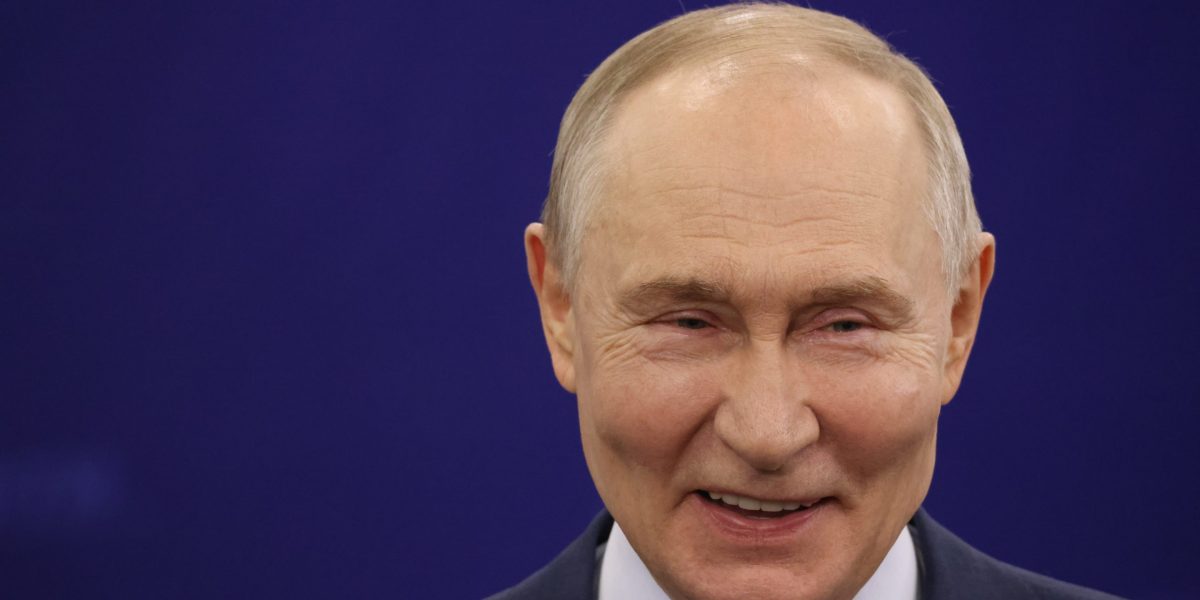
The war in Iran is spiking global oil prices, and Russian President Vladimir Putin couldn’t be happier.
The war has bottled up one-fifth of the world’s oil, putting a premium on the remaining supply, including Russian barrels.
Earlier this month, the U.S. issued a 30-day waiver that allows countries to buy Russian oil already at sea without the fear of sanctions, which the U.S. has steadily imposed on the country and those that buy oil from its largest producers since its full-scale invasion of Ukraine in 2022.
Treasury Secretary Scott Bessent has said the “deliberately short-term measure will not provide significant financial benefit to the Russian government.” But after years of big discounts and covert tactics to sell their oil abroad, the easing of Russian sanctions has already given Putin and other Russian officials new confidence, as well as hope that this U.S. leniency will last longer than its April 11 expiration date.
Prior to the Iran conflict, the Urals oil benchmark, on which most Russian crude is priced, stood at about $57 a barrel, a significant discount to Brent crude at $71 prior to the conflict. By Monday, Urals was trading at near parity to Brent at around $100, despite retreating by midday.
To be sure, Brent crude fell sharply on Monday, after President Donald Trump said he would postpone attacks on energy infrastructure as his officials negotiate with Iran on a way to end the war. Tehran denied it was in talks.
Still, Russia has earned an estimated $7 billion in the first two weeks of March from selling fossil fuels since the start of the war, according to a Guardian analysis of data from the Centre for Research on Energy and Clean Air (CREA).
The increase in oil has made Russia “the single biggest winners in the near term” from the Iran conflict, Wichita State University international business professor Usha Haley told Fortune.
Despite Bessent saying the 30-day waiver is “narrowly tailored” to oil already at sea, she said this caveat is hard to enforce in reality, especially given the large demand at the moment.
“It has actually rescued Russia’s oil revenues from decline and a decline over a very long period,” Haley said.
Four years after Russia invaded Ukraine, its fossil fuel exports, including coal, crude oil, liquified natural gas, pipeline gas, and oil products are 27% below pre-invasion levels, according to the CREA. As of February, the country’s fossil fuel exports had fallen 19% year on year, although the recent increase in demand due to the Iran war is likely to change that calculus, said Haley.
Putin intends to take advantage of the sudden opportunity while he can. The Russian president said during a Kremlin meeting with policymakers and Russian business leaders earlier this month it’s “important for Russian energy companies to make use of the current moment.”
He also appeared to troll his adversaries, saying Russia was ready to work with European countries as long as they are committed to “long-term cooperation” and are willing to drop “political overtones.”
Moscow’s special economic envoy, Kirill Dmitriev, went even further in a Telegram message earlier this month, saying “The U.S. has practically admitted the obvious,” with its 30-day waiver, the Washington Post reported. “The global energy market cannot remain stable without Russian oil.”
In more recent days, Dmitriev has continued to gloat on social media, lambasting the EU for distancing itself from Russia since its 2022 Ukraine invasion and predicting more pain for Western countries as a result of increased oil prices.
“Europe can finally enjoy the success of both its Green and Russophobic agendas—no oil, no gas,” he wrote in a post on X Sunday.
The Iran conflict, which is now in its fourth week, has led to a destabilization in the global oil supply due to Iran’s attacks on ships in the Strait of Hormuz, through which 20% of the world’s oil flows. As a result, the U.S. has taken steps to backstop supply including releasing 172 million barrels of oil from the strategic petroleum reserve—the second largest drawdown ever.
The U.S. last week also issued a 30-day waiver running through April 19 that would allow countries to purchase Iranian oil already loaded onto vessels. Bessent said in a post on X the move would bring 140 million barrels of oil to global markets.
However, the U.S’s easing of sanctions to try to bring stability to oil markets has been criticized by some as being ineffective for solving the global oil crisis.
Analysts at financial services firm Siebert Williams Shank, wrote in a report earlier this month that easing sanctions would not increase the supply of oil worldwide because much of this sanctioned supply already finds its way to the market by clandestine means.
“Sanctions have not materially impacted Russian production, only the price and markets they sell to, so they possess little incremental supply,” wrote the analysts.
Ukrainian President Volodymyr Zelenskyy, whose country has been locked in a full-scale war with Russia since 2022, has also said the move will embolden Putin.
“It spends the money from energy sales on weapons, and all of this is then used against us,” he said in a news conference with French President Emmanuel Macron earlier this month.