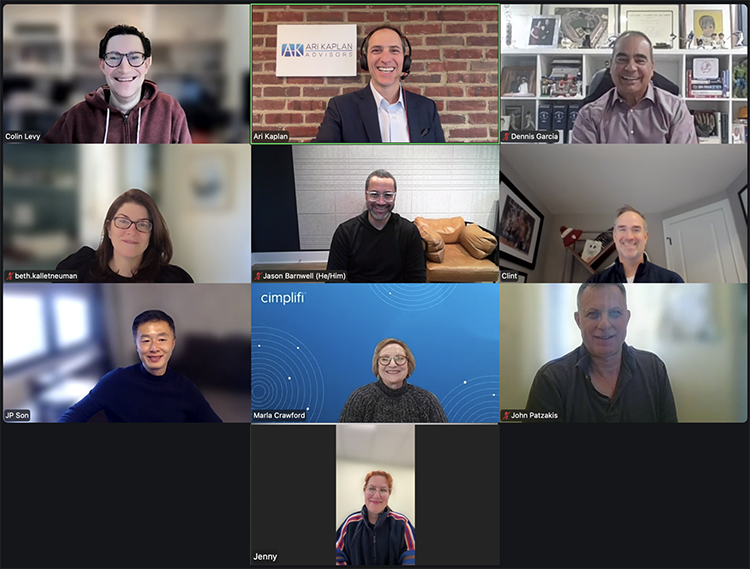
Legal industry analyst Ari Kaplan hosted his inaugural Ari Kaplan Advisors Legal Tech GC/CLO Roundtable to reflect on the legal industry in 2025 and discuss key challenges, trends and opportunities likely to affect strategic priorities in 2026.
Ari Kaplan: Welcome to the inaugural legal tech general counsel roundtable. For many years, I have focused on developments in legal technology and provided research for the annual general counsel report produced by Relativity and FTI. I thought convening a discussion among leading GCs and CLOs at legal technology companies could yield insights that benefit our entire community.
Beth Kallet-Neuman: I am Beth Kallet-Neuman from Relativity.
Marla Crawford: I’m Marla Crawford from Cimplifi.
Dennis Garcia: My name is Dennis Garcia. I’m a vice president and general counsel for Litera, based in Chicago.
Clint Crosier: My name is Clint Crosier, the general counsel of iManage.
JP Son: JP Son, I’m at Verbit based in New York.
John Patzakis: John Patzakis, CLO at X1.
Colin Levy: Colin Levy, general counsel of Malbek.
Jason Barnwell: Jason Barnwell, CLO at Agiloft.
Jenny Hamilton: I’m Jenny Hamilton. I’m the GC at Exterro.
Ari Kaplan: Is there something unique about being the general counsel of a legal technology company?
Colin Levy: I think there is because when you’re the GC of a legal tech company, legal becomes intertwined with so many other facets of the company, from development and product to governance and data privacy regulation. It’s a lot of different areas that converge. And while I think this is not necessarily isolated to legal tech, I do think legal tech is, in some ways, uniquely positioned to encounter these types of issues, particularly given how fast legal tech tends to move and how much faster it can move when things like AI become ever-present.
Dennis Garcia: Being part of a legal tech company, I find that my business clients, who are lawyers, law firms and corporate legal departments, have a deep appreciation for what lawyers do and the value we provide. I’ve also seen instances where, as a legal tech company, our clients are lawyers. They may not be practicing lawyers, but they hopefully have a healthy respect for what lawyers do. But by the same token, lawyers may not be the easiest clients, so that’s an interesting dynamic. Being a GC at a legal tech company gives us a real opportunity to serve as ambassadors for our companies. Our team has been using Litera’s products. We’re becoming power users of our solutions, and I want to evangelize to other corporate, in-house legal teams about how we’re using them and hopefully engage in business development on behalf of Litera.
Jason Barnwell: It is important for us to showcase what we make and serve as ambassadors but to truly demonstrate the highest expression of the value our products create for our customers. Like Dennis, I’m going to figure out how to run Agiloft legal on Agiloft, and I’m going to tell stories and show the recipes. I’m going to give away as much as I can, and in that process, hopefully earn a little attention from the market. That attention can then influence the product roadmap, bending it closer to the highest-value customer scenarios that are out there, so that we can keep delivering more value to our customers and ultimately turn that into a very virtuous cycle where we’re learning faster the kinds of problems we can go after with what we make and turn that into solutions that are valuable for customers, so they feel good about being our customers.
Marla Crawford: Being a general counsel at a legal technology company is a unique experience because how many general counsels are as familiar with the product their company sells as users are? I was one of the first e-discovery lawyers. My career has been in legal technology, and it was a natural progression to become the GC of a legal technology company. It allowed me to get started a lot faster.
Beth Kallet-Neuman: What’s interesting is having that unique insight into your customer persona. You really understand how they think and what they want. When it comes to product development, you can quickly identify gaps, and you can quickly see potential for other use cases. You really get into your customer’s mind. At other tech companies, you might not feel as comfortable being in the mind of the customer because it’s different to understand that legal persona and how we think.
John Patzakis: The great thing about being a CLO at a legal tech company is that you also wear an operating hat. On the product side, I get dragged into key product development meetings. The sales team, especially on the high end, wants to bring me in to speak with the lawyers on the other side who are looking to procure a solution, so I feel like I’m a dual executive, which is great. The one thing on the more stress-related side is that I have seen courts hold legal tech companies to a higher standard for discovery. So it’s something to be aware of if you get involved in litigation.
JP Son: As a general counsel or chief legal officer at any company, you’re going to have a very wide view of what’s going on. You’re there to connect the dots for your colleagues and management in general. That’s heightened even more at a legal tech company. You end up being not just the issue spotter for legal compliance but also the operator’s hat, drawing on your connections in the business and the industry. Even just using the legal tech tools and understanding where they are, you can give guidance that’s unique to your product, your R&D, your sales and marketing teams, guidance they may not have by virtue of you being that subject matter expert.
Clint Crosier: In this role, it’s very important for you to understand the market and what your competitors and peers are doing from a product standpoint because you likely see what they’re releasing sooner than most people at your company. Jokingly, one downside is that all your friends like to call you about fixing the product.
Ari Kaplan: Where did you discover an opportunity that stood out and that you’re going to carry into 2026? Or is there something in particular that you felt was transformative in the legal field?
Clint Crosier: 2025 was definitely the year when people stopped questioning AI. It’s happening. There’s nothing you can do at this point, and we need to be prepared on all sides to ensure it’s done in accordance with the frameworks and policies we’ve established, which are nimble enough to adapt.
Colin Levy: Over the last month, I’ve been involved in a fairly large number of negotiations, specifically around AI, not necessarily focused on capability, although that’s still present, but more on reliability and accuracy, which reflects growing acceptance of generative AI. Now, how do we deal with it? How do we make use of it in a way that’s productive? There’s also a growing realization that it’s here, but we shouldn’t be using it for everything. But if we can use it, how should we be using it? There’s a fair amount of education for legal tech companies to do, educating our customers and potential customers about what we can do and how we can help them. That starts with listening, having a conversation with them, and understanding what they would like to see, what they know, and what they would like to be doing in the future.
Marla Crawford: 2025 is the pivot moment for the change in our entire legal ecosystem, specifically, who is doing what. We’re seeing different employee categories taking on new tasks. We’re seeing a shift in the human aspect of who is working on what projects, and that’s going to continue to change.
John Patzakis: I’ve been fascinated by a lot of developments in AI. One thing I’ve noticed over the past six months is that many enterprises are slow to adopt AI. AI is adopted where data is already centralized. A great example is e-discovery. You have to collect data and put it upstream. Once it’s on the review platforms, it makes sense to apply AI to that dataset because it’s already there. But companies are reluctant to shift large swaths of their data, for compliance or other reasons, because it must go off-site and poses significant security risks. You don’t know how the models are being trained, and there could be intermingling, which introduces security risks. We can address that by keeping the AI on-prem as much as possible. For legal tech, I think your solution at least needs to be on-premises-capable.
Beth Kallet-Neuman: I think on-prem solutions are going to be a little bit dated because they won’t be able to keep up with the cloud, especially the progress that’s been made in cloud and the security elements, which are obviously critical for lawyers. If you find a solution that is scalable, secure, protects privacy, keeps the data where it should be and raises no questions about privilege, that’s going to move very quickly in terms of progress and in terms of getting the kind of technology that’s going to keep things at the cutting edge.
John Patzakis: There are two flavors of cloud. There’s multitenancy, which, to simplify, is bolted onto your Amazon environment and requires your clients to store data in your environment. It’s hard-coded there. Then there’s what’s called single-tenancy cloud, which is more flexible. You can host it in your client’s private cloud or on-premises. To me, it’s about single-tenancy versus multitenancy in the cloud.
Jason Barnwell: From a practical standpoint, if we think there will be machine intelligence-powered workloads, I don’t see how those will run in a conventional on-premises environment because you’re not going to have the compute infrastructure or capacity there. I also don’t see how any subscale operator will be able to run their own dedicated machine intelligence-focused compute, given the limited supply. Running the infrastructure at scale is very challenging. It is hard for me to see a future in which more machine intelligence is applied to workloads that do not align with the future Beth described.
JP Son: We’ve heard from clients and prospects that they would value having an on-prem or on-device solution, so there may be edge cases where that matters. In general, I agree that the cloud is better.
Jason Barnwell: The real question is what customers are actually willing to pay for. What premium are you willing to pay for this that we’re going to have to do special for you? If there’s pattern strength in the need, then it becomes a truly scalable product. But where customers are outliers, they should expect to pay a premium for us to effectively tailor how we create our product to accommodate a very small set of customers.
John Patzakis: When it comes to compute power, the single-tenancy cloud is where you have the most throughput. The reason many CTOs prefer multitenant cloud is that it allows them to scale across many customers and bring them on, but their workloads are throttled. So the computing power is best in scenarios where you have a large company with its own private, secure cloud environment and can allocate all available resources to a single operation. That’s how you really scale. Also, when it comes to AI, one thing I didn’t appreciate until six months ago, when we were getting into this, is that it’s all about the large language models. LLMs are the digital component of AI and have become increasingly portable. You can now deploy and run them on-prem. That’s where the magic happens right now. Training them is another thing.
Jason Barnwell: There is something worth teasing apart, specifically the types of models that will run and why this is important for us to understand and think about. Increasingly, the products we build will take advantage of long-running machine intelligence processes. It will not be a single prompt back and forth. Instead, it will involve delegating a context window into a compute space and having these processes do real work.
Ari Kaplan: Is there an expectation that the general counsel of a legal tech company can go toe to toe with any product salesperson in the organization? That’s how granular and deep your understanding of the product should be.
Colin Levy: It takes a special kind of person to be in legal tech, and that means being intellectually curious, willing to experiment, willing to learn and willing to acknowledge what you know and what you don’t know. That does not mean you have to be a programmer to be the GC of a legal tech company or even work in legal tech. At the same time, it requires fluency in the language of technology, so you can speak confidently with departments across your company, whether it’s engineering, product or sales. You have to be a connector and a translator because, as a lawyer, you often have to translate your legal understanding into something that someone else will understand and know how to act on. That often means that for the GC, you have to be comfortable delegating and leveraging others’ expertise, which, historically, can be tough for a lawyer because lawyers sometimes want to be in control of literally everything. You need a certain level of trust. That doesn’t mean you shouldn’t have understanding; you should, but you also need trust.
Marla Crawford: We should be able to listen and hear differently from the other division heads in our company. When we meet with our clients, we should be able to translate more effectively, understand what they are saying, and make a greater impact. Bigger than a GC at another company because we should hear those buzzwords that mean something special to us.
Dennis Garcia: All GCs and in-house lawyers need to understand the business as well as possible. If they can understand the products and solutions, that’s great. I don’t think you necessarily need to be an expert in those solutions. I can’t go toe to toe with our product teams on our products or even with our sales teams. One thing I have noticed is that the sales folks definitely want to lean on me to see how they can leverage the relationships I’ve built over a long period of time with in-house lawyers at our customers or other companies or with law firms or legal business decision-makers. I think a significant value-add is leveraging our relationships with legal decision-makers. Our senior business leaders love that, and that’s where they want me to be in terms of uncovering new opportunities.
Ari Kaplan: Are there things that people are excited about for next year or concerned about in any way?
Beth Kallet-Neuman: I’ve spoken with law firm partners about this. How are we going to train the next generation of lawyers? Everyone on this call has likely looked through Iron Mountain boxes, reviewed documents and printed materials. They’re not doing some of this because they don’t have to. The AI will handle the baseline work no one wants to do, which can be painful at times. So I’m very curious to understand how we will train them. The training will look different. There will need to be a shift, as skipping it is not the answer.
Clint Crosier: The key question is not that AI’s changing law; it’s changing how they make money. What’s changing is the leverage-based model they’ve relied on for years, which has billed associates out for way more than they’re worth and not given them the “10,000 hours” to become experts. We read through documents in a Redweld at a kitchen table and learned how to at least look at them. Some firms said AI has helped them create real-world simulations they could not have built before, including the ability to centralize their documents, examples, mock scenarios, responses, reverts and redlines. They couldn’t have built that in the past without thousands and thousands of man hours. Now, AI can build that and evaluate it, and it can change. It’s like a war game. You respond; it changes another way. Then they can be judged on that. AI is widening the gap between good and bad associates because the good ones are already good, and now they’re just getting better. Figuring out how to help the other associates is where they need to be, but they’re falling farther behind.
Jason Barnwell: One of the things that’s incredibly powerful about simulations and scenarios is that you’re no longer bound by an organic rate of education and growth. In the past, you had to have a certain number of deals or cases, and those had to organically appear, so the rate at which you could acquire skills had a fundamental limit. You were also limited by the amount of feedback a partner would actually provide. This is what I think underlies the divergence you’re seeing. For some people, it’s giving them rocket packs, and they’re just taking off. For people who are really motivated, curious and want to be on their growth edge, all of a sudden, they have this thing that will stay awake with them as long as they want to go and as hard as they want to go. That is very different. Then you have other people who came to just grind out what was put in front of them. The business used to operate that way very well for almost all of its existence. If it suddenly becomes, “I need to figure out how I’m going to create value earlier,” that doesn’t work with the old model. I recall having this conversation with someone from our shop. She really loved the law firm’s lockstep promotion for associates. As long as I stayed around, I was guaranteed to move up, she recalled. I said the thing I really hated about the law firm was the lockstep promotion because no matter how good a job I did, I was basically constrained. She saw it as a floor, and I saw it as a ceiling. It’s time for us to start thinking about how we take the lid off, and the people who think like that are going to get amazing outcomes from these things.
Dennis Garcia: All I want from my law firms is to pay less, and I hope they use more AI tools, so they can offer me more fixed-fee options. I think we’ll see more companies seeking a return on their AI investments. AI is not cheap, and I think larger and midsize in-house legal teams are asking themselves how they can get a return on investment. Maybe that means having fewer employees in a legal department. Instead of a 10-person practice group, if they’re embracing AI tools, they may need only eight people. That’s a trend we’re going see more of this year and moving forward. We expect to see some legal teams, year over year, with budgets that may remain flat or even decrease. I don’t know if you’ll see many legal teams with budgets that will increase over the next year or two.
Ari Kaplan: Where do you see the legal market heading in 2026?
Jenny Hamilton: I hope we train the next generation not to hide behind developing technical expertise, like we might have if we worked at a firm. You have to put your head down, learn the mechanics of practicing law and the grunt work, and build that foundation to build on—and then worry about how to advocate, how to communicate with your clients, who are often in-house counsel, and how to develop a reputation as a trusted adviser, start connecting the dots, and actually add value. I saw a lot of law firm associates hide behind the development of their legal expertise but not learn how to go to court, how to win and argue motions, or how to develop a trusted relationship with a client, so the client would call them first and increasingly rely on them to help them muddle through some of these complexities. This is an opportunity for younger associates and in-house counsel to start developing those skills earlier, now that some of the heavy lifting can be done by AI. Of course, you need to learn your craft, understand the practice of law, be strategic, and add strategic value to the business. But that will come sooner than it has for the previous generation. So I’m still optimistic but only if we have a group of legal leaders like us who are willing to go out and message. That’s what we need. Today, we need law firm attorneys to be able to show up and give us options that are business-friendly, that move us forward—not to equivocate, not to bury us in complexity, not to send us three-page memos by email that don’t get us to an answer. And in this role, that becomes critical because I can’t revert to being a second- or third-year and try to parse a senior associate’s three-page memo on this murky area we’re in and give us guidance. That’s not the job anymore, if it ever was.
JP Son: Education is a fundamental issue, but some skills will remain foundational, while others won’t be skills at all for becoming an attorney. We’re also seeing a rise in the use of ALSPs. Document review was previously handled by first-year associates. I think it’s been separated out from the law firm into a document review specialist role. The technology will enable this kind of bifurcation of duties between what’s done in a traditional law firm and what’s done in an ALSP. It’ll be interesting over the coming years to see how the definition of what constitutes an attorney at a law firm evolves and how some skills fade while new skills and competencies emerge, shifting the definition and, in turn, the education paradigm.
Ari Kaplan: Thank you all so very much.
Listen to the complete interview at Reinventing Professionals.
Ari Kaplan regularly interviews leaders in the legal industry and in the broader professional services community to share perspective, highlight transformative change and introduce new technology at his blog and on Apple Podcasts.