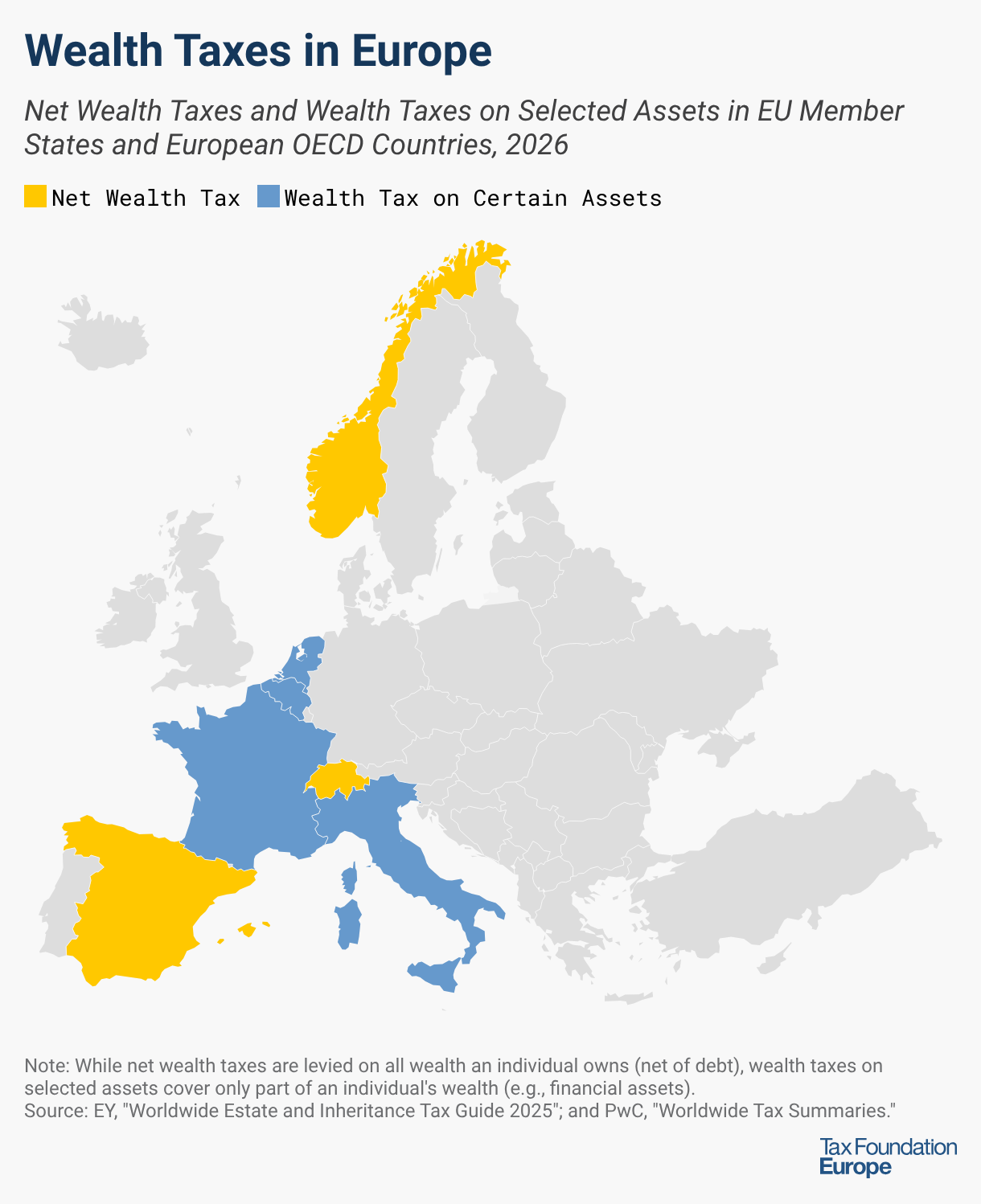
Net Wealth Taxes in Europe
Norway levies a net wealth tax of 1 percent on individuals’ wealth stocks exceeding NOK 1.9 million (EUR 172,710 or USD 198,996), with 0.35 percent going to municipalities and 0.65 percent to the central government. Norway’s net wealth tax dates to 1892. Additionally, for net wealth exceeding NOK 21.5 million (USD 2.2 million), the taxA tax is a mandatory payment or charge collected by local, state, and national governments from individuals or businesses to cover the costs of general government services, goods, and activities. rate is 1.1 percent.
Spain’s net wealth tax is a progressive taxA progressive tax is one where the average tax burden increases with income. High-income families pay a disproportionate share of the tax burden, while low- and middle-income taxpayers shoulder a relatively small tax burden. ranging from 0.16 percent (in Navarra) to 3.5 percent on wealth stocks above EUR 700,000 (USD 805,330; lower in some regions), with rates varying substantially across Spain’s autonomous regions. Andalusia, Cantabria, La Rioja, Madrid, and Murcia offer 100 percent relief to individuals with net wealth below €3 million. Extremadura offers 100 percent relief. Spanish residents are subject to the tax on a worldwide basis while nonresidents pay the tax only on assets located in Spain.
Additionally, the Spanish central government introduced a “solidarity wealth tax” in 2022 ranging from 1.7 percent to 3.5 percent on individuals with net assets exceeding EUR 3 million (USD 3.46 million). Under this tax scheme, the central government collects any additional revenue from the solidarity tax once the regional wealth tax collection is deducted. In December 2023, the Spanish central government extended the solidarity tax’s application indefinitely. Consequently, Madrid and Andalusia restored the wealth tax so that the regional governments retain the revenues the central government planned to collect.
Switzerland levies its net wealth tax at the cantonal level and covers worldwide assets (except real estate and permanent establishments located abroad). The tax rates and allowances vary significantly across cantons. The Swiss net wealth tax was first implemented in 1840.
Wealth Taxes on Selected Assets
France abolished its net wealth tax in 2018 and replaced it that year with a real estate wealth tax. French tax residents whose net worldwide real estate assets are valued at or above EUR 1.3 million (USD 1.5 million) are subject to the tax, as well as non-French tax residents whose net real estate assets located in France are valued at or above EUR 1.3 million. Depending on the net value of the real estate assets, the tax rate ranges as much as 1.5 percent.
Italy taxes financial assets held abroad without Italian intermediaries by individual resident taxpayers at 0.2 percent and 0.4 percent for assets held in certain countries. Since 2023, a tax of 0.2 percent per year has also applied to crypto assets held with a nonresident intermediary or stored on a USB stick or smartphone. In addition, real estate properties held abroad by Italian tax residents are taxed at 1.06 percent.
Since 2021, Belgium has had a solidarity tax or tax on securities accounts (TSA) of 0.15 percent on securities accounts with an average value of EUR 1 million (USD 1.15 million).
In the Netherlands, the value of net wealth, excluding primary residence and substantial interests in companies, is included in the income tax. Nevertheless, the Dutch Supreme Court ruled in 2021 that this system violates European law regarding property rights and non-discrimination. In 2022, a new temporary alternative system for the years 2023, 2024, 2025, 2026, and 2027 was proposed where each asset category (e.g., savings, debts, and others) would have its own deemed return. For 2026, the weighted average yield over all categories will be applied to the total assets above a personal exemption of EUR 59,357 (USD 68,373) to determine the taxable benefit that will be subject to tax at a flat rate of 36 percent. The government is aiming to have a new system based on actual returns by 2028.
Wealth taxes not only collect little revenue and create legal uncertainty, but an OECD report argues that they can also disincentivize entrepreneurship, harming innovation and long-term growth. Instead of reforming and hiking the wealth tax, one of the most harmful taxes ever created, countries should repeal it.
Stay informed on the tax policies impacting you.
Subscribe to our free newsletter to get the latest tax data, news and analysis.
Subscribe