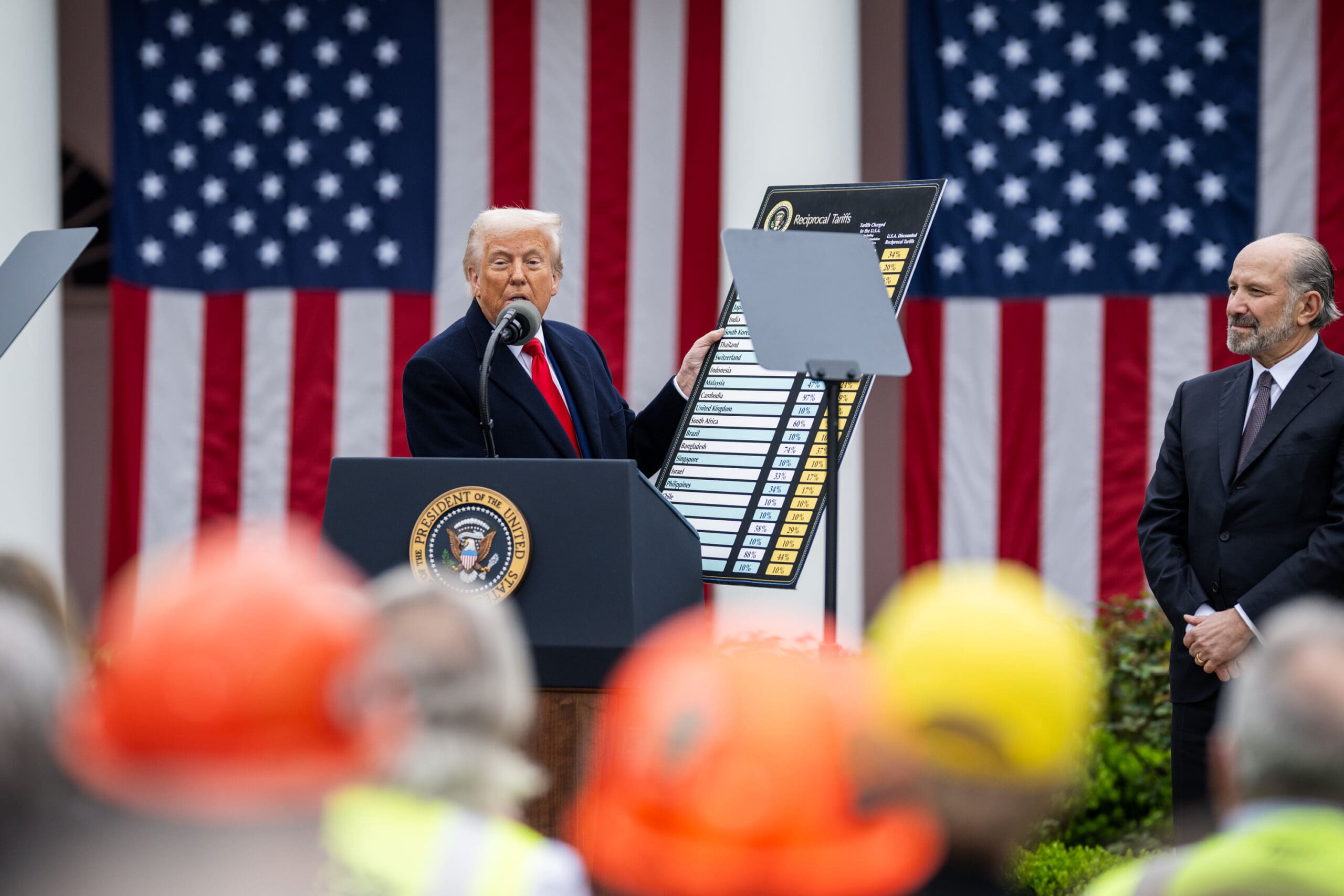
On Friday, February 20, 2026, the Supreme Court ruled against President Trump’s use of the International Emergency Economic Powers Act (IEEPA) to impose sweeping new tariffs on US imports. The decision strikes down all the tariffs imposed under the statue, including the “Liberation Day” tariffs and returns the case to United States Court of International Trade to address the issue of refunds. We estimate more than $160 billion of tariffs have been illegally collected under IEEPA Removal of the IEEPA tariffs will shield the economy and taxpayers from damage, but uncertainty remains over what the Trump administration will do next.
Which Tariffs Did the Supreme Court Rule Illegal?
President Trump used IEEPA to impose most of his new tariffs, which was the first time the emergency law was used to do so. We estimate that from 2026 through 2034, the IEEPA tariffs would have generated $1.4 trillion in revenue for the federal government:
Border security and fentanyl tariffs target imports from the US’s three largest trading partners at varying rates: China (10 percent on all imports), Mexico (25 percent on non-USMCA imports), and Canada (35 percent on non-USMCA imports, or 10 percent for certain energy or fertilizers).
“Liberation Day” reciprocal tariffs target imports from nearly every US trading partner at rates ranging from 10 percent to 50 percent but exclude goods that face separate product-specific tariffs or that are on exemption lists. IEEPA actions also end the de minimis exemption for low-cost imports from all countries.
Russian oil tariffs that currently apply to India.
Brazil tariffs.
Additional threatened tariffs.
US imposed tariffs are taxes on imported goods purchased by importers in the US. While importers are legally responsible for paying the taxA tax is a mandatory payment or charge collected by local, state, and national governments from individuals or businesses to cover the costs of general government services, goods, and activities. on their imports to the US government, they may pass some of the tariffTariffs are taxes imposed by one country on goods imported from another country. Tariffs are trade barriers that raise prices, reduce available quantities of goods and services for US businesses and consumers, and create an economic burden on foreign exporters. burden on to their consumers through higher prices or foreign sellers may absorb some of the burden by lowering their sales price. Whether tariffs remain at the importer level or are passed to the consumer level, they reduce incentives for work and investment in the US economy, leading to lower output, wages, and incomes.
Several US businesses sued the federal government over the tariffs (Learning Resources, Inc. v. Trump), arguing the tariffs exceeded the president’s authority under IEEPA. The plaintiffs are small business owners, including American manufacturers and retailers, and several state attorneys general.
On May 28, 2025, a panel of judges at the US International Court of Trade unanimously ruled that the IEEPA tariffs were illegal, a decision that was upheld by the US Court of Appeals on August 29, 2025. The tariffs remain in effect while the administration prepares its appeal to the Supreme Court. The Supreme Court heard oral arguments on November 5, 2025. On February 20, 2026, the Court ruled in a 6-3 decision in Learning Resources Inc. v. Trump and V.O.S. Selections v. United States that “IEEPA does not authorize the President to impose tariffs.” Chief Justice John Robert was joined by Justices Sotomayor, Kagan, Gorsuch, Barrett, and Jackson, while Justices Thomas, Kavanaugh, and Alito dissented.
While the ruling strikes down the IEEPA tariffs, estimated to raise $1.4 trillion over the next decade, it does not affect the industry-specific Section 232 tariffs imposed by President Trump. The Section 232 tariffs affect products including steel, aluminum, autos, and heavy trucks, and they will remain in place. We estimate that these remaining section 232 tariffs would raise $635 billion in revenue over the next decade, amounting to average tax increase of $400 per US household in 2026.
More than $160 Billion in Illegal Tariff Payments Must be Refunded
As of December 14, 2025, the latest data available, the government had collected $133.5 billion of IEEPA tariff payments from US importers. We estimate through February 20, 2026, they have generated at least $160 billion.
The case has been remanded to the United States International Trade Court deal with the issue of refunds. If the IEEPA tariffs are fully refunded to US importers, it would erase nearly three-fourths of the new revenues from President Trump’s tariffs. The US government should make the process for importers to receive their refunds as simple and transparent as possible.
Table 1. US Importers Have Paid More than $133 Billion in IEEPA Tariffs Ruled Illegal as of December 14
Source: CBP Trade Statistics.
Altogether, Trump tariffs were the largest US tax increase as a percent of GDP in more than 30 years and amounted to an average tax increase per US household of $1,000 in 2025 and $1,300 in 2026, primarily driven by the now-illegal IEEPA tariffs.
The IEEPA tariffs, including the “Liberation Day” reciprocal tariffs, raised the applied US tariff rate by 7 percentage points and the effective tariff rate by nearly 5 percentage points.
Supreme Court Decision Provides Economic Relief, But with a Major Caveat
If the IEEPA tariffs had been left in place, we estimate US GDP would have shrunk by 0.3 percent. Removing the tariffs will remove that drag on US growth by reducing marginal tax rates on work and investment going forward.
However, in the near term, uncertainty is likely to increase because the Trump administration may pursue other avenues to impose tariffs, such as Section 232, Section 301, Section 122, or Section 338. If the IEEPA tariffs are replaced by other types of tariffs the Trump administration can impose using its other authorities, then tariff-related headwinds would increase.
Currently, the Trump administration is conducting 12 Section 232 investigations on various products. These investigations allegedly target imports that “threaten or impair the national security” of the US. Some imports, such as copper, lumber, and heavy trucks, have already had tariffs imposed on them, while the President has threatened but not yet imposed tariffs on others, such as semiconductors and pharmaceuticals. The President may replace IEEPA tariffs with more product-focused tariffs, which he has broad powers to do.
Additionally, the President may also consider imposing new Section 301 tariffs, which target “discriminatory” trade practices by other countries. President Trump invoked this authority to impose tariffs as high as 25 percent on Chinese imports in 2018, which still remain in place. The President may consider raising existing duties or targeting other countries.
Finally, the administration might consider more obscure authorities, such as Section 122 and Section 338. Section 122 gives the President the authority to impose tariffs to address balance-of-payment concerns, while Section 338 targets discriminatory practices that affect US commerce. However, tariffs under Section 122 could not exceed 15 percent, and any extension of those tariffs would require Congressional approval after 150 days. Similarly, tariffs could not exceed 50 percent under Section 338. Neither authority has ever been invoked by a US President.
Overall, the Supreme Court ruling against the IEEPA tariffs provides immediate relief to US businesses and workers and is a welcome rebuke of President Trump’s overreach of executive authority to unilaterally impose significant tax hikes on the US economy.
Stay informed on the tax policies impacting you.
Subscribe to get insights from our trusted experts delivered straight to your inbox.
Subscribe
Share this article