Key Takeaways
Roth IRA penalties can include a 10% early withdrawal penalty and income taxes if you take out earnings before age 59½ or before the 5-year rule is met.
You can always withdraw your original Roth IRA contributions tax- and penalty-free, but earnings have stricter rules that often surprise investors.
The IRS orders Roth IRA withdrawals as contributions first, then conversions, then earnings, which helps determine whether taxes or penalties apply.
Excess Roth IRA contributions may trigger a 6% IRS penalty each year until the extra amount is fixed or removed.
Inherited Roth IRA beneficiaries must take required minimum distributions (RMDs) or face penalties on missed withdrawals.
If you live in California or elsewhere in the U.S., understanding Roth IRA rules and penalties can help you avoid costly mistakes and protect your retirement savings.
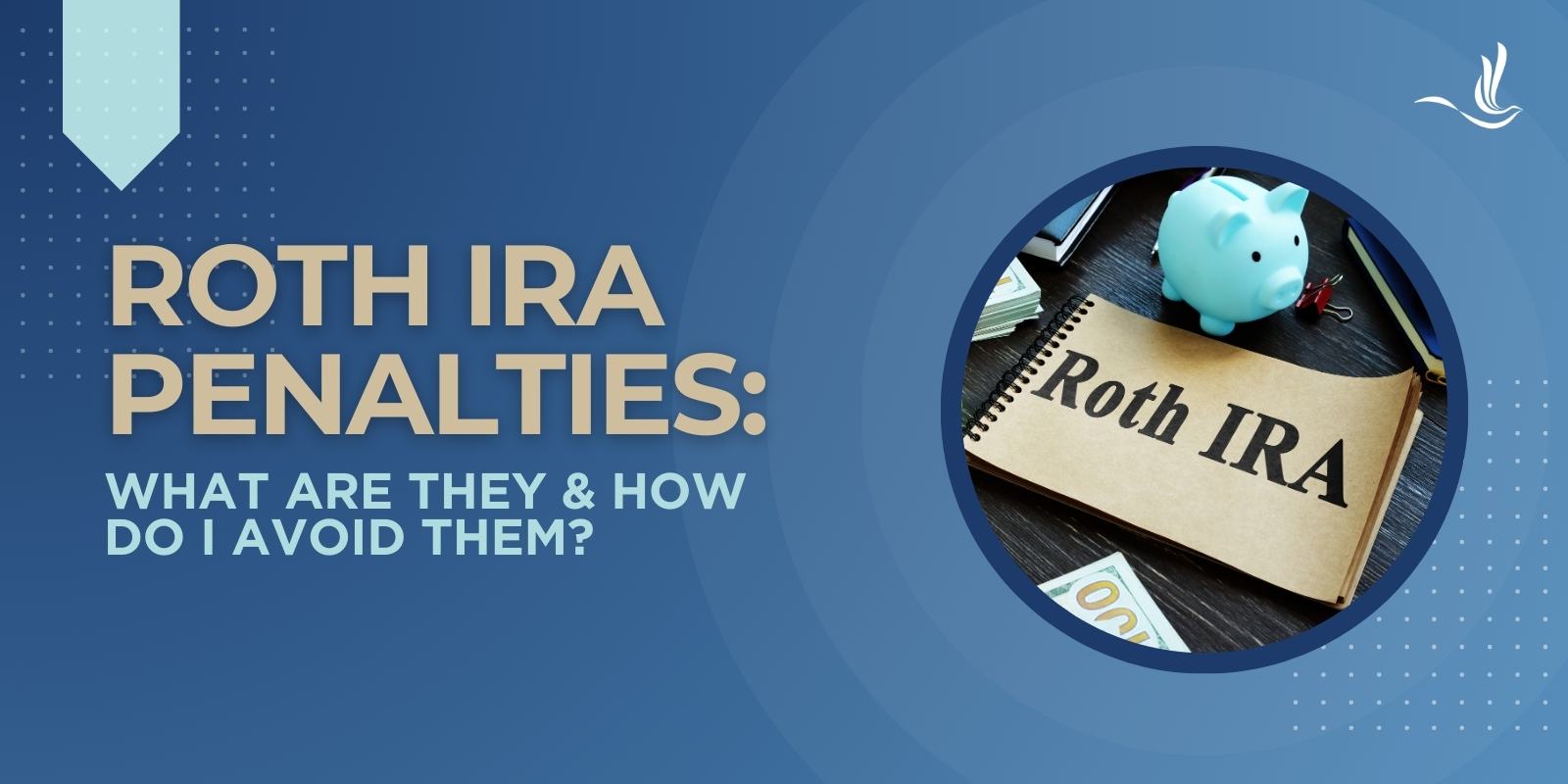
Roth Individual Retirement Accounts (IRAs) are popular investment vehicles that offer tax advantages for retirement savings. However, it’s crucial for account holders to be aware of Roth IRA penalties to make informed financial decisions. This article will explore the various penalties associated with Roth IRAs, helping readers navigate the potential issues and optimize their retirement planning.
What is a Roth IRA?
A Roth IRA is a type of retirement savings account that allows your money to grow tax-free. Unlike a traditional IRA, where contributions may be tax-deductible but withdrawals in retirement are taxed, a Roth IRA operates differently. In retirement, you can withdraw your contributions and any earnings completely tax-free if you meet certain conditions. For example, you must be at least 59½ years old and have held the account for at least five years.
The Five-Year Rule Explained
The five-year rule applies to two situations: withdrawals of earnings and conversions. Understanding this rule helps you avoid premature distributions that could trigger taxes and penalties.
Withdrawals of Earnings: For your earnings to be withdrawn tax-free, your Roth IRA must be at least five years old. This five-year period begins on January 1 of the year you made your first contribution.
Conversions: Each Roth IRA conversion has its own five-year waiting period. If you convert a traditional IRA to a Roth IRA, you must wait five years to access that converted amount penalty-free, regardless of your age.
Understanding the Key Roth IRA Rules
Before diving into the specifics of penalties, let’s review the foundational rules for Roth IRAs:
Contribution Limits: For 2025, you can contribute up to $7,000 per year to your Roth IRA if you are under age 50, or $8,000 if you are 50 or older. However, these limits are phased out if your modified adjusted gross income (MAGI) exceeds certain thresholds.
Qualified Distributions: Withdrawals of earnings are tax-free if the account has been open for at least five years and you are 59½ or older, or if you qualify for an exception (e.g., first-time home purchase).
Early Withdrawal Rules: Withdrawals of contributions are always tax- and penalty-free, but taking out earnings early may incur taxes and penalties.
Key Roth IRA Penalties
10% additional tax on early, non‑qualified distributions of earnings (generally before age 59½ and before meeting the 5‑year rule)
6% excise tax each year on excess contributions until corrected
Ordinary income tax on non‑qualified earnings
Inherited Roth IRA RMD penalty: 25% of the shortfall (may be reduced to 10% if timely corrected).
Early Withdrawal Penalties
One of the primary penalties associated with Roth IRAs is the early withdrawal penalty.The Roth IRA must be at least five years old to withdraw earnings. If you withdraw earnings from your Roth IRA before the age of 59½, you may be subject to a 10% early withdrawal penalty. This means you’d pay 10% of the amount withdrawn as a penalty. This penalty is in addition to any regular income tax that may apply to the earnings.
It’s important to note that contributions to a Roth IRA can be withdrawn tax and penalty-free at any time, as these have already been taxed. Suppose you withdraw $10,000 of earnings from your Roth IRA at age 45 without qualifying for an exception. In this case, you’ll owe income tax on the $10,000 and an additional $1,000 penalty.
Roth IRA Distribution Ordering Rules
Roth IRA distribution ordering rules are basically the IRS’s way of deciding which “bucket” your withdrawal is coming from first. This matters because some buckets are always tax-free and some might not be.
When you take money out of a Roth IRA, it’s assumed to come out in this order:
Your contributions: the money you originally put in
Conversions: amounts converted from a traditional IRA. These come out next, ordered by year of conversion (older first). These can be tax-free if you already paid taxes when you converted, but there can be a 5-year rule that affects whether you owe a 10% penalty if you’re under 59½.
Investment earnings: interest, dividends and gains in the account. These are the most restricted. Earnings are only tax- and penalty-free if you meet two conditions: you’re 59½ or older and your Roth has been open at least 5 years. If not, that portion could be taxed and possibly penalized.
Suppose your Roth IRA has $10,000 of your own contributions, $5,000 from a 2023 conversion, and $3,000 of earnings. If you withdraw $12,000 before age 59½ and before satisfying all 5-year rules, the first $10,000 comes out as contributions (no tax/penalty), then up to $2,000 comes from the 2023 conversion (still no tax but could be penalized if within five years of conversion), and earnings are only reached if you withdraw more than $12,000.
Exceptions to Early Withdrawal Penalties
While the 10% early withdrawal penalty is a general rule, there are exceptions that allow account holders to avoid this penalty under certain circumstances. Some common exceptions include:
Qualified higher education expenses for you, your spouse, children, or grandchildren
First-time home purchase (up to $10,000 lifetime for a qualified acquisition within 120 days for you, your spouse, child, or grandchild)
Birth or adoption of a child (up to $5,000)
Unreimbursed medical expenses exceeding 7.5% of your adjusted gross income
Unreimbursed health premiums while you are unemployed
Disability or death
Substantially equal periodic payments (SEPP)
IRS levy
Withdrawal during time in armed forces
Domestic abuse victim distributions (Penalty-free up to the lesser of $10,000 or 50 % of your Roth IRA if you qualify)
Federally declared disaster relief
Emergency personal expense distributions (One penalty-free distribution per calendar year (up to $1,000 or other limits) for personal or family emergencies)
Returned IRA contributions
It’s crucial to understand these exceptions thoroughly and consult with a financial advisor to ensure compliance with IRS regulations.
Excess Contributions Penalties
Contributions to a Roth IRA are subject to annual limits set by the IRS. In addition, you may not contribute more than your household earned income. In 2025, the Roth IRA contribution limit is $7,000 if you are under the age of 50, and $8,000 if you are 50 or older. These amounts are the maximum, but they can decrease if your modified adjusted gross income (MAGI) falls within higher thresholds. For example, if you are a single filer with a MAGI between $150,000 and $165,000 in 2025, you can make Roth IRA contributions. However, you are not eligible for the full limit. In 2025, if you are a single filer with a MAGI of $165,000 or more, you are not eligible to make Roth IRA contributions. Joint filers with a MAGI of $246,000 or more are also ineligible.
If you contribute more than the allowed amount, you may face excess contribution penalties. The penalty is 6% of the excess contribution amount for each year the excess remains in the account. For example, if you mistakenly contribute $8,500 to your Roth IRA, $1,500 over the $7,000 limit, you’ll face a $90 penalty each year the excess remains in the account. To avoid this penalty, it’s essential to stay informed about annual contribution limits and adjust contributions accordingly.
Penalties for Missing RMDs for Inherited Accounts
While Roth IRAs have no RMDs for the original owner during their lifetime, beneficiaries of inherited Roth IRAs must take RMDs. Failing to do so results in a 25% penalty on the amount not withdrawn. For example, if a beneficiary fails to withdraw $5,000 as required, they may face a $1,250 penalty.
Failure to Follow Conversion Rules
Roth IRA conversions involve moving funds from a Traditional IRA or a qualified retirement plan to a Roth IRA. If the conversion rules are not followed correctly, penalties may apply. For example, if you convert funds and then withdraw them within five years, a 10% penalty may be imposed on the earnings portion of the distribution. You’ll need to report any conversions to the IRS using Form 8606, Nondeductible IRAs when you file your taxes.
Conversion Five-Year Clocks
When you convert money from a traditional IRA to a Roth IRA, the IRS starts a separate five-year waiting period for that conversion. This rule is different from the five-year rule for Roth IRA earnings, and it often catches people off guard. Even though you already paid taxes when you converted the money, you can still owe a 10% penalty if you take that converted money out too soon.
What to know:
Every Roth conversion has its own five-year clock
The clock starts on January 1 of the year you convert, not the exact conversion date
Converted amounts are not taxed again
But if you’re under age 59½ and withdraw converted funds before five years pass, the IRS may charge a 10% early-withdrawal penalty
Once you reach age 59½, this penalty no longer applies, even if five years haven’t passed
This is often called a conversion penalty or recapture penalty.
Conversion Clocks Examples
Let’s say you convert $20,000 to a Roth IRA in 2022 at age 45. In 2025, you take out $10,000 of that converted money.
The five-year clock runs through December 31, 2026
Because you’re under 59½ and the five years aren’t up, the $10,000 withdrawal is penalty-taxed at 10%, even though it isn’t taxable income
Let’s look at another example. You convert $15,000 to a Roth IRA in 2019 at age 50. In 2025, you withdraw that $15,000.
The five-year clock ended on December 31, 2023
The withdrawal is penalty-free, even though you’re still under 59½. If you’ve done more than one Roth conversion, you have more than one five-year clock. Taking money out before the right clock expires can trigger penalties, even when the withdrawal seems allowed.
How to Fix Roth IRA Mistakes
Mistakes happen, but they don’t have to derail your retirement savings. Be sure to correct excess contributions quickly. Do this before the tax deadline to minimize penalties. If you owe a penalty, report it on IRS Form 5329, Additional Taxes on Qualified Plans (Including IRAs) and Other Tax-Favored Accounts. Even if you can’t pay immediately, filing the form helps prevent further penalties for non-reporting. If you realize a mistake after filing your tax return, you can amend it to reflect the correction. This may help reduce or eliminate any penalties owed.
60-Day Rollover Relief
A 60-day rollover means you can take money out of your Roth IRA and avoid taxes or penalties if you put the same amount back into a retirement account within 60 days. If done correctly, the IRS treats it as a nontaxable rollover instead of a permanent withdrawal. To qualify, you have to return the full amount you took out, and if you miss the 60-day deadline, the withdrawal is usually treated as taxable (and possibly penalized if you’re under 59½).
Keep in mind the once-per-12-month rule: you can generally only do one 60-day rollover across all your IRAs (traditional, Roth, SEP, SIMPLE) during any 12-month period, starting from the date you received the distribution. Direct trustee-to-trustee transfers don’t count toward this limit and aren’t subject to the 60-day clock.
Frequently Asked Questions
In what order does the IRS treat Roth IRA withdrawals, and why does it matter?
Roth IRA distributions are deemed to come out in this order: 1) regular contributions, 2) conversions (oldest first), 3) earnings. This matters because contributions are always tax- and penalty-free; converted amounts may face a 10% recapture penalty if withdrawn within their own five-year clock; earnings can be taxable and penalized unless a qualified distribution applies.
Can I avoid taxes/penalties by rolling a distribution back within 60 days?
Yes. Once in a rolling 12-month period, you can complete a 60-day rollover of an IRA distribution to another IRA and avoid taxes/penalties if the funds are redeposited within 60 days. Amounts withheld for taxes must be made up out of pocket to roll over the full gross amount.
What happens if I’m over age 59½ but my Roth IRA is under five years old?
Earnings are taxable but not subject to the 10% early withdrawal penalty. Once the five-year holding period is met, withdrawals become tax- and penalty-free if other qualified distribution rules are met.
Which newer penalty exceptions apply to early Roth withdrawals?
Beyond longstanding exceptions (first‑time home, education, disability, death, medical, unemployment health insurance), additional exceptions include domestic abuse survivor distributions, federally declared disaster distributions, and distributions due to an IRS levy. These can waive the 10% penalty; taxes on earnings may still apply.
How do separate five-year clocks for Roth conversions work?
Each conversion starts its own five-year period. Withdrawing converted principal within that period before age 59½ can trigger a 10% recapture penalty. After its five years, or after you reach 59½, the converted amount can be withdrawn penalty‑free; earnings still follow the general five‑year/qualified distribution rules.
Tax Help for Those Who Have Roth IRAs
Roth IRA penalties are important considerations for individuals planning their retirement savings strategy. Understanding the rules surrounding early withdrawals, contribution limits, and conversions is essential for avoiding unnecessary financial setbacks. To make the most of the benefits offered by Roth IRAs, it’s advisable to seek guidance from financial professionals who can provide personalized advice based on individual circumstances. By staying informed and making informed decisions, individuals can optimize their Roth IRA contributions and enhance their financial well-being in retirement. Optima Tax Relief is the nation’s leading tax resolution firm with over a decade of experience helping taxpayers with tough tax situations.
If You Need Tax Help, Contact Us Today for a Free Consultation