Advisors interested in serving charitably inclined clients will soon have a new designation program to consider, one focused specifically on donor-advised funds.
Processing Content
The nonprofit American College of Financial Services will launch the donor-advised fund certified professional program, on Sept. 1. The 30-hour online curriculum has no prerequisites and can be completed at a self-guided pace over eight to 20 weeks. Tuition is $1,495 for most financial professionals or $1,195 for nonprofit professionals. The King of Prussia, Pennsylvania-based organization offers more than 150 state-approved continuing education courses.
Six modules make up the DAFCP course, covering DAF fundamentals; tax fundamentals; gift acceptance; investing and grantmaking; estate and planned giving; and ethics, compliance and technology.
“Donor-advised funds involve highly complex planning considerations, and financial advisors need specialized knowledge to serve clients, especially high-net-worth individuals, who expect proficiency in this area,” Paul M. Caspersen, program director of the new designation program, said in a statement. “For professionals at DAF-sponsoring organizations, the designation offers technical grounding and a mark of ongoing professionalism.”
DAFs are one tool among many
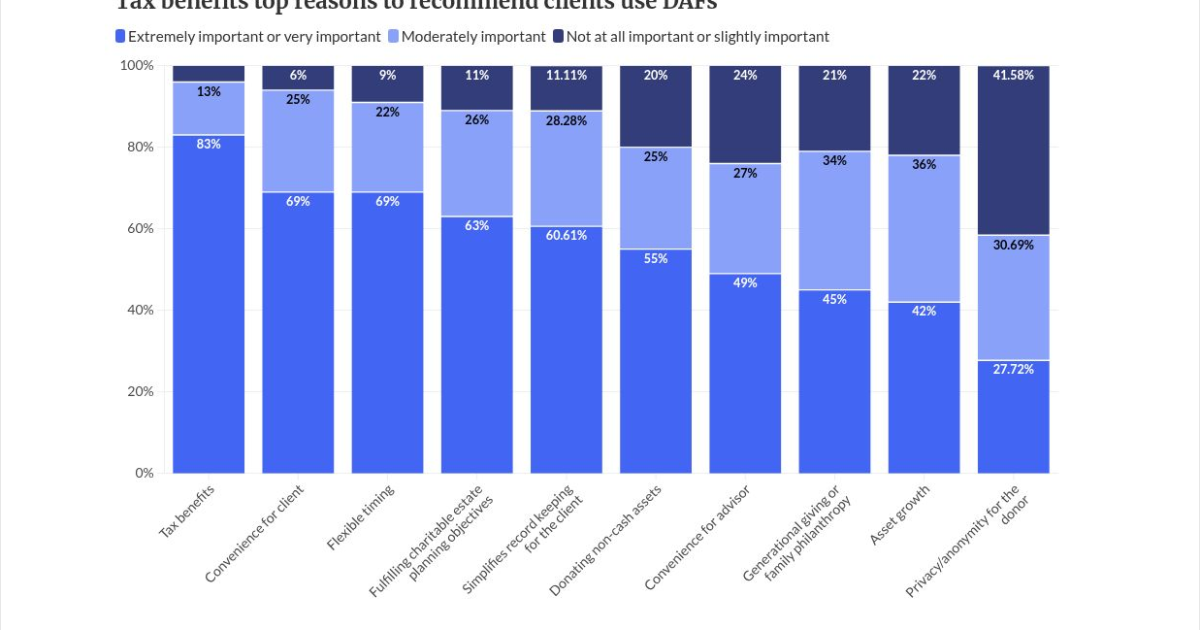
Advisors tend to recommend DAFs as a tax-advantaged method of giving so clients can maximize charitable contribution deductions or donate appreciated assets while avoiding capital gains taxes.
“More education is always beneficial, and so if people have time and capacity and interest, I think there’s things that would translate through, but you could do it as part of a broader charitable planning section,” said Chris Nason, head of private wealth at New York City-based estate and tax planning platform Wealth.com and a lecturer of trusts and estate planning at Stanford Law School. “DAFs are interesting. DAFs are special. DAFs are super important, but they’re a tiny slice of charitable giving.”
Considerations related to DAFs — such as advising clients, choosing charities and planning the bunching and valuations in how to deploy funds — can be useful in other situations, too, Nason said.
DAFs are just one way of being philanthropic, and it’s best to start with “the why,” while “DAFs are the ‘how,'” said Andrew Slade, VP and endowment and foundation advisory team lead at Philadelphia-based Glenmede, a boutique wealth management firm.
“I wouldn’t want advisors who are newer to philanthropy to conclude that DAFs are the only solution or the best one for every client just because they have this designation,” he said.
DAFs can help mitigate a downside to charitable giving that resulted from tax law changes. The increase in the standard deduction, under tax laws passed in 2017 and 2025, reduced the incentive to use itemized deductions, such as the one for charitable contributions. DAFs allow donors to group or “bunch” multiple years of gifts into a single tax year for a one-time deduction; the DAF sponsor then doles out the funds over subsequent years.
Slade said he sees potential for nonprofit development professionals to benefit from the designation, based on his conversations with them.
“They see assets flowing in, and they say, ‘How do I access these funds?'” he said. “My hope would be that this designation would give them further insight into how to cultivate and steward supporters who are giving to their nonprofit through a DAF.”
Although nonprofits tend to send formal gift acknowledgement letters to DAF sponsors, since DAFs are the legal source of the funds, engaging directly with the individual donor advisors when possible would “be much more effective for donor stewardship purposes,” he said.
Forty-two percent of millennials who donated to charities in the last year reported using a DAF, compared to only 13% of Generation Xers and 10% of baby boomers, according to Bloomerang and The Harris Poll.
However, for some, DAFs may have lost some appeal after recent events. Charles Schwab, Fidelity and Vanguard prohibited the DAFs they sponsor from making grants to the Southern Poverty Law Center, The New York Times and other outlets reported.
READ MORE: SPLC controversy underscores key limitation of donor-advised funds
“Six months ago, I would have told you 99.999% of the time, the DAF is going to listen to your recommendation,” Nason said. “There’s been a slight movement in the other direction that gets people a little bit worried.”
Slade emphasized the importance of educating clients who are would-be donors that they would legally give up control of their assets if they give to donor-advised funds, whereas private foundations allow them to maintain legal control.
DAFs tend to be more useful for ultrahigh net worth individuals.
“Unless you’re trying to bunch your charitable contributions or give away highly appreciated stock, most people are just writing checks sort of on an ongoing basis to the charities that they care about and having their funds take effect immediately,” Nason said. It is “different in the ultrahigh net worth space, where DAFs are super important.”