Financial advisors may spend hours each week building their firms’ brands, but growth in the industry still runs largely on referrals.
Processing Content
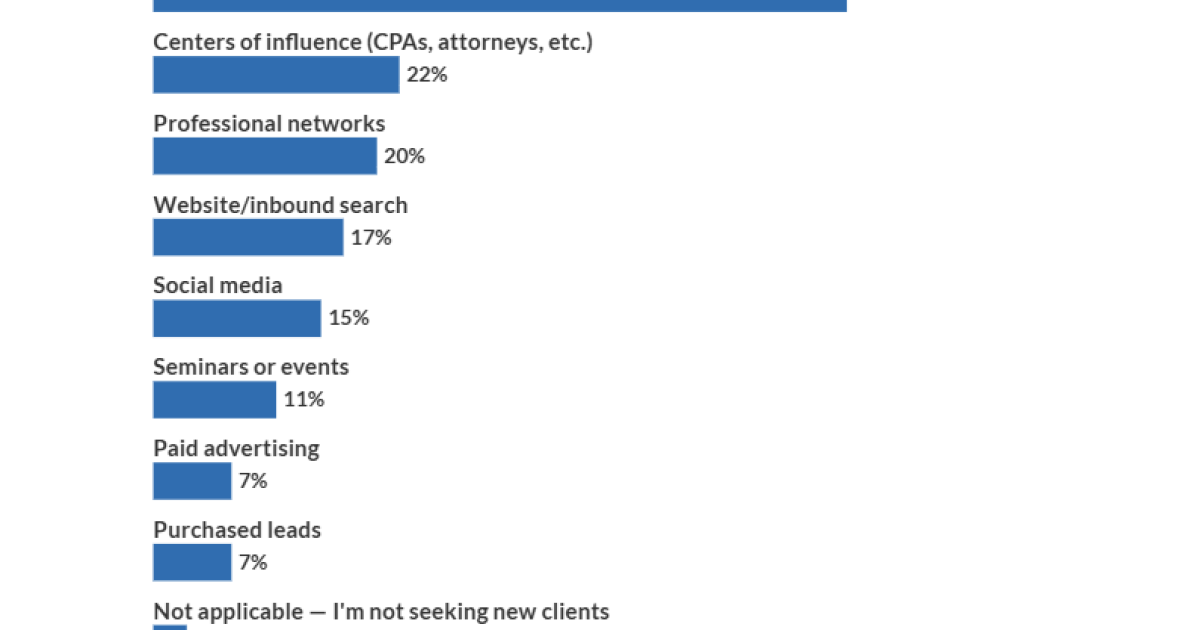
In the March Financial Advisor Confidence Outlook survey, 62% of respondents said client referrals are their top source of new clients, far ahead of any other channels, with centers of influence the second highest source at 22%. More than one-quarter (27%) of advisors said they spend at least four hours a week on branding for their business, while another 37% said they spend between one and three hours per week.
The survey also found that client retention is advisors’ No. 1 marketing objective this year, at 69% — a priority that helps fuel referrals, as satisfied clients recommend their advisors to friends and family.
For advisors on the ground, that can mean finding ways to make branding and marketing work in service of relationships, not as a replacement for them.
READ MORE: How teaming with relatives gives advisors an edge
How advisors are investing time in branding
Shane Tenny, partner at boutique wealth management firm Spaugh Dameron Tenny in Charlotte, North Carolina, said his firm employs a full-time marketing and communications director. He personally spends between two and three hours each week meeting with her and writing and producing blog and video content.
The firm also has a structured process to generate marketing ideas: A four-person editorial review committee meets monthly to brainstorm topics for future content.
“Because we have clients nationwide, we do not spend time on [local] workshops,” he said.
Although referrals from existing clients and professional networks remain the firm’s top sources of new clients, Tenny said the firm invests heavily in its online and social media presence to clarify its brand and messaging.
“This way, potential clients are very familiar with our process, pricing and culture when they initially contact us, making the conversion rate very effective,” he said.
Tenny added that some of the firm’s highest-quality clients come through referrals from CPAs. As a result, this year, the firm is focusing on expanding its online presence and launching a regular email newsletter.
“Content is specifically created to deepen these relationships and encourage more collaboration,” he said. “We have also identified a need among widowed retirees and are creating messaging and collateral to better service this growing population.”
Mark B. Cannon, president of private wealth advisory firm Luminate in Dallas, said his firm’s main priorities this year are lead generation and attracting high-value clients.
On average, he spends about five hours per week focused on building and maintaining his firm’s brand.
“That includes enhancing the client experience, keeping our messaging consistent across channels, supporting prospecting efforts and managing ongoing marketing initiatives,” he said.
The March FACO survey indicated that holding webinars or other events, cited by 11% advisors, are a relatively uncommon way of winning new clients. But for some advisors, they can work well.
Cannon said his firm’s strongest source of new clients continues to be referrals. But he also uses seminars and smaller client events to strengthen relationships and generate introductions.
Recently, his firm hosted events including retirement dinners, a “Galentine’s high tea” and a private-club golf clinic.
“These more intimate, unique gatherings have been especially effective because they create memorable interactions and give us the opportunity to build genuine connections with prospective clients,” he said.
George Chang, financial advisor and principal at Pillar Point Wealth Management in San Francisco, is still in his first year post-launch and is dedicating significant time to shaping his firm’s brand.
Chang said he spends close to nine hours each week on branding and marketing efforts — time he sees as an investment in laying the foundation of the firm’s brand identity.
READ MORE: How advisors can get noticed in a no-click search world
Chang said he has two primary marketing objectives this year, both with the goal of building a voice and credibility: building a niche serving Kaiser Permanente physicians — a community he understands well because his wife is a doctor with the organization — and maintaining consistent communication with clients and prospects.
“My desired outcome would be awareness and referrals through these two efforts,” he said.
So far, Chang said new clients have primarily come from referrals within his broader network. He said he doesn’t envision purchasing leads or paying for placement services anytime soon.
“I have the luxury of taking my time, ensuring that I take clients that are a good fit for my services and areas of expertise, and who want an ongoing partnership,” he said.