Retirement planning is often a cornerstone of a client’s financial plan, with advisors estimating how much the client can safely spend in retirement. In practice, advisors typically begin with the client’s target retirement date, and then adjust levers such as withdrawal rates, asset allocation, and spending flexibility to make the plan work. But when the retirement date is treated as fixed, an important part of the planning problem may be left unexamined: whether the timing of retirement itself is helping or hurting the plan from the outset.
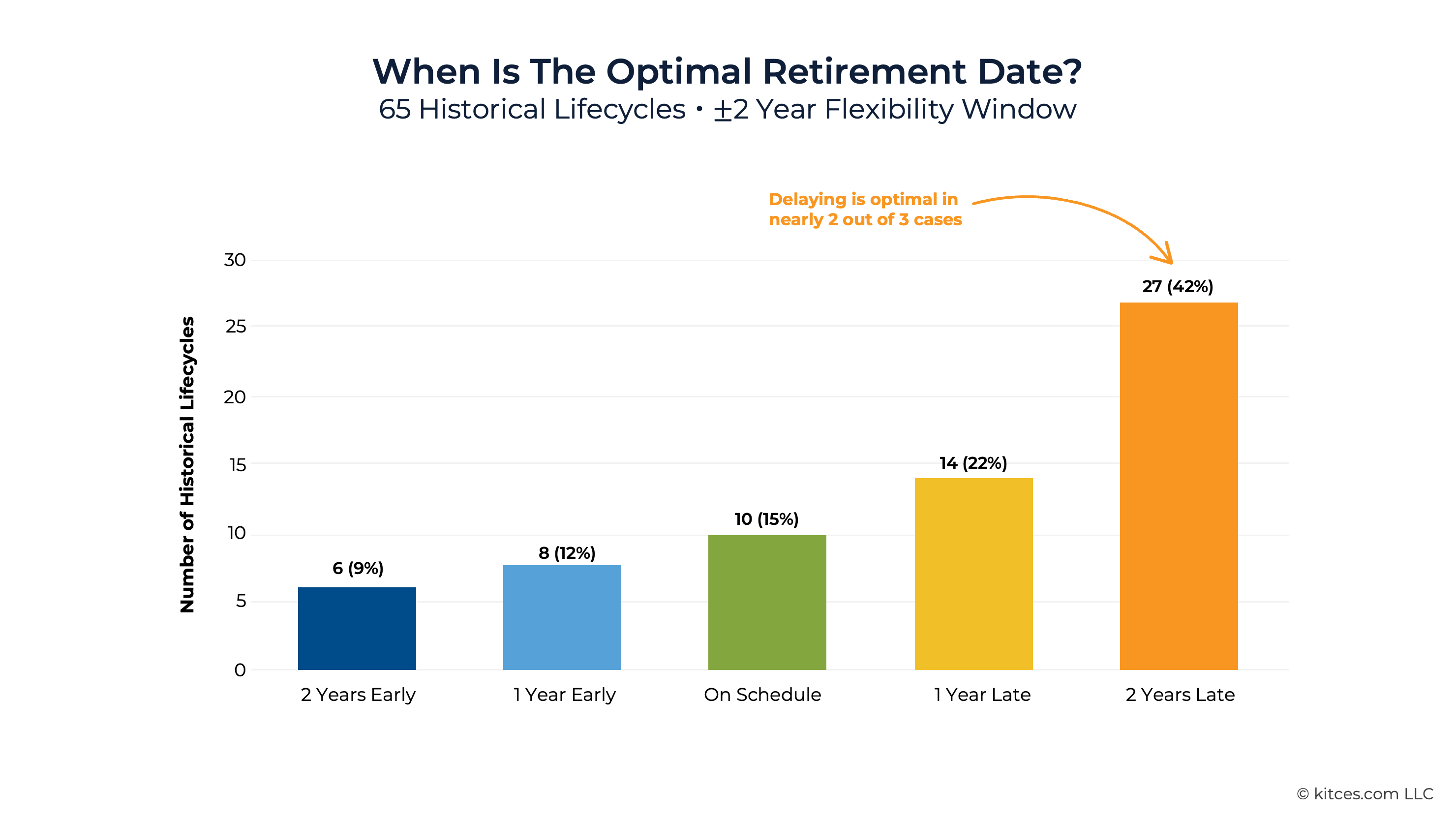
In this guest post, Georgios Argyris, Research Director at bellavia.app, explains how even a small shift in retirement timing can change the market environment the retiree enters and, with it, the sustainability of the plan. The effect becomes clear when comparing otherwise identical retirees who begin withdrawals in different environments. Across the historical lifecycle cohorts examined, allowing for a two-year flexibility window produced a median gap of roughly two-thirds in final portfolio value between the best and worst timing choice within the window. Retiring at the originally planned date was optimal only about 15% of the time; in most cases where a different choice helped, delaying retirement produced a better outcome.
This result can be understood by separating retirement timing risk into two components: cohort risk, which reflects the overall return environment a retiree experiences, and pure sequence risk, which reflects the order of returns within that environment. Historical analysis suggests that roughly three-quarters of retirement outcome variability is driven by cohort risk, while only about one-quarter is attributable to return ordering within a cohort. This distinction matters because most traditional planning tools – including dynamic withdrawal strategies, guardrails, and allocation adjustments – operate only within a given cohort, therefore addressing only the smaller portion of risk. By contrast, adjusting the retirement date is one of the few levers that can shift a client into a different cohort altogether.
This framework also leads to a counterintuitive insight: clients who appear most prepared for retirement – often those with the largest portfolios after strong accumulation periods – may still face elevated timing risk. Strong bull markets can inflate retirement balances while leaving clients exposed to weaker forward returns. As a result, a large portfolio value at retirement might not, on its own, indicate that the timing is favorable. Advisors can partially assess this risk using valuation metrics such as the Shiller CAPE ratio, which has shown a relationship with subsequent decade-long returns and can help identify whether current conditions resemble historically unfavorable retirement environments.
Ultimately, the key point is that retirement timing may deserve a larger role in retirement planning than it is often given. Advisors may improve outcomes by first considering whether the retirement date itself should be adjusted, particularly when market conditions appear unfavorable. When timing flexibility is limited, reducing the initial withdrawal rate can provide a margin of safety, while dynamic spending strategies can help manage the remaining ordering risk. By recognizing retirement timing as a planning variable rather than simply a fixed assumption, advisors can better position clients to navigate uncertainty and support the sustainability of retirement income over time.
Read More…