Your channel sales strategy isn’t failing because of your partners. It’s failing because of what you can’t see. When partner performance data lives in disconnected spreadsheets, rebate claims get processed manually, and lead registration happens through email threads, even a well-structured partner program becomes impossible to scale. A fragmented channel data strategy doesn’t just slow your team down; it actively erodes the revenue you’ve already earned.
If you’ve felt the frustration of reconciling POS data at month-end, chasing down MDF approvals, or watching deals fall through the cracks due to channel conflict, you’re not alone. These are the operational realities that keep channel managers reactive instead of strategic, and they’re almost always rooted in the same cause: manual processes that were never built to handle growth.
This article shows you exactly how to design, execute, and automate a channel sales strategy built for predictable revenue in 2026. You’ll learn how to move from fragmented tracking to real-time visibility, eliminate the administrative drag that’s costing your team time and accuracy, and build a partner ecosystem that scales without adding operational overhead. From automated onboarding to incentive optimization, what follows is a practical framework for turning your channel program into a performance engine.
Key Takeaways
A modern channel data strategy is the foundation of predictable revenue growth, replacing fragmented spreadsheets and manual processes with real-time visibility across your entire partner ecosystem.Scalable channel programs are built on measurable KPIs and structured partner enablement, not just relationship management – learn the five-step framework that separates high-performing programs from stagnant ones.MDF and co-op funds only deliver ROI when request, approval, and reconciliation workflows are automated; manual administration is where channel momentum goes to die.POS and inventory data transparency is the single most effective lever for eliminating operational bottlenecks and giving channel managers the clarity to act strategically rather than reactively.PartnerPortal™ consolidates deal registration, rebates, lead management, and incentive programs into one cloud-based platform – discover how modular SaaS infrastructure scales with your partner network without adding overhead.
What Is a Channel Sales Strategy and Why It Matters in 2026
A channel sales strategy is the structured roadmap a company uses to sell its products or services through third-party partners rather than directly to end customers. Those partners, including distributors, value-added resellers (VARs), managed service providers (MSPs), and system integrators, act as extensions of your sales force. They carry your product into markets you couldn’t efficiently reach on your own. The strategy defines how you recruit those partners, enable them, compensate them, and measure their contribution to revenue.
That definition, however, only captures the mechanics. The strategic weight of a channel program in 2026 comes from something more consequential: the ability to scale market coverage without scaling headcount at the same rate. For manufacturers and technology vendors serving complex, geographically distributed markets, indirect sales aren’t a fallback. They’re a deliberate growth lever.
The Strategic Shift from Direct to Indirect Sales
The economics of direct-only sales models are increasingly difficult to justify at scale. Building regional sales teams requires significant fixed investment, and enterprise sales cycles in distributed markets demand local credibility that takes years to establish. Indirect channels solve both problems simultaneously. A well-selected regional reseller brings an existing customer base, established trust, and on-the-ground market knowledge that no centrally deployed sales rep can replicate quickly.
The challenge, and it’s a real one, is avoiding internal competition between direct and indirect motions. Channel conflict erodes partner confidence faster than almost any other operational failure. Companies that manage this successfully do so through disciplined deal registration processes and clearly defined rules of engagement, not through informal agreements that break down under quota pressure.
Identifying High-Value Channel Partner Profiles
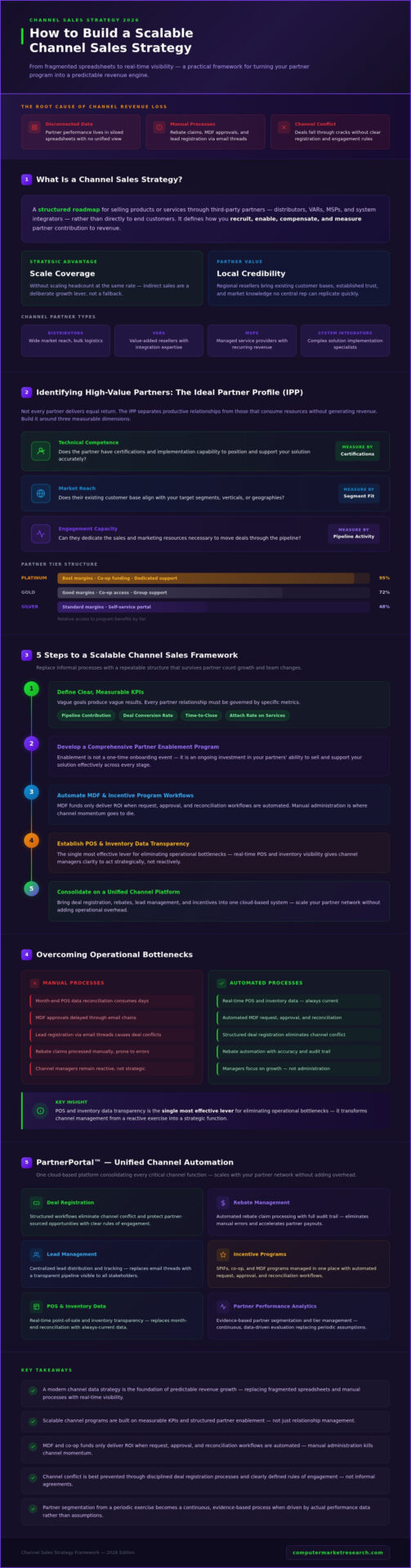
Not every partner delivers equal return. Defining an Ideal Partner Profile (IPP) is how high-performing channel programs separate productive relationships from ones that consume enablement resources without generating revenue. The IPP should be built around three measurable dimensions:
Technical competence: Does the partner have the certifications and implementation capability to position and support your solution accurately?Market reach: Does their existing customer base align with your target segments, verticals, or geographies?Engagement capacity: Can they dedicate the sales and marketing resources necessary to move deals through the pipeline?
Partner tiers formalize these distinctions, giving your highest-performing partners structured access to better margins, co-op funding, and dedicated support while creating a clear progression path that incentivizes performance across the entire ecosystem. A sound channel data strategy makes it possible to evaluate partners against these criteria using actual performance data rather than assumptions, turning partner segmentation from a periodic exercise into a continuous, evidence-based process.
5 Steps to Building a Scalable Channel Sales Framework
A channel program without a repeatable structure isn’t a program. It’s a collection of individual relationships held together by institutional memory and manual effort. When a key channel manager leaves or your partner count doubles, that structure collapses. The five steps below replace informal processes with a framework designed to scale without breaking.
Step 1: Define clear, measurable KPIs for partner performance. Vague goals produce vague results. Every partner relationship should be governed by specific metrics: pipeline contribution, deal conversion rate, time-to-close, and attach rate on services. Without these benchmarks, you can’t distinguish a partner who’s growing with you from one who’s quietly stagnating.
Step 2: Develop a comprehensive partner enablement program. Enablement isn’t a one-time onboarding event. It’s an ongoing investment in your partners’ ability to represent your solution accurately and competitively. Structured certification tracks, sales playbooks, and regular competitive updates keep your partners effective long after their initial training is complete.
Step 3: Establish a transparent deal registration process. Channel conflict is almost always a process failure, not a people failure. A clearly defined, consistently enforced deal registration system protects partner investments in opportunities, eliminates internal competition, and gives your channel managers the visibility to coordinate rather than compete. This is where a sound channel data strategy pays immediate dividends.
Step 4: Implement automated incentive and rebate structures. Manual rebate processing is where partner loyalty quietly erodes. When partners wait weeks for claim approvals or reconcile discrepancies through email threads, their confidence in your program diminishes. Automated incentive workflows eliminate that friction and ensure accurate, timely payouts that reinforce the behaviors you want to reward.
Step 5: Deploy a centralized Partner Relationship Management (PRM) system. All four preceding steps depend on a single source of truth. A centralized PRM consolidates deal registration, enablement resources, performance data, and incentive tracking into one accessible platform. Without it, each step operates in isolation. With it, they compound. Channel sales management software built for this purpose eliminates the coordination overhead that keeps channel teams reactive.
Aligning Channel Goals with Corporate ROI
New and established partners shouldn’t share the same revenue targets. A recently onboarded reseller needs ramp-period benchmarks tied to activity metrics, such as certifications completed and deals registered, rather than closed revenue. Established partners should be measured against contribution to customer lifetime value, not just transaction volume. Linking partner performance to CLV shifts the conversation from short-term quota attainment to long-term account health, which is where sustainable channel ROI is actually built.
Designing a Tiered Partner Program Structure
Tiered structures work because they make performance visible and progression attainable. A Silver, Gold, and Platinum model should define requirements and benefits with precision at each level:
Silver: Entry-level certification, access to standard margins and deal registration, basic co-op funding eligibilityGold: Advanced certification, higher margin thresholds, priority deal registration review, increased MDF allocationPlatinum: Full technical competency, dedicated channel support, maximum rebate tiers, joint business planning access
Critically, the framework must allow upward mobility. Partners who hit Gold-level metrics mid-year should advance mid-cycle, not wait for an annual review. Rigid annual tier resets discourage the sustained engagement that high-performing programs depend on. If you’re ready to move from spreadsheet-based tracking to a structured framework, explore how a modern PRM approach can accelerate that transition.
Driving Growth with MDF and Incentive Programs
Channel marketing funds are not interchangeable, and treating them as such is one of the more costly administrative oversights in partner program management. Co-op funds are earned incrementally, typically calculated as a percentage of a partner’s purchase volume, and are intended to reimburse partners for pre-approved marketing activities tied to your brand. Market Development Funds (MDF) operate differently. They’re discretionary allocations awarded by the vendor to support specific strategic initiatives, such as entering a new vertical, launching a product, or accelerating pipeline in an underperforming region. The distinction matters because the approval criteria, compliance requirements, and ROI expectations for each are fundamentally different.
When both fund types are managed through email threads and spreadsheets, the distinction collapses in practice. Requests stall in inboxes. Approvals happen without audit trails. Reconciliation at quarter-end becomes a forensic exercise rather than a routine process. That’s not a minor inconvenience; it’s a structural drag on the marketing momentum your partners need to generate pipeline on your behalf.
Optimizing Co-op/MDF Management for Better ROI
Automated fund management replaces that friction with a traceable, auditable workflow. When partners submit requests through a structured platform, every claim carries a timestamp, a documented activity type, and a supporting proof of performance. Approvals route to the right stakeholder automatically. Fund balances update in real time. The result is a system where compliance isn’t enforced retroactively through reconciliation; it’s built into the submission process itself. For channel teams managing partners across multiple geographies, that auditability is non-negotiable. For a deeper look at how to structure fund programs for measurable returns, the Market Development Funds (MDF) Guide covers the strategic architecture in detail. If you’re evaluating platforms built for this purpose, CMR’s Co-op/MDF management solution is designed specifically to eliminate manual claim processing across distributed partner networks.
Implementing Performance-Based Rebates and Incentives
Rebate structures do more than reward volume. When designed with precision, they shape partner behavior at the SKU level, encouraging inventory turnover on specific product lines, accelerating deals in targeted segments, or increasing attach rates on high-margin services. A tiered rebate that pays out at 2% on standard volume and 4% above a defined threshold creates a clear behavioral incentive without requiring your channel team to manually manage the outcome.
Non-monetary incentives deserve equal attention. Exclusive lead access, priority deal registration review, and advanced certification tracks are often more motivating than incremental margin for partners who already operate at high volumes. Structured correctly, these incentives deepen partner engagement without increasing fund expenditure.
Automated incentive processing is where a sound channel data strategy pays compounding dividends: when partners receive accurate payouts on a predictable schedule without needing to chase approvals or reconcile discrepancies, their confidence in your program stays intact, and their motivation to prioritize your products over a competitor’s remains consistently high. Manual processing erodes that trust one delayed claim at a time.
Overcoming Operational Bottlenecks with Data Transparency
Manual data entry isn’t just inefficient. It’s structurally incompatible with a channel program that’s meant to scale. When partner sales reports arrive in inconsistent formats, get re-keyed into spreadsheets, and then reconciled against purchase orders by hand, every step in that chain introduces latency and error. The operational drag is measurable, but the strategic cost is harder to quantify: channel managers who spend their week normalizing data can’t spend it analyzing it.
Data transparency solves a problem that goes beyond internal efficiency. Partners who can see their deal status, fund balances, and claim histories in real time don’t need to call your channel desk for updates. That visibility builds confidence in your program, and confidence is what keeps a partner prioritizing your product line over a competitor’s when they’re standing in front of a customer.
Ship-and-debit claims illustrate the margin risk precisely. These transactions, where a distributor sells below the standard price and claims the difference from the vendor, require exact alignment between submitted claims and approved pricing agreements. When that reconciliation happens manually, overbilling goes undetected, underpayments create disputes, and the cumulative margin erosion across a large distributor network compounds quietly. Automated ship-and-debit management eliminates that exposure by validating claims against pre-approved terms at the point of submission, not weeks later during a quarterly audit.
Eliminating Errors in POS and Inventory Tracking
Dirty data doesn’t stay contained to the spreadsheet it originates in. Inaccurate point-of-sale reporting distorts demand signals, which cascades into flawed inventory planning, misallocated production capacity, and missed replenishment windows. For manufacturers operating across distributed channel networks, the source of that distortion is almost always inconsistent partner reporting formats that were never designed to integrate cleanly with upstream systems.
Automating the collection and normalization of partner sales reports through a structured channel data management system removes that variability at the source. Rather than reconciling dozens of proprietary report formats each month, your team receives standardized, validated data that feeds directly into planning workflows. The result isn’t just cleaner records; it’s supply chain decisions built on evidence rather than estimates.
Using Real-Time Insights to Prevent Channel Conflict
Channel conflict emerges when two parties, whether two partners or a partner and a direct sales rep, pursue the same opportunity without visibility into each other’s activity. The outcome is predictable: the partner who loses the deal loses trust in your program, and that erosion rarely announces itself before it affects pipeline contribution.
Deal registration software addresses this directly by establishing first-to-find protection with a timestamped, auditable record. When a partner registers an opportunity, the system enforces exclusivity automatically, removing the ambiguity that invites conflict. For a deeper understanding of how data architecture supports this kind of operational clarity, the Channel Data Management (CDM) Guide outlines the full decision-grade data framework. A mature channel data strategy makes conflict prevention a system property, not a management judgment call.
If your team is still managing POS validation and deal protection through manual workflows, the gap between where you are and where your partners expect you to be is widening. Start your 90-day free trial and see how automated data transparency transforms channel operations from reactive to strategic.
Modernizing Your Strategy with PartnerPortal™ Automation
Fragmented tools create fragmented programs. When onboarding happens through email, deal registration lives in a spreadsheet, and performance reporting requires a manual pull from three separate systems, the operational cost isn’t just administrative. It’s strategic. Channel managers spend their capacity on coordination instead of optimization, and partners experience a program that feels difficult to engage with. The solution isn’t adding more tools. It’s replacing the stack with a single, purpose-built platform.
PartnerPortal™ is CMR’s cloud-based SaaS solution designed specifically for this consolidation. It brings deal registration, rebate tracking, lead management, MDF workflows, and performance visibility into one accessible environment, giving both channel teams and partners a shared operational foundation that scales without adding overhead.
Centralizing Operations with a Unified Partner Portal
A self-service partner environment changes the operational dynamic in a measurable way. Partners who can access collateral, check fund balances, register deals, and track claim status without contacting your channel desk don’t generate support tickets; they generate pipeline. That shift frees your channel managers to focus on strategic conversations rather than status updates.
Communication flow improves structurally when both sides operate from the same data. Rather than reconciling partner-reported figures against internal records, channel managers work from a single source of truth. Notifications, approvals, and performance alerts route automatically, reducing the back-and-forth that slows program execution. The result is a partner experience that feels responsive and organized, which directly influences how consistently partners prioritize your product line.
PartnerPortal™ also automates the onboarding sequence itself. New partners move through certification requirements, agreement acknowledgment, and system access provisioning within a structured workflow rather than an ad hoc email chain. That consistency protects your program’s compliance posture and accelerates time-to-productivity for every partner you bring on.
Leveraging Managed Services for Strategic Insights
Software alone doesn’t guarantee clean data. A platform that accepts inconsistent partner inputs produces inconsistent outputs. This is the distinction between a software-only model and a managed data services approach. CMR, founded in 1984 and serving Fortune 500 and Global 2000 companies, combines platform infrastructure with data normalization expertise, ensuring that the information flowing into your channel data strategy is validated and decision-ready before it reaches your planning workflows.
For enterprise channel programs operating across dozens of partners and geographies, that distinction is consequential. Clean, normalized data enables the kind of ROI analysis that drives real program adjustments: identifying which partner segments over-index on high-margin SKUs, where MDF spend is generating pipeline, and which tier transitions are stalling. Manual tracking can’t produce that clarity. In 2026, it’s not just inefficient; it’s obsolete.
If your channel program is still running on disconnected tools and manual reconciliation, the gap between your current operations and what your partners expect is already costing you. Explore CMR’s channel sales management software to see how PartnerPortal™ consolidates your entire partner ecosystem into one performance-ready platform.
Turn Your Channel Program into a Predictable Revenue Engine
A high-performing channel program in 2026 isn’t built on stronger relationships or bigger fund allocations. It’s built on operational clarity. When your channel data strategy replaces manual reconciliation with real-time visibility, partners engage more consistently, incentive programs reinforce the right behaviors, and your channel team shifts from reactive administration to strategic execution.
The path forward is straightforward: structured partner tiers, automated MDF workflows, and clean POS data feeding decisions that actually reflect what’s happening in the field. These aren’t aspirational improvements; they’re the baseline that Global 2000 enterprises already expect from a vendor partner.
CMR has been helping manufacturers and technology vendors eliminate manual tracking inefficiencies since 1984. PartnerPortal™ consolidates everything from deal registration to automated co-op tracking and real-time POS data normalization into one platform built to scale with your network.
Your partners are ready to perform. Give them a program that’s ready to support them. Start your 90-day free trial and see the difference a unified platform makes.
Frequently Asked Questions
What is the difference between direct and channel sales?
Direct sales means your internal sales team sells to end customers without intermediaries. Channel sales routes products through third-party partners like distributors, VARs, or MSPs who carry your solution into markets you can’t efficiently reach on your own. The core tradeoff is coverage versus control: direct sales gives you tighter margin management, while channel sales scales market reach without proportional headcount growth.
The two models aren’t mutually exclusive, but running them simultaneously without clear rules of engagement creates internal competition. Companies that manage both successfully define explicit territory and account boundaries before conflict has a chance to surface.
How do I choose the right channel partners for my strategy?
Start by building an Ideal Partner Profile around three measurable criteria: technical competence to implement and support your solution, market reach into your target segments or geographies, and the sales capacity to actively work deals rather than passively list your product. Partners who score well on all three generate revenue; partners who don’t consume enablement resources without returning proportional value.
Avoid selecting partners based on brand recognition alone. A well-known distributor with no alignment to your vertical will consistently underperform a smaller, specialized reseller who already owns the customer relationships you’re trying to reach.
What are the common challenges in channel sales management?
The most persistent challenges are operational rather than relational: inconsistent partner reporting formats that make data normalization a manual exercise, rebate and MDF claims that stall in approval queues, and deal registration gaps that invite channel conflict. Each problem compounds the others. Dirty POS data distorts planning, delayed incentive payouts erode partner confidence, and unresolved conflict discourages the partners you most need to stay engaged.
Most of these issues trace back to the same root cause: processes built for a smaller partner count that were never redesigned as the network grew. Spreadsheets and email threads don’t scale, and the cost of not replacing them accumulates quietly until it becomes a strategic liability.
How can automation improve my channel sales ROI?
Automation improves ROI by eliminating the latency and error rates that manual workflows introduce at every stage of channel execution. When rebate claims are validated against pre-approved terms at submission rather than reconciled weeks later, margin leakage stops accumulating. When MDF approvals route automatically with full audit trails, fund utilization improves because partners submit requests knowing the process is predictable. A sound channel data strategy depends on this kind of structural reliability to produce accurate performance signals.
The compounding effect matters too. Partners who receive accurate, on-time payouts without chasing approvals consistently prioritize your product line over competitors. That behavioral shift doesn’t show up in a single quarter’s numbers, but it’s one of the most durable ROI drivers a channel program can build.
What is deal registration and why is it important?
Deal registration is a formal process where a partner claims exclusivity on a sales opportunity by logging it in a centralized system before pursuing it. The vendor acknowledges that claim with a timestamped record, which protects the partner’s investment in developing that opportunity and prevents another partner or direct rep from competing for the same deal. Without it, channel conflict is essentially structural, built into the program by default.
The operational discipline deal registration enforces is just as valuable as the conflict prevention itself. When every opportunity enters a shared system, channel managers gain real-time pipeline visibility that would otherwise require manual aggregation across partner-submitted reports.
How do I measure the success of my channel sales program?
Effective measurement requires metrics at both the program and partner level. Program-level KPIs include total pipeline contribution from indirect channels, average deal conversion rate, and MDF-to-revenue ratio. At the partner level, track time-to-close, attach rate on services, and tier progression velocity. Measuring only closed revenue misses the leading indicators that signal whether a partner is growing with you or quietly disengaging.
The reliability of these metrics depends entirely on data quality. If partners submit sales reports in inconsistent formats and your team normalizes them manually, the numbers you’re measuring against are estimates, not facts. Automated data collection and normalization is what converts reporting into decision-grade insight.
What is the role of a Partner Relationship Management (PRM) system?
A PRM system is the operational infrastructure that connects every component of a channel program into a single platform. It consolidates deal registration, enablement resources, performance tracking, incentive workflows, and communication into one environment accessible to both your team and your partners. Without a PRM, each program component operates in isolation, and the coordination overhead falls on channel managers who should be focused on strategic execution instead.
The self-service dimension is particularly consequential. Partners who can check fund balances, register deals, and track claim status without contacting your channel desk don’t generate support tickets; they generate pipeline. That shift in operational dynamic is what allows a channel team to scale partner count without scaling administrative headcount at the same rate.
How does channel data management prevent channel conflict?
Channel conflict almost always originates from a visibility gap: two parties pursuing the same opportunity without knowing the other exists. A mature channel data strategy closes that gap by creating a shared, real-time record of every registered deal, active opportunity, and assigned account. When that data is centralized and timestamped, exclusivity is enforced by the system rather than negotiated after the fact.
The broader benefit is that clean, accessible data lets channel managers identify conflict risk before it becomes a dispute. When pipeline data flows into one platform in normalized form, patterns become visible: overlapping territory claims, duplicate registrations, and accounts being worked simultaneously by a partner and a direct rep. Catching those signals early is what separates a proactive channel operation from one that’s always in damage-control mode.

Article by
Del Heles
Del Heles is the founder and CEO of Computer Market Research (CMR), a channel management software company he launched in 1984. With more than 40 years of experience, he’s known for helping manufacturers and distributors simplify complex partner programs through practical, customer-focused technology solutions.