While it is true that polls conducted more than two years out from a presidential election are hardly indicative of which candidates will rise, fall, and ultimately win or lose, they do serve some useful purposes. Primarily, they test the staying power of prospective presidents, some of whom will find hope in the early numbers while others will see the unfortunate handwriting on the wall and take a pass.
Name recognition is the prevailing currency in early polls, so it is to be expected that candidates familiar to the voters will sit at or near the top of most surveys this far out. But, as the saying goes, familiarity breeds contempt. And that is magnified exponentially in the age of social media, when nary a thought goes unexpressed by countless millions across the globe. High name recognition inevitably leads to all manner of ignorant and disparaging commentary by the poorly informed masses with too much time on their hands.
Presidential Prospects Rising and Falling
That said, as potential presidential candidates sharpen their focus beyond the impending midterm elections, the growing volume of polls measuring more than a dozen prospective Democratic presidential candidates has become ever more difficult to analyze. One poll has Gavin Newsom in the lead, another shows Kamala Harris in front, and a third looks promising for Pete Buttigieg, and on and on. Survey results both nationally and in purple states have started fluctuating to the point that one wonders if any of the candidates could even be considered the frontrunner.
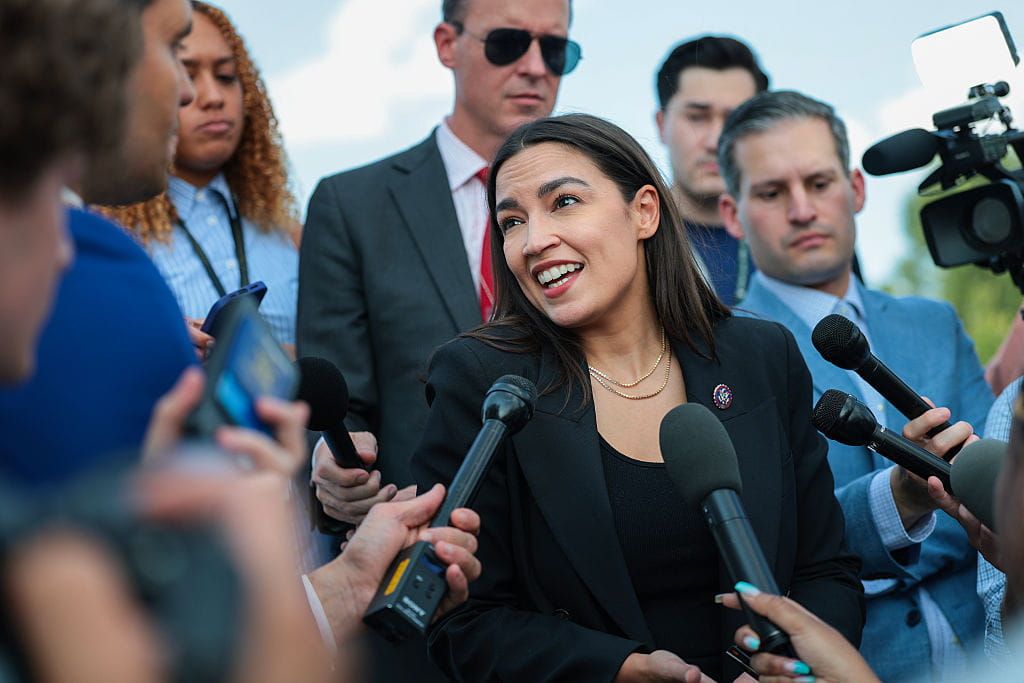
Try this one on for size: Finishing atop the pack in a recent poll of 648 likely Democratic primary voters in New Hampshire was — drumroll, please — Alexandria Ocasio-Cortez (AOC). The far-left congresswoman attracted 22% support while former Secretary of Transportation Pete Buttigieg finished at 21% and Arizona Sen. Mark Kelly, who is not even on the A-list of potential candidates, came in third at 9%.
Another national poll by Emerson College has Buttigieg in the lead with 19%, then 17% for California Gov. Gavin Newsom, who barely registered in New Hampshire, Georgia Sen. Jon Ossoff, another B-lister, at 13%, and former Vice President Kamala Harris at 8%. And yet, Harris finished 17 points ahead of Newsom in another national poll just released by the Daily Mail and by more than 10 points in the Real Clear Politics (RCP) average of polls. While Harris looks strong by these metrics, it is almost inconceivable that the party would go down that dead-end road again. At the same time, none of the candidates reaches 20% in Polymarket odds measuring prediction markets. Thus, no one appears to have anything close to a leg up or even a genuine advantage.
It all comes down to a matter of which candidate has the most national appeal. Newsom has become the face of all that has gone wrong in the once Golden State of California. He may be popular on the deep-blue West Coast but hardly beyond. Buttigieg’s appeal is limited to highly educated — some say overeducated — white elites. Harris is a two-time loser whose renomination would almost certainly signal defeat. Gov. Josh Shapiro, a popular moderate from Pennsylvania, is Jewish in a party riven with shocking levels of thinly veiled antisemitism. AOC was a 26-year-old bartender in Queens eight years ago and has glaring deficiencies beyond her far-left worldview, most notably a lack of intellectual depth and knowledge of international affairs. Gov. Andy Beshear is promising, having won two terms as governor in the deep red state of Kentucky, yet he is all but unknown and overshadowed by high-profile rivals on the national stage.
Simply put, there is no Barack Obama, Bill Clinton, Ronald Reagan, or Donald Trump — all two-term presidents — in the bunch. And there are no candidates — think Hillary Clinton, John McCain, and Mitt Romney — who start the primary race as an undisputed frontrunner.
Vance 2028? Hold Your Horses
As much as the race among Democratic presidential hopefuls is defined by uncertainty, it was supposed to be the opposite for Republicans. Vice President JD Vance would be the heir apparent to Donald Trump, the anointed one, battle-tested after four years as Trump’s understudy, ready to carry the MAGA flag forward into the future. But a funny thing — or person — happened on the way to the anointing. His name is Marco Rubio, who somehow enjoys broad and growing popularity even as the war he is helping to conduct — in which the promised six weeks have turned into six grueling months — becomes increasingly unpopular. It is actually paradoxical that Rubio’s fortunes are rising as an architect of a conflict driving up everyone’s cost of living, while Vance, widely considered the most skeptical of the war among Trump’s inner circle, sees his status as unquestioned frontrunner increasingly threatened.
While the VP continues to hold a solid lead in an unformed but inevitably small field — 18% in the RCP average — the recent poll referenced above was something of a shocker on the GOP side. After leading by 30% or more in four surveys conducted in the last month, Vance’s national lead shrunk to 1% over Rubio, according to Emerson College. This result comes in the wake of a statement by Vance, somewhat overlooked but disturbing to conservatives, arguing that the principles of legendary economist Milton Friedman were no longer relevant, while those of the founder and big-government advocate Alexander Hamilton should be embraced. Of course, any significant challenge to Vance is predicated on the notion that Rubio would run against Vance, which is far from certain, or that another Republican — perhaps Texas Sen. Ted Cruz, Florida Gov. Ron DeSantis, or Donald Trump Jr. — enters the fray.
Trump loves to playfully pit Vance and Rubio against each other, hoping for a ticket with both men. But that would almost necessarily place Vance in the top spot, as it is beyond unlikely that he would accept being number two for a second time. Rubio would then become the VP nominee, which would amount to a demotion for the current Secretary of State and National Security Advisor — plus de facto governor of Venezuela and emissary to Cuba. But if Trump’s term goes south, Rubio would likely rise past Vance while inherently appealing to a broader demographic. Put it all together, and the prospects of a ticket with both men are slim to none.
So, the media and political junkies long focused on a broad array of Democratic presidential hopefuls now have plenty of fodder from both sides of the aisle — a scrum on the left, perhaps a mano-a-mano on the right. The race has become less predictable with each passing month. Once we clear the midterms, all bets are off, and especially but no longer exclusively on the Democratic side, it’s every man for himself.