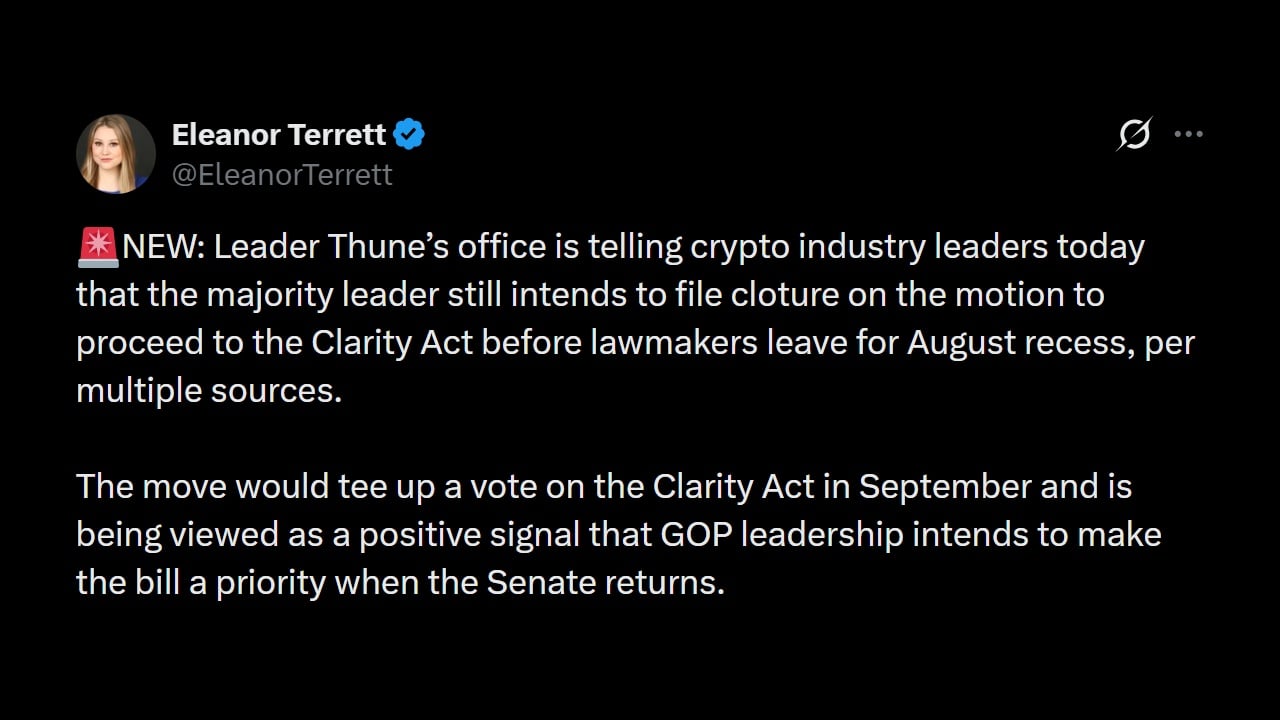
Senate Majority Leader John Thune is pushing the CLARITY Act to a floor vote before the August recess, even if the landmark CLARITY Act lacks the 60 votes needed to clear a Senate filibuster.
According to CNBC, Thune wants to force the vote specifically to get every senator on the record. “I would like to at least get Clarity started.We’ll see where the votes are,” he said.
A Make-or-Break Window for U.S. Crypto Regulation
The CLARITY Act, formally known as H.R. 3633 and also called the Digital Asset Market Clarity Act, passed the House in July 2025 with strong bipartisan backing.
The Senate Banking Committee advanced an amended version 15-9 in May 2026. This week, a merged Banking and Agriculture Committee text, now including ethics language, was released.
But as CoinGape reported, Thune himself has admitted the CLARITY bill is unlikely to pass before August.
The bill needs roughly seven Democratic votes to survive a filibuster, assuming near-unanimous Republican support.
Republicans currently hold 53 Senate seats. A coalition of seven Democratic senators, led by Senator Angela Alsobrooks, says the current draft “falls short” on consumer protections and illicit-finance safeguards.
Ethics provisions remain the sharpest sticking point. The bill includes a temporary ban on federal officials, including the president and vice president, from issuing or sponsoring digital assets.
The restriction sunsets in 2029. Senator Cynthia Lummis, who has been vocal on ending regulatory uncertainty around digital assets, flagged thetension between ethical restrictions and industry needs, noting that any provision pleasing Trump’s opponents may lose the White House’s support.
White House crypto adviser Patrick Witt has separately endorsed the law-enforcement and Fidelity support provisions.
Ripple and Coinbase CEOs have both publicly urged passage of the CLARITY Act, joining Fidelity and major industry groups lobbying for floor action.
Goldman Sachs CEO David Solomon also backed the bill despite banking industry concerns over stablecoin yields.
What a Failed Vote Means for Institutional Capital
A successful cloture vote would deliver long-sought jurisdictional clarity between the SEC and CFTC.
It would establish clearer rules for digital commodities, create developer safe harbors, and improve the regulatory environment for ETFs, exchanges, and institutional capital.
A failed or delayed vote, by contrast, pushes the CLARITY Act into a politically charged midterm cycle, one that could redraw the Senate map and shift legislative priorities entirely.
Senator John Kennedy underscored the urgency. “If we don’t have a positive vote before the August break, I think the odds shift against us,” he said.
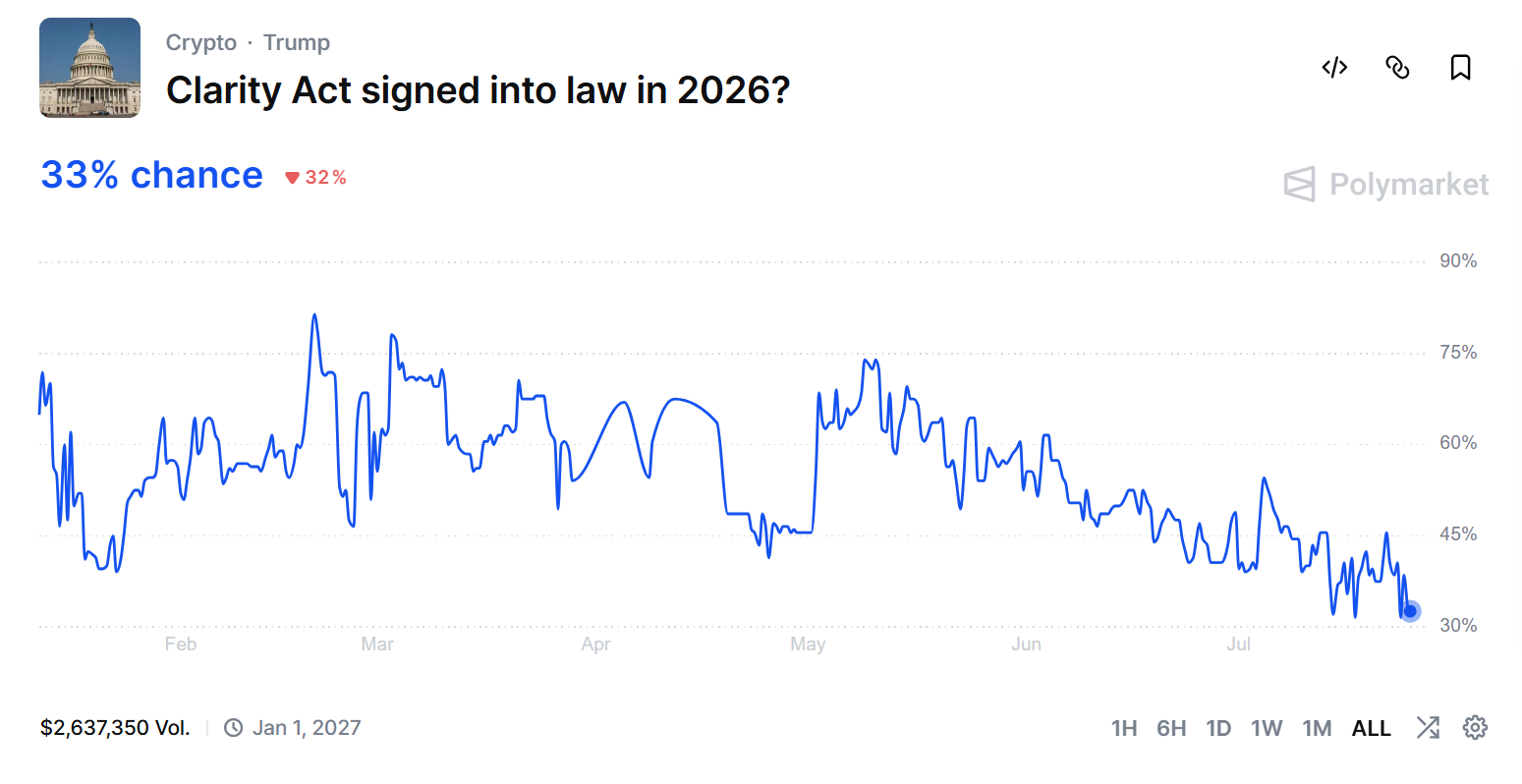
Approval odds have already dropped sharply as Democrats oppose key provisions in the latest draft.
Senator Tillis has separately said the ethics deal is ‘not quite there’, adding further uncertainty to the timeline.
Thune’s decision to force a floor vote, even without guaranteed passage, is a calculated move. It creates a public record. It pressures Democratic holdouts.
Also, it preserves the bill’s momentum heading into a volatile political season. The question now is whether that pressure is enough.
If you’re hunting for early-stage opportunities, check out our list of the best crypto presales.