If you or someone you love ever needs surgery, you’ll obviously want to use the best surgeon available.
But what if that surgeon isn’t in your city? Or even your state?
Last month, researchers at the University of California San Diego successfully used humanoid robots controlled remotely by surgeons to perform live surgery.
The robots didn’t make any decisions, they simply carried out the surgeons’ movements.
But what’s remarkable is that the surgeon didn’t have to be in the operating room.
I think this demonstration could prove to be one of the most important advances in robotics we’ve seen in years.
Because it could help solve a problem that has plagued humans for centuries:
What I call the distance bottleneck.
Beyond Human Reach
Human expertise has always come with one unavoidable limitation.
If you wanted the best surgeon, engineer or technician, you either traveled to them or they traveled to you.
But humanoid robots have the potential to change that.
The surgery performed at UC San Diego wasn’t exciting because robots can now operate on patients. After all, surgeons have been using robotic surgical systems like Intuitive Surgical’s da Vinci platform for over two decades.
Image: Intuitive.com
What made this demonstration different is that researchers used general-purpose humanoid robots rather than specialized surgical equipment.
Why does that matter?
Last week, I wrote about how robots are about to become an ordinary part of our everyday lives.
This experiment shows just how transformative their impact could be.
Because it means the world’s best human expertise will no longer be limited by geography
With two arms, two hands and two legs, humanoid robots can stand beside an operating table, hold the same instruments a surgeon uses and move through a hospital without engineers redesigning the room around the robot.
That makes them far more flexible than machines built to perform just one task.
For example, imagine living in a small town and learning you need a highly specialized operation.
Today, that could mean traveling hundreds of miles to a major medical center, spending weeks away from home and waiting for an opening on the surgeon’s schedule.
Tomorrow, that same patient might be able to receive the procedure at their local hospital while one of the world’s leading specialists operates a humanoid robot from hundreds or even thousands of miles away.
In other words, instead of asking patients to travel to expertise, expertise could come to the patient.
That removes a very important bottleneck.
And it extends well beyond medicine.
Consider disaster response.
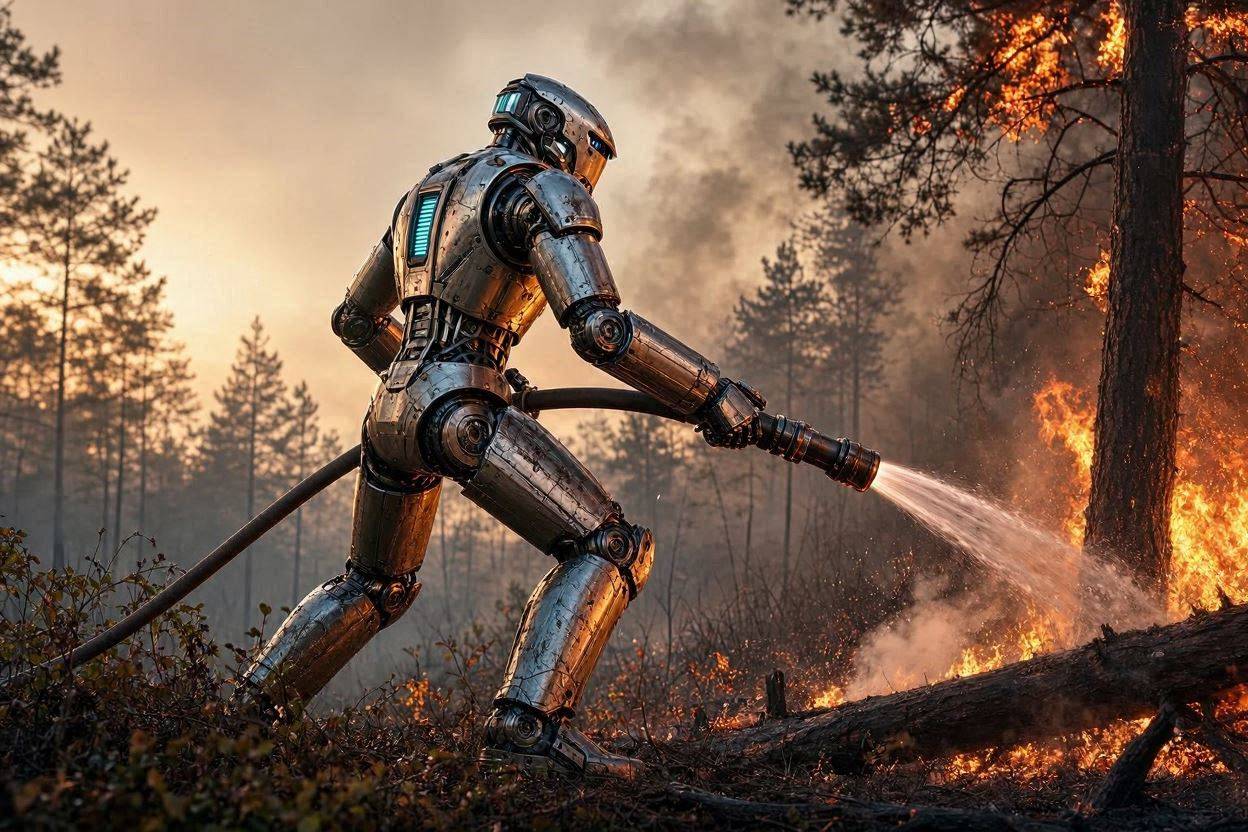
When a chemical plant explodes, a building collapses or a wildfire threatens nearby communities, the first people through the door often face the greatest danger.
But instead of sending firefighters or emergency crews into the most dangerous areas first, one day we should be able to send robots controlled by experienced responders from a safe location.

Image: NASA/Bill Stafford, James Blair, Regan Geeseman
Obviously, the goal isn’t to replace firefighters. It’s to keep them alive.
And that’s a major reason researchers have spent so much time developing humanoid robots to navigate environments built for humans.
Following the Fukushima disaster in Japan, engineers spent years developing robots capable of entering areas where radiation made it too dangerous for people to work.
The problem wasn’t building a robot that could survive the radiation. It was that most robots couldn’t move through facilities that were built entirely for humans.
Humanoid robots solve this problem because they can climb the same stairs, turn the same control valves and use the same tools that human workers already use.
And if that sounds ambitious, consider what Elon Musk has planned.
For more than two decades, Musk has said his ultimate goal is to build a self-sustaining city on Mars.
But earlier this year, he announced an important change in strategy.
Instead of going straight to Mars, SpaceX is now prioritizing what Musk calls a “self-growing city” on the Moon, with the goal of beginning construction within the next decade.

Mars still remains the long-term destination, but Musk says the Moon is the faster path because it’s only a few days away. That makes the Moon a much better place to test new technologies before sending them millions of miles farther into space.
And that’s where humanoid robots come in.
Rather than asking astronauts to spend months unloading cargo, assembling habitats, deploying solar panels and preparing living quarters, Musk envisions Tesla’s Optimus robots arriving first.
As Strategic Fortunes readers know, one of the reasons I added Tesla (Nasdaq: TSLA) to our model portfolio in 2024 is because I’m bullish on the Optimus project.
In Musk’s latest vision, these robots would be tasked with building infrastructure on the Moon for humans before they arrive.
So instead of astronauts arriving at an empty, barren landscape, they could arrive to find livable habitats already waiting for them.
And if that strategy works on the Moon, it could eventually work on Mars.
Here’s My Take
Last week, I argued that robots are about to become an ordinary part of our daily lives.
But the next generation of robots won’t simply take on repetitive jobs.
They’ll allow the world’s best surgeons, engineers, scientists and emergency responders to extend their skills far beyond where their own bodies can reach.
That’s an exciting prospect.
Because it could give millions of people access to expertise they’ve never had before.
Regards,
 Ian KingChief Strategist, Banyan Hill Publishing
Editor’s Note: We’d love to hear from you!
If you want to share your thoughts or suggestions about the Daily Disruptor, or if there are any specific topics you’d like us to cover, just send an email to [email protected].
Don’t worry, we won’t reveal your full name in the event we publish a response. So feel free to comment away!