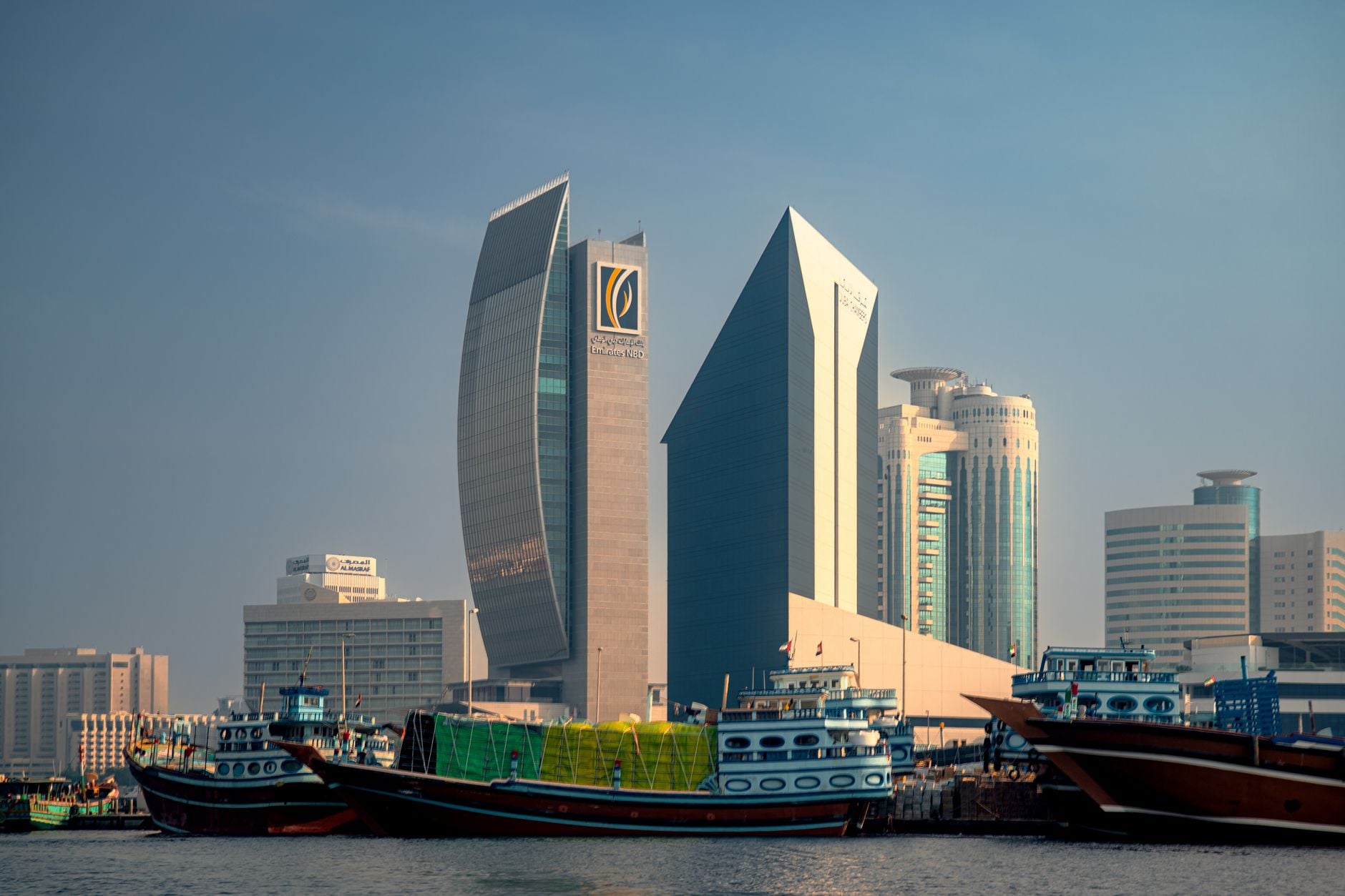
Dubai is routinely treated as an oil city because it is wealthy, Gulf-based and visually associated with the wider United Arab Emirates. Its economy now looks very different. Trade is its largest directly measured sector, while finance, transport, property, tourism and aviation carry much of the rest.
The familiar claim that oil has fallen from roughly half of Dubai’s economy in the early 1980s to less than 1 per cent is broadly useful, but its two endpoints come from different vintages of data. In 2004, a Dubai government official said oil’s share had fallen from 54 per cent in the early 1980s to below 7 per cent. An International Monetary Fund discussion paper later listed Dubai’s oil share at below 1 per cent in 2009.
The latest official tables do not isolate oil in the same way. Dubai’s first-quarter 2025 GDP table assigns 2.3 per cent to the broader category of mining and quarrying, which includes more than crude oil. The statistical series was revised again from the beginning of 2026. A precise current oil-only percentage is therefore not available in the newest headline release.
The larger conclusion survives that caveat: hydrocarbons are a small single-digit part of Dubai’s measured output, not the engine of the economy.
Dubai and the UAE are not interchangeable
Much of the confusion begins by treating Dubai as shorthand for the UAE. The federation’s large oil reserves and most of its production sit in Abu Dhabi. Dubai discovered oil in the 1960s and used the revenue to accelerate infrastructure spending, but its reserves and output were much smaller.
Oil mattered enormously as early capital. That is different from saying it remains the source of most annual economic activity.
The historical comparison also needs care because GDP measures production within an economy, not the origin of every dirham invested in it. Oil revenue could finance a port, road or airport; once built, the trade, transport and services enabled by that infrastructure appear under their own sectors. Diversification changes both what an economy produces and how its income circulates.
Trade is the largest direct sector
Dubai’s newest revised data make the structure fairly plain. In the first quarter of 2026, wholesale and retail trade accounted for about 22 per cent of GDP. Financial and insurance activities contributed 14 per cent, real estate 11.2 per cent, construction 8.1 per cent and information and communications 5.2 per cent.
That mix was built through logistics and regulation as much as through landmark buildings. Port Rashid began operating in 1972, followed by Jebel Ali Port in 1979. The adjacent Jebel Ali Free Zone was created by decree in 1985, starting with 19 companies. Jafza now reports more than 11,000 businesses, including over 100 companies from the Fortune Global 500.
The port and free zone made Dubai useful as an entrepôt: goods could arrive by sea, be stored, processed, financed and re-exported across the Middle East, Africa and South Asia. This extended an older trading role rather than inventing commerce from nothing.
Aviation connects the model
Emirates was established in 1985 with $10 million in seed funding and a five-month launch deadline, according to the airline’s corporate history. It became more than a transport company. A hub airline links visitors, cargo, conferences, financial services and regional headquarters to the same city.
An Oxford Economics study commissioned by Emirates Group and Dubai Airports estimated that aviation supported AED137 billion in gross value added in 2023, equivalent to 27 per cent of Dubai’s GDP. The published impact assessment separated AED94 billion of core aviation activity from AED43 billion generated by aviation-facilitated tourism.
That 27 per cent should not be added to transport, trade and tourism shares in the GDP table. It is an economic-impact estimate that follows direct activity through supply chains, employee spending and visitor expenditure. Some of the output therefore appears inside sectors such as accommodation, retail and transport.
The distinction matters because Dubai’s economic components reinforce one another. The airport feeds hotels and shops. Trade supports logistics and finance. Property accommodates companies, workers and visitors. Treating each headline number as an independent slice would count some activity twice.
Tourism is larger than the hotel line
Accommodation and food services contributed 3.4 per cent of GDP during the first nine months of 2025. That direct category is narrower than tourism’s total economic effect because visitors also spend on flights, shops, local transport, entertainment and property-related services.
Dubai’s Department of Economy and Tourism recorded 19.59 million international overnight visitors in 2025, up 5 per cent from 2024. Hotels recorded 44.85 million occupied room nights and average occupancy of 80.7 per cent. Dubai International handled 95.2 million passengers over the same year, although many were transferring rather than entering the city.
Tourism, aviation and trade are therefore better understood as one connectivity strategy with several revenue channels. Dubai earns from moving people, goods, capital and companies through a compact hub.
Diversification does not remove exposure
Moving away from oil production changed Dubai’s risks rather than eliminating them. The economy remains sensitive to global travel, shipping volumes, property cycles, interest rates and regional security. Its airlines, ports, hotels and property market all depend on international demand and open transport routes.
The model also rests on continuing infrastructure investment. Dubai has approved a new AED128 billion airport at Dubai World Central, while its D33 economic agenda aims to expand foreign trade and double the size of the economy by 2033. Those are policy targets and spending plans, not guaranteed outcomes.
Oil supplied early capital, but the operating system built with it now matters more: ports beside free zones, an airline tied to a global airport, and rules designed to attract trade, investment and mobile labour. The latest data show an economy led by services and exchange, with no single replacement for oil.
Dubai did not swap one dominant commodity for one dominant industry. It assembled several interdependent ones.