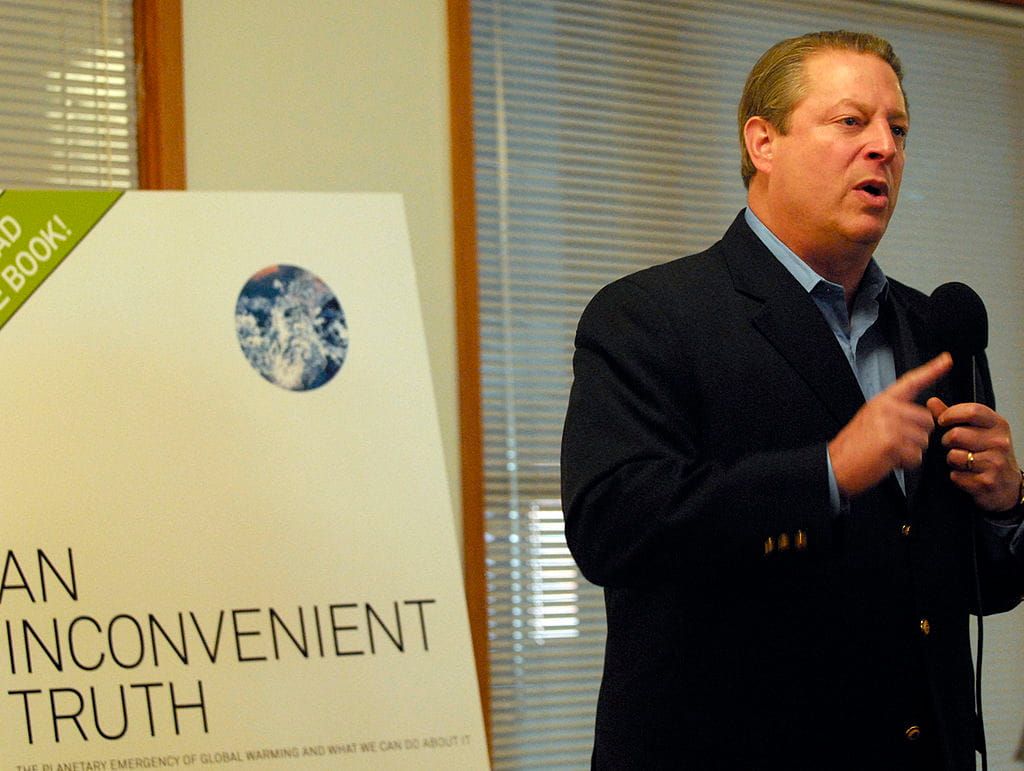
“The scientists were dead right” about global warming, former Vice President Al Gore recently told ABC News and The Bulwark podcast. The world marks the 20th anniversary of the release of An Inconvenient Truth, a documentary that influenced public policy, shaped a generation, and made Gore millions of dollars wealthier. But while he claims its predictions hold up, the reality is far more inconvenient for the climate alarmists.
Celebrating An Inconvenient Truth
One of the best things to have ever happened to Al Gore was losing the 2000 presidential election. The defeat by President George W. Bush allowed him to focus on writing and producing An Inconvenient Truth, which netted him an Academy Award, a Nobel Prize, and the eternal adoration of paper-straw lovers.
Gore has been on a media tour in recent weeks to commemorate its release two decades ago. When asked by ABC News if the film’s claims hold up, he responded definitively: “Unfortunately, yes.” The former vice president continued:
“The scientists were dead right on all the important elements of it, and it really is insane that we are continuing to use the sky as an open sewer and we’re trapping so much heat every day it’s equal to the amount that would be released by 800,000 Hiroshima-class atomic bombs exploding every day on the earth.”
But how accurate were his various claims – cities underwater, the extinction of polar bears, and an ice-free Arctic – actually? Suffice it to say, pretty much nothing came true. But there is still time!
Blame Everything on Global Warming
One of the most memorable predictions was that the polar bear population would shrink. He shared a heart-wrenching graphic of one trying to find an ice sheet, supporting his point that they are drowning at high levels, and symbolizing the planet’s impending doom. The reality is that the study Gore cited only found four polar bears drowning. Additionally, the global population has improved, rising from around 20,000 in 2006 to about 32,000 last year.
The glacial ice cover on Mount Kilimanjaro has grown by almost four square kilometers over the last 25 years. This is in stark contradiction to a stunning prognostication from Gore’s documentary: “Within the decade, there will be no more snows of Kilimanjaro.” He also predicted that the Glacier National Park in Montana would lose its glaciers by 2020.
At the time, Gore warned that world maps would have to be redrawn because Greenland and Antarctica would eventually melt and break apart. If they broke up and melted, a 20-foot sea rise would occur: Florida would be underwater, San Francisco Bay would be gone, and the Netherlands would be devastated. A hundred million people in China, India, and Bangladesh would be displaced by severe flooding.
It turns out that any recession in the Greenland ice sheet has slowed and stabilized in recent years. Antarctica’s sea ice has not only been firm but has also increased. Sea levels, according to Gore, would climb by 236 inches. But they rose just 3.8 inches between 1993 and 2021.
Then there are hurricanes, the one type of weather event that the left uses to reaffirm climate change. Gore cited Hurricane Katrina in the movie, arguing that it illustrates global warming driven by warm Gulf of Mexico waters. However, the data shows that over the last decade, hurricane activity has been variable. In fact, there were zero last year for the first time since 2015, something that NPR suggested “shows effects of climate change.”
Despite fact-checkers spotting many of the inaccuracies, Gore continued to make outlandish claims after the film was released, which were also wrong. In 2009, speaking at the Copenhagen climate change summit, Gore predicted that the North Pole would be ice-free by 2013 due to global warming. It is 2026, and the ice remains.
Paul Ehrlich 2.0
Like Supersize Me encouraging people to stop eating Big Macs, An Inconvenient Truth pushed the world to muster up the political will and courage to save the polar bears. We listened. Collectively, the planet has spent about $16 trillion on implementing these climate policies. The exorbitant cost of fighting the climate crisis has not yielded results.
In 2006, the globe received 83% of its total energy from fossil fuels. Nearly 20 years later, those numbers have declined to 81%, making the net-zero goal adopted by governments worldwide a bad, expensive joke. In the 21st century, costs will outweigh the benefits, according to a 2023 paper released earlier this year. Researchers determined that the Paris climate policy will cost $27 trillion per year, while the benefits will be $4.5 trillion annually.
In the 1960s, US scientist Paul Ehrlich published The Population Bomb, a book that shaped public opinion and attitudes for decades. Although virtually none of his predictions came true, Ehrlich doubled down on his claims over the years. Al Gore is doing the same thing, and he does not intend to learn from his mistakes.
“I put it in the context of all of the other morally based challenges that humanity has confronted: the abolition of slavery, the women’s rights and women’s suffrage,” Gore said.


-1024x683.jpg "Liberty Lifestyle: The New American Hobby – Tracking Everything")





-1024x683.jpg "Florida Roads Become a Battleground for Illegal Immigration")