
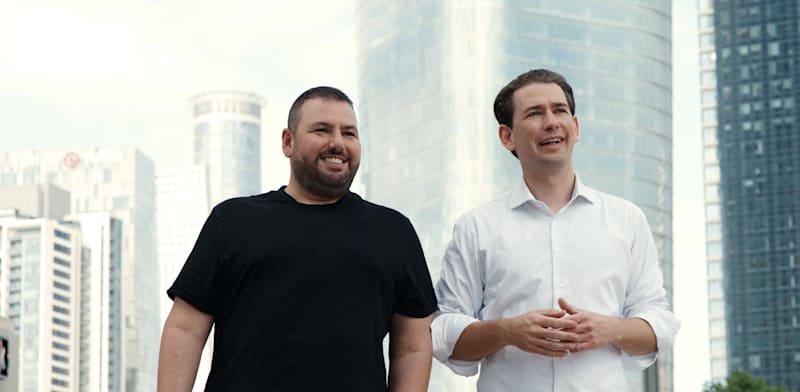
Israeli cybersecurity company Dream Security, which was founded by former spyware company NSO Group CEO Shalev Hulio, and former Austrian Chancellor Sebastian Kurz, has announced a $260 million financing round at a company valuation of $3 billion. The company has been completing a financing round each year and this time the round was led by Dovi Frances’s Group 11.
Also participating in the financing round is Bicycle Capital from Miami, managed by former J.P. Morgan and SoftBank senior executive Shu Nyatta, who sits on the board of Israeli digital insurance company lemonade. One of the drivers for the huge round is a number of launches that provide countries with a solution to a problem that surfaced last week, when the US government decided to block access to powerful language models Mythos and Fable for non-US citizens. This means governments need a sovereign national language model to avoid dependence on companies like Anthropic and OpenAI.
Also participating in the round are Clal Insurance and Financial and existing investors including Bain Capital, which led the previous round of funding, BRV, Antler, Tru Arrow Partners and Aleph Fund. The funding was completed after the company claims that since the start of its commercial operations in late 2024, it has accumulated $300 million in orders. According to estimates, the company’s annual recurring revenue (ARR) recently crossed the $100 million mark.
Dream Security operates differently from other cybersecurity companies in that it does not focus on a specific product niche such as identifying vulnerabilities, protecting databases or an organizational network, but on its target market. Dream addresses national cyber systems, governments and national infrastructure companies – nuclear reactors, gas, oil, water and electricity – and markets them a cybersecurity system that tries to do simultaneously what other cybersecurity companies offer in a variety of different products. However, in the last two years, the company has also worked on developing sovereign language models that go beyond cyber applications and address all government offices such as the ministries of finance, justice and interior.
Dream is renowned thanks to a system called Sphere – a kind of cybersecurity system sold to governments and national infrastructure operators that identifies, investigates and thwarts cyberattacks by state actors. But now the company is moving towards the field of researching and “sealing” vulnerabilities – a field in which many companies such as Zafran, Psychoginto, Pantera, Simulate and Safe Breach, some of which are Israeli, are active. Dream’s product called Hero autonomously investigates vulnerabilities and attack routes of state actors like Russia, Iran and China, assesses the risks and recommends ways to fix them.
RELATED ARTICLES
Israeli co Dream Security raises $100m at $1.1b valuation
Dream Security raises $45m in secondary financing
Dream’s new product, Atlas, is designed to address the closure of Anthropic’s language models to non-Americans by creating a natural language model intended for state use.
Dream CEO Shalev Hulio tells “Globes,” “If in the past we talked about a language model for state cyber uses, we have also developed other models that are also used for intelligence, health, finance and law that can be used by states as their sovereign language models,”
Hulio stresses that the company does not have access to the information of the governments, which train the model in their cloud and operate it from their data centers. This also has an advantage for Dream – it is not required to be responsible for the inference aspect of the models, and the number of customers is limited to government and national entities only, which reduces the burden of using the system. Dream’s language models include 8-80 billion parameters – a medium order of magnitude compared with the powerful models of Anthropic and Mythos, and on the other hand, these are models focused on the world of government content and do not need to process data on a variety of other topics.
Dream holds space in MegaDC’s data center in Modi’in with an activity volume of 250 kilowatts, with hundreds of Blackwell 200 GPUs. “Every country has information, but few know how to protect it, even fewer know how to use it. And only a few know how to turn it into a strategic asset,” says Hulio. “In the coming decade, the ability to turn data into a strategic asset will be one of the factors that will determine the strength, independence and resilience of countries. We founded Dream with the belief that AI is a new national infrastructure, and when it comes to critical national infrastructure, access is not enough. Countries need control, independence and the ability to operate their AI in accordance with their national interests.”
“The central question for governments is no longer whether to use AI, but who controls it,” says Sebastian Kurz. “Countries that want to maintain their independence must be able to operate advanced AI capabilities on infrastructures under their control and in accordance with their national interests. Sovereignty over AI is becoming one of the foundations of the resilience, security and independence of countries today.”
Dovi Frances, who led the company’s seed round, as well as the current round, the fourth in number (not including “secondary” rounds), says, “Dream is building the most important infrastructure layer of the AI era.”
Published by Globes, Israel business news – en.globes.co.il – on June 18, 2026.
© Copyright of Globes Publisher Itonut (1983) Ltd., 2026.






-1024x683.jpg "Judge Who Helped Violent Illegal Alien Evade ICE Faces New Test")


-1024x683.jpg "Montana Puts Democrats in a Bind as Senate Hopes Fade")








