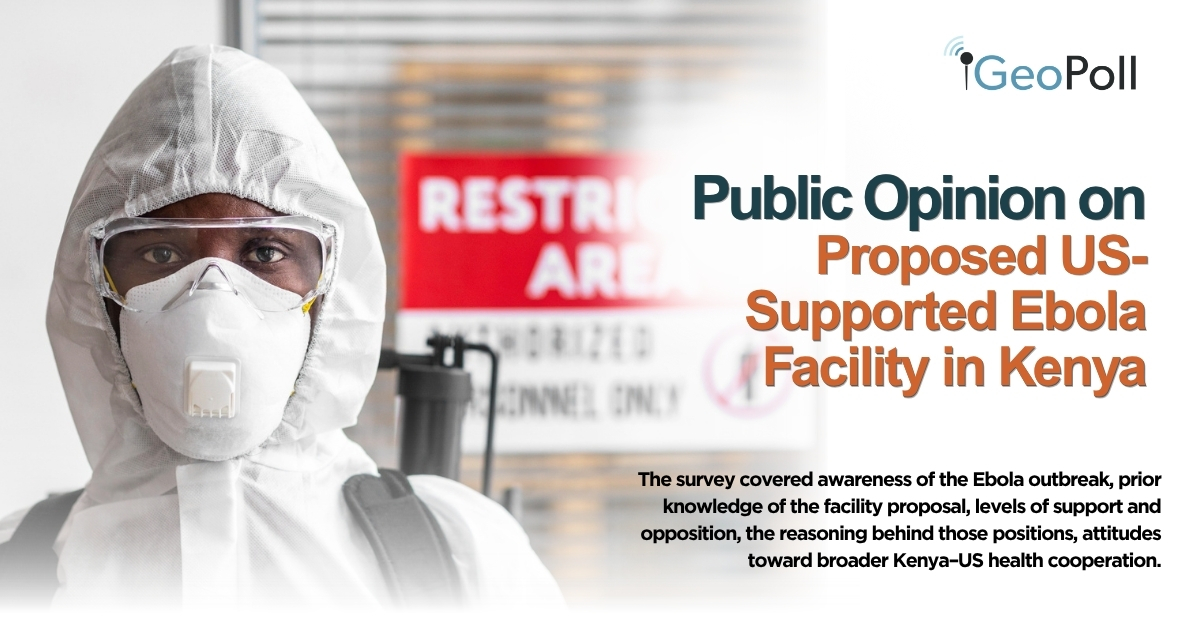
In late May 2026, reports emerged that the United States government was in advanced discussions with Kenyan authorities to establish a quarantine facility in Laikipia County, designed to house American citizens and personnel exposed to Ebola in the region. The proposal triggered significant public debate, raising questions about sovereignty, public health risk, and the terms of Kenya’s engagement with foreign governments in health emergencies.
To understand where Kenyan public opinion stood on this issue, GeoPoll deployed a mobile panel survey between 29th and 31st May 2026, reaching 691 respondents across the country. The survey covered awareness of the Ebola outbreak, prior knowledge of the facility proposal, levels of support and opposition, the reasoning behind those positions, attitudes toward broader Kenya–US health cooperation, and the institutions and media channels Kenyans trust most when it comes to public health information.
The results are clear and consistent across the sample. Kenyans are well-informed about both the Ebola threat and the specific proposal, and they are largely opposed to it. But the nature of that opposition carries important nuance: it is rooted primarily in concern about disease transmission risk, not in anti-American sentiment or diplomatic grievance. And despite opposing this specific facility, a majority of Kenyans would support broader infectious disease preparedness cooperation with the United States.
Key Findings
Awareness of both Ebola and the proposed center is very high. 97% of respondents had heard of the current Ebola outbreak, and 92% were already aware of the Laikipia facility proposal before taking this survey.
Opposition to the center is strong and decisive. 71% oppose the Kenya government allowing the center, 61% strongly. Only 26% express any level of support.
Health risk is the dominant concern. 45% of multi-select reasons cite the center as a health risk that could spread Ebola in Kenya. Sovereignty concerns (17%) and the view that Americans should be treated at home (15%) also feature prominently.
Most respondents (64%) are specifically concerned about the risk of disease spread; safety and security concerns follow at 15%.
54% do not believe the center would strengthen Kenya’s healthcare system overall.
On broader US partnership, Kenyans are more divided: 54% would support Kenya partnering with the US on infectious disease preparedness, while 28% oppose it, suggesting the objection is specific to this facility rather than to US engagement generally.
93% say communities near the proposed center must be consulted before implementation. 81% are very concerned about Ebola misinformation in Kenya.
TV News (31%), Ministry of Health announcements (20%), and social media (17%) are the most trusted information sources on the center.
Ebola Outbreak Awareness
An overwhelming 97% of respondents reported awareness of the current Ebola outbreak, while only 3% indicated they were not aware. This near-universal awareness suggests a highly informed public, indicating that opinions on the proposed quarantine facility are likely based on informed understanding rather than uninformed or reactive sentiment.
Methodology/About this Survey
This exclusive survey was powered by GeoPoll’s AI platform; Tuucho run via the GeoPoll mobile application and WhatsApp in Kenya between between 29 and 31 May 2026 the sample size was 691, composed of random users between 18 and 50. Since the survey was randomly distributed to an and the results are slightly skewed towards younger respondents. All questions were self-administered via mobile survey in English.
This study examines public perceptions in Kenya regarding the proposed US-supported Ebola quarantine facility in Laikipia, with a broader focus on attitudes toward international cooperation in infectious disease preparedness and the information environment shaping these views.
The aim is to understand how Kenyans perceive the proposed facility, the extent to which they support or oppose it, and how these views relate to broader acceptance of Kenya–US health collaboration. It also explores expectations around community consultation and the role of trust and misinformation in shaping public opinion.
Overall, the study seeks to provide insight into the balance between public health security priorities, sovereignty concerns, and trust in both government and information sources in the context of emerging infectious disease preparedness.
Please get in touch with us to get more details about our capabilities, explore more on various topics in Africa, Asia, and Latin America.









-1024x683.jpg "Judge Who Helped Violent Illegal Alien Evade ICE Faces New Test")


-1024x683.jpg "Montana Puts Democrats in a Bind as Senate Hopes Fade")