No Result
View All Result
SUBMIT YOUR ARTICLES
  • Login
Tuesday, June 9, 2026
TheAdviserMagazine.com
  • Home
  • Financial Planning
    • Financial Planning
    • Personal Finance
  • Market Research
    • Business
    • Investing
    • Money
    • Economy
    • Markets
    • Stocks
    • Trading
  • 401k Plans
  • College
  • IRS & Taxes
  • Estate Plans
  • Social Security
  • Medicare
  • Legal
  • Home
  • Financial Planning
    • Financial Planning
    • Personal Finance
  • Market Research
    • Business
    • Investing
    • Money
    • Economy
    • Markets
    • Stocks
    • Trading
  • 401k Plans
  • College
  • IRS & Taxes
  • Estate Plans
  • Social Security
  • Medicare
  • Legal
No Result
View All Result
TheAdviserMagazine.com
No Result
View All Result
Home Market Research Economy

Is the US Economy Headed for a Bust?

by TheAdviserMagazine
14 hours ago
in Economy
Reading Time: 5 mins read
A A
Is the US Economy Headed for a Bust?
Share on FacebookShare on TwitterShare on LInkedIn


There is a high likelihood that, due to the past large decline in the yearly growth rate of the money supply, the US economy is heading towards an economic bust. Note that the yearly growth rate of money supply fell from 79 percent in February 2021 to minus 7 percent by May 2023.

The sharp decline in the yearly momentum of money supply is starting to hurt various activities that emerged on the back of the huge increases in the money supply between August 2019 and February 2021—from minus 1 percent to 79 percent. It is likely that the effect of this massive increase is still dominating the present state of economic activity (see chart).

As time goes by, however, the effect of the huge decline in money supply growth is increasingly likely to assert itself on economic activity.

As a result, various bubble activities are likely to crumble. The reason for this is that the diversion of savings to them from wealth-generators will weaken due to the decline in money supply growth. Consequently, various bubble activities will be deprived of funds they have relied upon in order to grow and survive.

Projects that have emerged because of the expansionary monetary policy of the central bank and the resulting money creation by the commercial banks might be impressive in nature and scale—such as the artificial intelligence (AI) capex boom—but these projects might not be affordable. What determines the affordability of these ventures is the state of the subsistence fund.

The Essence of a Subsistence Fund

Most goods that individuals require to support their lives and well-being are not readily available from nature. These goods have to be produced by transforming various things in nature into goods that individuals can use. This transformation undergoes various stages.

In an economy which operates in the framework of the division of labor, some individuals are employed in the extraction of various raw materials such as coal and iron. Some other individuals are employed in the alteration of raw materials into various tools and machinery. Whereas some other individuals are employed in the transformation, by means of the tools and machinery, of various goods into consumer goods.

Individuals employed in the various stages of production must have access savings to support them while producing in those stages. This investment in capital goods comes from private savings.

If private production and saving increases, all other things being equal, this would permit an expansion of productive infrastructure. An expanded subsistence fund enables individuals to introduce new stages of production which, prior to the expansion of the fund, could not be undertaken. This, in turn, permits the production of a greater quantity and a greater variety of consumer goods.

In addition, once there has been an adequate increase in saving, individuals would then be in a position to aim at further enhancing their well-being by seeking things such as entertainment and services related products, such as medical services, etc. The size of the subsistence fund—comprised of private savings—sets the limit on the projects that can be implemented. On this, Richard von Strigl wrote:

Let us assume that in some country production must be completely rebuilt. The only factors of production available to the population besides laborers are those factors of production provided by nature. Now, if production is to be carried out by a roundabout method, let us assume of one year’s duration, then it is self-evident that production can only begin if, in addition to these originary factors of production, a subsistence fund is available to the population which will secure their nourishment and any other needs for a period of one year. . . . The greater this fund, the longer is the roundabout factor of production that can be undertaken, and the greater the output will be. It is clear that under these conditions the “correct” length of the roundabout method of production is determined by the size of the subsistence fund or the period of time for which this fund suffices.

According to Bohm-Bawerk:

The entire wealth of the economical community serves as a subsistence fund, or advances fund, and, from this, society draws its subsistence during the period of production customary in the community.

The size of the subsistence fund constrains the affordability of various projects such as AI. An enhanced structure of production is what sets in motion an increase in economic growth, all other things being equal. The improvement in the infrastructure, in turn, takes place as a result of the increase in the subsistence fund. Hence, anything that weakens the subsistence fund undermines the prospects for economic growth. Consequently, regardless of how impressive various projects are, what determines whether these projects are viable is the state of the subsistence fund.

Introducing Money

Money’s main function is to fulfill the role of the medium of exchange. Money does not sustain or fund economic activity, but, without the medium of exchange, neither the division of labor nor the market economy could have emerged. (The existence of money enables individuals to specialize).

Individuals pay with goods and services they produce—they do not ultimately pay with money. Money only helps to facilitate payments. Money enables the goods of one specialist to be exchanged for the goods of another specialist. On this Mises wrote,

Commodities, says Say, are ultimately paid for not by money, but by other commodities. Money is merely the commonly used medium of exchange; it plays only an intermediary role. What the seller wants ultimately to receive in exchange for the commodities sold is other commodities.

By means of money, an individual can channel savings to other individuals as capital investment, which, in turn, permits the widening of the process of wealth generation.

As things currently stand, it is likely that the yearly growth rate of private savings is under pressure. The key reason for this is the ever-growing government outlays and the relentless central bank tampering with financial markets (see charts below). In April 2026, government outlays increased by almost 400 percent versus January 2000.
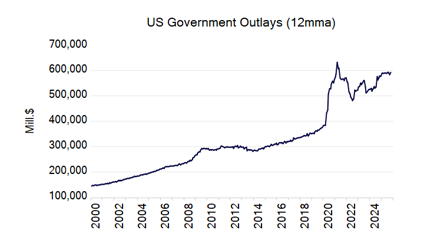
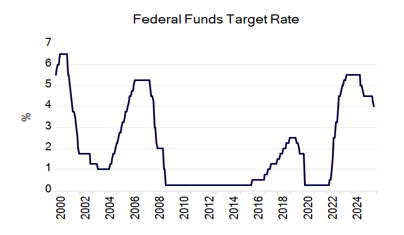


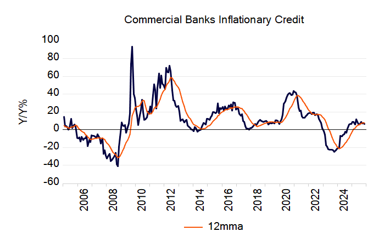
The erosion of the savings through decades of money printing and distortion of market signals means that individuals in the economy are currently not wealthy enough to pursue the current level of investment in activities. If the central bank were to aggressively lower the interest rates and increase the money supply, this would make things much worse. Expansionary monetary policy further undermines saving, depreciates the value of the money, and distorts the structure of production. Furthermore, expect the yearly growth rate of banks’ inflationary credit to weaken in the months ahead. As a result, this is expected to put more pressure on bubble activities as they are starved of inflationary money and credit.
To alleviate the likely economic crisis what is required is a reduction or cessation in the central bank’s tampering with financial markets and a large curtailment of government spending.

Conclusion

As a result of the decline in the monetary growth during the February 2021 to May 2023, it is quite likely that the US economy is heading towards an economic bust. Various projects that have emerged on the back of the previous expansionary policy from August 2019 and February 2021 might be of an impressive nature but these projects are likely not demanded to that extent by an undistorted market. Regardless of how impressive these projects are, they are bubble activities and therefore are likely to burst.



Source link

Tags: BusteconomyHeaded
ShareTweetShare
Previous Post

Four Moves in Six Weeks: How Payward Is Remaking Kraken as a Regulated Infrastructure Platform

Next Post

How GPS Fleet Tracking Helps Small Businesses Scale Without Hiring More Drivers 

Related Posts

edit post
Market Talk – June 8, 2026

Market Talk – June 8, 2026

by TheAdviserMagazine
June 8, 2026
0

ASIA: The major Asian stock markets had a negative day today: • NIKKEI 225 decreased 2,563,52 points or -3.85% to...

edit post
The Dem Establishment Goes All-In Against Platner

The Dem Establishment Goes All-In Against Platner

by TheAdviserMagazine
June 8, 2026
0

While nominally an opposition party facing an existential fight with an authoritarian GOP, the Democratic party establishment and their allies...

edit post
Household financial worries at highest level since 2022, New York Fed says

Household financial worries at highest level since 2022, New York Fed says

by TheAdviserMagazine
June 8, 2026
0

U.S. households grew more worried over their financial situation, with the share of those seeing things as much worse than...

edit post
We’re Freaking Doomed without Freedom from State Rule

We’re Freaking Doomed without Freedom from State Rule

by TheAdviserMagazine
June 8, 2026
0

What is the Mises Institute? The Mises Institute is a non-profit organization that exists to promote teaching and research in...

edit post
Links 6/8/2026 | naked capitalism

Links 6/8/2026 | naked capitalism

by TheAdviserMagazine
June 8, 2026
0

Major quake off Philippines kills at least 15, triggers tsunami warnings Straits Times Sunflower power: Inside Barry Callebault’s bid to...

edit post
The Self, the Crowd, and Social Contagion (with Luke Burgis)

The Self, the Crowd, and Social Contagion (with Luke Burgis)

by TheAdviserMagazine
June 8, 2026
0

0:37Intro. Russ Roberts: Today is April 28th, 2026, and my guest is author Luke Burgis. His latest book is The...

Next Post
edit post
How GPS Fleet Tracking Helps Small Businesses Scale Without Hiring More Drivers 

How GPS Fleet Tracking Helps Small Businesses Scale Without Hiring More Drivers 

edit post
Household financial worries at highest level since 2022, New York Fed says

Household financial worries at highest level since 2022, New York Fed says

  • Trending
  • Comments
  • Latest
edit post
Supreme Court Delivers More Bad Redistricting News for Democrats

Supreme Court Delivers More Bad Redistricting News for Democrats

May 19, 2026
edit post
From Maine to Michigan, Democrats Are Making Communism Great Again

From Maine to Michigan, Democrats Are Making Communism Great Again

May 16, 2026
edit post
The 8 States That Still Tax Social Security in 2026

The 8 States That Still Tax Social Security in 2026

June 6, 2026
edit post
A Tax on Social Media – Blue-State Governments’ Newest Ploy

A Tax on Social Media – Blue-State Governments’ Newest Ploy

June 5, 2026
edit post
It’s Time To Talk About Massie

It’s Time To Talk About Massie

May 23, 2026
edit post
Red Snapper Used as Cudgel by Fed Judge

Red Snapper Used as Cudgel by Fed Judge

May 31, 2026
edit post
Texas Topples California Off Its Fortune 500 Throne

Texas Topples California Off Its Fortune 500 Throne

0
edit post
Is the US Economy Headed for a Bust?

Is the US Economy Headed for a Bust?

0
edit post
UK Proposes Limited Retail Fund Exposure to Crypto

UK Proposes Limited Retail Fund Exposure to Crypto

0
edit post
6 Markets Where You Can Launch a Real Estate Investment Career With Homes Under 0,000

6 Markets Where You Can Launch a Real Estate Investment Career With Homes Under $300,000

0
edit post
American Home Shield’s Video Chat: Is It Worth the Hype?

American Home Shield’s Video Chat: Is It Worth the Hype?

0
edit post
People who spend their Sunday rebuilding their task system instead of doing the tasks aren’t procrastinating, many are trying to feel in control of a week they secretly believe will overwhelm them

People who spend their Sunday rebuilding their task system instead of doing the tasks aren’t procrastinating, many are trying to feel in control of a week they secretly believe will overwhelm them

0
edit post
People who spend their Sunday rebuilding their task system instead of doing the tasks aren’t procrastinating, many are trying to feel in control of a week they secretly believe will overwhelm them

People who spend their Sunday rebuilding their task system instead of doing the tasks aren’t procrastinating, many are trying to feel in control of a week they secretly believe will overwhelm them

June 9, 2026
edit post
UK Proposes Limited Retail Fund Exposure to Crypto

UK Proposes Limited Retail Fund Exposure to Crypto

June 9, 2026
edit post
Mid and smallcaps get the money as Nifty lags

Mid and smallcaps get the money as Nifty lags

June 8, 2026
edit post
Mission Produce forecasts M-M second half adjusted EBITDA following Calavo close, with M synergies targeted within 18 months (NASDAQ:AVO)

Mission Produce forecasts $84M-$88M second half adjusted EBITDA following Calavo close, with $25M synergies targeted within 18 months (NASDAQ:AVO)

June 8, 2026
edit post
Strategy Erases Last Week’s Bitcoin Sale With 1,550 BTC Buy

Strategy Erases Last Week’s Bitcoin Sale With 1,550 BTC Buy

June 8, 2026
edit post
American Home Shield’s Video Chat: Is It Worth the Hype?

American Home Shield’s Video Chat: Is It Worth the Hype?

June 8, 2026
The Adviser Magazine

The first and only national digital and print magazine that connects individuals, families, and businesses to Fee-Only financial advisers, accountants, attorneys and college guidance counselors.

CATEGORIES

  • 401k Plans
  • Business
  • College
  • Cryptocurrency
  • Economy
  • Estate Plans
  • Financial Planning
  • Investing
  • IRS & Taxes
  • Legal
  • Market Analysis
  • Markets
  • Medicare
  • Money
  • Personal Finance
  • Social Security
  • Startups
  • Stock Market
  • Trading

LATEST UPDATES

  • People who spend their Sunday rebuilding their task system instead of doing the tasks aren’t procrastinating, many are trying to feel in control of a week they secretly believe will overwhelm them
  • UK Proposes Limited Retail Fund Exposure to Crypto
  • Mid and smallcaps get the money as Nifty lags
  • Our Great Privacy Policy
  • Terms of Use, Legal Notices & Disclosures
  • Contact us
  • About Us

© Copyright 2024 All Rights Reserved
See articles for original source and related links to external sites.

Welcome Back!

Login to your account below

Forgotten Password?

Retrieve your password

Please enter your username or email address to reset your password.

Log In
No Result
View All Result
  • Home
  • Financial Planning
    • Financial Planning
    • Personal Finance
  • Market Research
    • Business
    • Investing
    • Money
    • Economy
    • Markets
    • Stocks
    • Trading
  • 401k Plans
  • College
  • IRS & Taxes
  • Estate Plans
  • Social Security
  • Medicare
  • Legal

© Copyright 2024 All Rights Reserved
See articles for original source and related links to external sites.