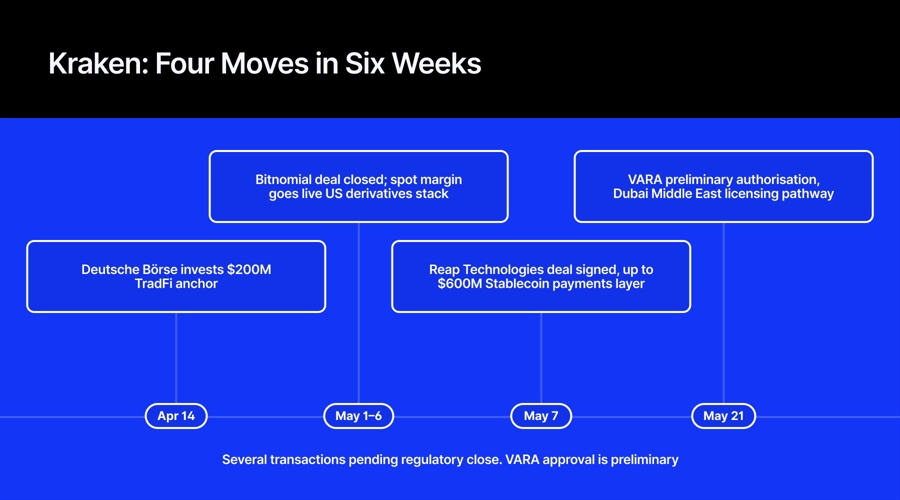
In just six weeks, Kraken’s parent company Payward added the core pieces of a regulated infrastructure platform around the exchange: a TradFi anchor, a US derivatives stack, payments rails, and a Dubai licensing pathway.
Those pieces came through Deutsche Börse’s $200 million stake purchase, the Bitnomial acquisition and US margin launch, the Reap agreement, and preliminary authorization from Dubai’s VARA.
The pattern points to a company moving beyond the crypto exchange model and toward a multi-jurisdictional financial infrastructure platform.
Payward’s own branding has changed. In recent corporate announcements, the company has described itself not simply as a crypto exchange operator, but as a “unified financial infrastructure platform.”
The TradFi Anchor
The first move came on April 14, when Deutsche Börse announced it would acquire a 1.5% fully diluted stake in Payward for $200 million. The stake purchase was structured as a secondary transaction rather than a primary capital raise, implying a company valuation of approximately $13.3 billion.
It followed a strategic partnership announced four months earlier and remained subject to regulatory closing as of June 2026. The investment gave Kraken’s parent a named TradFi market-infrastructure anchor in Europe, where the two companies were already working across trading, derivatives, and custody.
Deutsche Börse framed the investment as a step toward “hybrid market infrastructure” for traditional securities and blockchain-native tokens. That language matches the platform architecture Payward says it is building.
The US Regulatory Stack
On May 1, Payward completed its acquisition of Bitnomial, a Chicago-based derivatives firm, for up to $550 million. The deal gave Payward a CFTC-licensed derivatives stack covering exchange, clearinghouse, and brokerage functions.
Payward described Bitnomial as the first such structure built specifically for digital assets in the US. Five days later, Kraken Pro launched CFTC-regulated spot margin for eligible US retail clients, with leverage of up to 10x.
The live product is offered through NinjaTrader Clearing LLC, doing business as Kraken Derivatives US. The entity is a CFTC-registered Futures Commission Merchant and NFA member. Financing is provided by Payward Accredited LLC.
The regulatory history adds context. In September 2021, the CFTC fined Payward $1.25 million for offering margin trading without the necessary FCM registration.
The current structure directly addresses that gap. Five years after the CFTC action, Payward has spent up to $550 million acquiring part of the licensing architecture it previously lacked.
The scope is limited: the product is available to eligible US retail clients under specific program criteria, and leverage varies by asset.
The Payments Infrastructure
But this was not the end of the move. On May 7, Payward announced a definitive agreement to acquire Reap Technologies, a Hong Kong-based stablecoin payments infrastructure company, for up to $600 million. The deal remains subject to regulatory approvals in Hong Kong and Singapore, with closing expected in H2 2026.
The owner of crypto exchange Kraken has agreed to pay $600 million for Reap Technologies, a stablecoin-oriented provider of cross-border and business payments services. https://t.co/iu5FDFDcOq
— Bloomberg (@business) May 7, 2026
Reap has previously said it processed about $3 billion in monthly transaction volume. It provides card issuance and stablecoin settlement infrastructure with licensing coverage across APAC, MENA, and Latin America.
Co-CEO Arjun Sethi described the acquisition’s strategic role this way: “Reap is the payments layer for what comes next. Card networks, banking rails, and blockchains on a single API, settling in stablecoins.”
Arjun Sethi, co-CEO of Kraken, Source: Youtube
The Reap deal is the least common part of the build. Most large crypto platforms have focused first on trading, custody, and derivatives. Payward is also buying payments infrastructure with stablecoin settlement and card issuing capabilities.
The Dubai Pathway
On May 21, Payward FZCO received preliminary authorisation from Dubai’s Virtual Assets Regulatory Authority (VARA) for a broker-dealer, investment and management licence.
Once the full licence is issued, the approval would allow Payward to serve retail and professional investors in Dubai. Planned services include spot trading, OTC, staking, institutional products, and AED funding and withdrawals.
Kraken is now authorized by VARA in Dubai.
Authorization covers spot, margin, OTC, staking, and institutional access through Kraken Prime.$AED funding follows later this year.
Full details: https://t.co/EUChz8IOQo
— Kraken (@krakenfx) May 21, 2026
VARA operates a staged process: In-Principle Approval, Preliminary Approval, Full Operational Licence. Having passed the In-Principle stage, Payward is now at Preliminary.
In the Dubai virtual asset market, Payward is a late entrant: OKX has held a full VARA operational licence since September 2024, and Binance since April 2024. Dubai gives Payward a regulated Middle East foothold alongside its US and European infrastructure. But in this market, the company is following rather than leading.
Why the Timing Matters
The six-week sequence is part of a longer build. Since early 2025, Payward has committed several billion dollars to acquisitions across trading, clearing, and payments infrastructure.
In March 2026, it became the first crypto firm to receive a Federal Reserve master account, giving it direct access to US payment rails. The regulatory backdrop has also changed. MiCA has been operational across the EU since late 2024. VARA has matured into one of the more developed virtual asset frameworks globally.
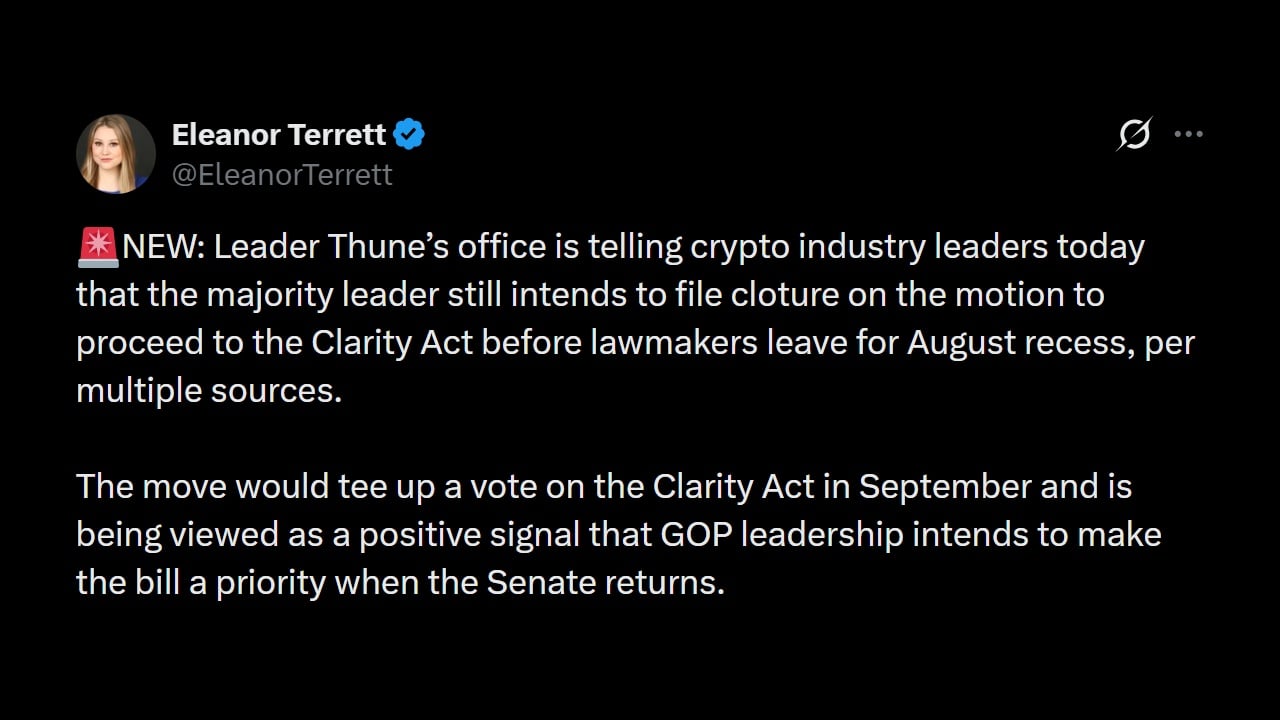
In the US, the CLARITY Act, which would formally divide digital asset oversight between the CFTC and the SEC, has passed the House and is advancing through the Senate.
The IPO adds context without resolving the picture. Payward filed a confidential S-1 with the SEC in November 2025, and the regulated expansion clearly supports a pre-IPO positioning story.
But the timeline has slipped toward 2027, and valuations implied by recent transactions sit below the peak of the November funding round. The operational stack and the IPO preparation run in parallel. They are related, but not the same story.
Not a Kraken-Only Story
Payward is not alone in this direction. Major crypto platforms have been moving toward regulated infrastructure for more than a year. The reason is simple: rules are becoming clearer, and institutional clients want licensed counterparties.
Coinbase has made a comparable derivatives push. In August 2025, it closed its $2.9 billion acquisition of Deribit, strengthening its position in crypto options. It has also expanded its regulated footprint in Europe through MiCA and MiFID II licences.
Gemini received CFTC derivatives clearing authorisation in April 2026. In Dubai, OKX and Binance have held full VARA operational licences since mid-2024. Payward enters a market where its largest competitors are already established.
The pace looks unusual. In six weeks, the company added capital, payments infrastructure, a US derivatives stack, and a new geographic licence. Among private companies with an active IPO filing, the breadth of this build has no direct parallel in the sector.
Where It Could Still Go Wrong
Several of the moves described above are still in process. The Deutsche Börse investment is pending regulatory closing. The Reap acquisition has not closed. The Dubai VARA approval is preliminary. The US spot margin product carries eligibility restrictions.
None of this undermines the pattern — but the pattern is a direction of travel, not a completed transformation. Payward is building broker-adjacent regulated infrastructure across multiple jurisdictions simultaneously.
In the US, the relevant status is FCM registration in the commodities context, not securities broker-dealer status. In Dubai, Payward has only preliminary VARA authorisation.
In Europe, the relevant permissions depend on the specific activity under MiCA and MiFID. Taken together, the structure increasingly resembles a regulated financial intermediary. Legally, the picture is still jurisdiction-specific and uneven.
Payward still has to secure the full VARA licence and close the Reap and Deutsche Börse deals. It also has to turn the CFTC-licensed derivatives stack into live products beyond spot margin.
However, building a multi-layer stack is only the first part of the challenge. The second is turning it into a profitable operating platform.
In just six weeks, Kraken’s parent company Payward added the core pieces of a regulated infrastructure platform around the exchange: a TradFi anchor, a US derivatives stack, payments rails, and a Dubai licensing pathway.
Those pieces came through Deutsche Börse’s $200 million stake purchase, the Bitnomial acquisition and US margin launch, the Reap agreement, and preliminary authorization from Dubai’s VARA.
The pattern points to a company moving beyond the crypto exchange model and toward a multi-jurisdictional financial infrastructure platform.
Payward’s own branding has changed. In recent corporate announcements, the company has described itself not simply as a crypto exchange operator, but as a “unified financial infrastructure platform.”
The TradFi Anchor
The first move came on April 14, when Deutsche Börse announced it would acquire a 1.5% fully diluted stake in Payward for $200 million. The stake purchase was structured as a secondary transaction rather than a primary capital raise, implying a company valuation of approximately $13.3 billion.
It followed a strategic partnership announced four months earlier and remained subject to regulatory closing as of June 2026. The investment gave Kraken’s parent a named TradFi market-infrastructure anchor in Europe, where the two companies were already working across trading, derivatives, and custody.
Deutsche Börse framed the investment as a step toward “hybrid market infrastructure” for traditional securities and blockchain-native tokens. That language matches the platform architecture Payward says it is building.
The US Regulatory Stack
On May 1, Payward completed its acquisition of Bitnomial, a Chicago-based derivatives firm, for up to $550 million. The deal gave Payward a CFTC-licensed derivatives stack covering exchange, clearinghouse, and brokerage functions.
Payward described Bitnomial as the first such structure built specifically for digital assets in the US. Five days later, Kraken Pro launched CFTC-regulated spot margin for eligible US retail clients, with leverage of up to 10x.
The live product is offered through NinjaTrader Clearing LLC, doing business as Kraken Derivatives US. The entity is a CFTC-registered Futures Commission Merchant and NFA member. Financing is provided by Payward Accredited LLC.
The regulatory history adds context. In September 2021, the CFTC fined Payward $1.25 million for offering margin trading without the necessary FCM registration.
The current structure directly addresses that gap. Five years after the CFTC action, Payward has spent up to $550 million acquiring part of the licensing architecture it previously lacked.
The scope is limited: the product is available to eligible US retail clients under specific program criteria, and leverage varies by asset.
The Payments Infrastructure
But this was not the end of the move. On May 7, Payward announced a definitive agreement to acquire Reap Technologies, a Hong Kong-based stablecoin payments infrastructure company, for up to $600 million. The deal remains subject to regulatory approvals in Hong Kong and Singapore, with closing expected in H2 2026.
The owner of crypto exchange Kraken has agreed to pay $600 million for Reap Technologies, a stablecoin-oriented provider of cross-border and business payments services. https://t.co/iu5FDFDcOq
— Bloomberg (@business) May 7, 2026
Reap has previously said it processed about $3 billion in monthly transaction volume. It provides card issuance and stablecoin settlement infrastructure with licensing coverage across APAC, MENA, and Latin America.
Co-CEO Arjun Sethi described the acquisition’s strategic role this way: “Reap is the payments layer for what comes next. Card networks, banking rails, and blockchains on a single API, settling in stablecoins.”
Arjun Sethi, co-CEO of Kraken, Source: Youtube
The Reap deal is the least common part of the build. Most large crypto platforms have focused first on trading, custody, and derivatives. Payward is also buying payments infrastructure with stablecoin settlement and card issuing capabilities.
The Dubai Pathway
On May 21, Payward FZCO received preliminary authorisation from Dubai’s Virtual Assets Regulatory Authority (VARA) for a broker-dealer, investment and management licence.
Once the full licence is issued, the approval would allow Payward to serve retail and professional investors in Dubai. Planned services include spot trading, OTC, staking, institutional products, and AED funding and withdrawals.
Kraken is now authorized by VARA in Dubai.
Authorization covers spot, margin, OTC, staking, and institutional access through Kraken Prime.$AED funding follows later this year.
Full details: https://t.co/EUChz8IOQo
— Kraken (@krakenfx) May 21, 2026
VARA operates a staged process: In-Principle Approval, Preliminary Approval, Full Operational Licence. Having passed the In-Principle stage, Payward is now at Preliminary.
In the Dubai virtual asset market, Payward is a late entrant: OKX has held a full VARA operational licence since September 2024, and Binance since April 2024. Dubai gives Payward a regulated Middle East foothold alongside its US and European infrastructure. But in this market, the company is following rather than leading.
Why the Timing Matters
The six-week sequence is part of a longer build. Since early 2025, Payward has committed several billion dollars to acquisitions across trading, clearing, and payments infrastructure.
In March 2026, it became the first crypto firm to receive a Federal Reserve master account, giving it direct access to US payment rails. The regulatory backdrop has also changed. MiCA has been operational across the EU since late 2024. VARA has matured into one of the more developed virtual asset frameworks globally.
In the US, the CLARITY Act, which would formally divide digital asset oversight between the CFTC and the SEC, has passed the House and is advancing through the Senate.
The IPO adds context without resolving the picture. Payward filed a confidential S-1 with the SEC in November 2025, and the regulated expansion clearly supports a pre-IPO positioning story.
But the timeline has slipped toward 2027, and valuations implied by recent transactions sit below the peak of the November funding round. The operational stack and the IPO preparation run in parallel. They are related, but not the same story.
Not a Kraken-Only Story
Payward is not alone in this direction. Major crypto platforms have been moving toward regulated infrastructure for more than a year. The reason is simple: rules are becoming clearer, and institutional clients want licensed counterparties.
Coinbase has made a comparable derivatives push. In August 2025, it closed its $2.9 billion acquisition of Deribit, strengthening its position in crypto options. It has also expanded its regulated footprint in Europe through MiCA and MiFID II licences.
Gemini received CFTC derivatives clearing authorisation in April 2026. In Dubai, OKX and Binance have held full VARA operational licences since mid-2024. Payward enters a market where its largest competitors are already established.
The pace looks unusual. In six weeks, the company added capital, payments infrastructure, a US derivatives stack, and a new geographic licence. Among private companies with an active IPO filing, the breadth of this build has no direct parallel in the sector.
Where It Could Still Go Wrong
Several of the moves described above are still in process. The Deutsche Börse investment is pending regulatory closing. The Reap acquisition has not closed. The Dubai VARA approval is preliminary. The US spot margin product carries eligibility restrictions.
None of this undermines the pattern — but the pattern is a direction of travel, not a completed transformation. Payward is building broker-adjacent regulated infrastructure across multiple jurisdictions simultaneously.
In the US, the relevant status is FCM registration in the commodities context, not securities broker-dealer status. In Dubai, Payward has only preliminary VARA authorisation.
In Europe, the relevant permissions depend on the specific activity under MiCA and MiFID. Taken together, the structure increasingly resembles a regulated financial intermediary. Legally, the picture is still jurisdiction-specific and uneven.
Payward still has to secure the full VARA licence and close the Reap and Deutsche Börse deals. It also has to turn the CFTC-licensed derivatives stack into live products beyond spot margin.
However, building a multi-layer stack is only the first part of the challenge. The second is turning it into a profitable operating platform.