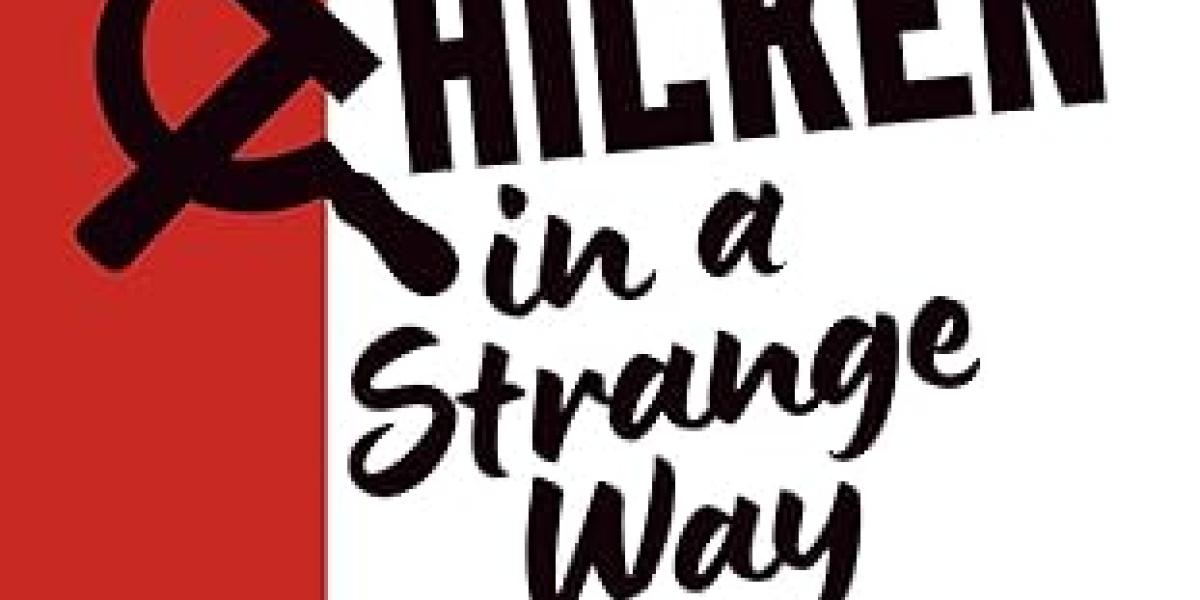
Chicken in a Strange Way by Melanie Thomas Armstrong (Ballast Books, 2026), 461 pp.
When the communist regimes of Eastern Europe and the Soviet Union collapsed in 1990 and 1991, followers of the Austrian School of Economics knew that socialism’s lack of a coherent method of economic calculation certainly led to the demise of these regimes. Economists had known for years of the chronic shortages, shoddy workmanship, and all of the other negative aspects of economic life in those countries and why no one who understood socialism was surprised at these results.
However, most of us who had the “I knew it” response as communist regimes fell like dominoes understood communism in an abstract sense. We knew the theories, so we could better interpret the outcomes. Some of us had been on the other side of the Berlin Wall, albeit for a short time, but still could see the bleak and crumbling infrastructure and the economic deadness that characterized these countries. But while I had taken a tour through a small part of commieland, I had never experienced the day-to-day life that made life so miserable behind the Iron Curtain.
The daily deprivation that most people faced in Eastern Europe and the USSR was well-known to most people (except, of course, True Believers like Bernie Sanders, who insisted after his honeymoon in Moscow in 1988 that there was no economic deprivation in the Soviet Union). However, many people assumed that the economic deprivation of the communist bloc was due more to political repression than to socialism itself, as John Fea and others claim:
Many Marxists and liberals posit an organic relationship between liberalism and capitalism and deny the former is compatible with socialism. (Matthew) McManus seeks to refute this idea. All liberals, he contends, share a “commitment to the normative equality, or equal worth, of all human beings and, relatedly, their fundamental entitlement to equal liberty in civil society.” These commitments, however, are not enough to get from liberalism to socialism. To do that, McManus introduces republicanism and the hybrid figure of the “republican liberal,” who embraces the principles of solidarity or fraternity. These republican liberals appear to be basically indistinguishable from liberal socialists, who also embrace “the republican principle of community and solidarity” and “extend it to the economy.” Republicanism therefore plays a crucial if not fully acknowledged role in McManus’s framework—a kind of emulsifier that allows for the potentially incompatible ingredients of liberalism and socialism to mix successfully. And there are recurrent similarities between McManus’s elaborations of liberal socialism and the radical republicanism Leipold considers in Citizen Marx.
In other words, we can have both liberal governance and a socialist economy that will (apparently) perform in a way that provides prosperity for all, or at least the working classes. As John Fea declared, a “communist dictatorship” is not necessary to implement socialism. All that is needed for a society of economic plenty and equality are enough voters willing to put socialists into power.
However, as Melanie Thomas Armstrong would find out in the mid-1990s, the communist system under a relatively benign government indeed was as unproductive and troublesome as anything that existed in the darkest days of Iron Curtain. Armstrong, who was a recent college graduate from Southern California, had landed a position with the accounting firm Arthur Andersen and was given an assignment to help audit manufacturing firms in Czechoslovakia, which had broken away from its communist government in 1989 and had elected the dissident Václav Havel as president, who clearly was no one’s dictator.
When this young twenty-something arrived in Prague in January 1993 as a young auditor, her only knowledge of communism was what she had read in textbooks and the experiences she had in East Berlin before the infamous wall came down. Moving into her new apartment, she quickly learned what it meant to be in a country with an economy that didn’t work and manufacturing enterprises whose management seemed to defy every law of sound accounting.
At this time, Czechoslovakia, like the other Iron Curtain countries, were dominated by communist economies in the very early stages of moving toward a market system. Czechoslovakia was also in the early stages of becoming a liberal democracy, although the economic planning apparatus remained, at least for the time being. In other words, it was exactly the utopia that people like Bernie Sanders and John Fea claim is the best of both worlds: a liberal democratic government and a socialist economy.
One of the common denominators of communist societies has been bad food, and 1993 Prague excelled in that. Armstrong writes about going to a pizza shop and getting pizza made with ketchup. She writes:
Jamie (a fellow auditor) closed his eyes and swallowed the rest of his bite. I debated spitting it out into a napkin, but there were no napkins to be found. I stopped chewing, swallowed, and gave him a look. We both understood. Ketchup was fine served with French fries or a hot dog. Good even! But NOT ON PIZZA! We sucked down the rest of our beer, trying to cleanse our palates, left 100 (koruna ceska) on the table – more than enough to cover our bill – and bolted out the door. (p. 43-44)
There were other little things, like getting coffee at a coffee shop in which the grounds had not been removed from the coffee. But the real accounting adventures began with the businesses themselves. Her first visit was to a cement factory, where the management had bought a 50-year supply of pencils. Obviously, a trained auditor would want to know why the company made this purchase, but no one could explain. She goes on:
And it seemed that in this Czech world, everything a company owned was viewed as having value. Everything. Lots of random things showed up in inventory. I suppose it helped make their companies look like they were actually thriving businesses – instead of fronts pretending to do actual business, micromanaged by the communist government. I also learned that until 1993, the Federal Ministry of Finance didn’t allow companies to reduce the value of the things they owned, even if they were obsolete, excessive, uncollectible, or otherwise useless and without value. Every single item appeared as an asset of the company. Forever. (p. 60)
Armstrong spent more than two years as an auditor and time and again she found the state-owned companies making baffling decisions that made no sense in a world of normal, double-entry bookkeeping. However, because of the perverse incentives that the socialist system created, she could see that the decisions made sense to those making them. It was political calculation over economic calculation, the very thing that both Ludwig von Mises and Murray Rothbard said would make it impossible to have a functioning socialist economy. While Austrian economists were reading about the pitfalls of socialist economic organization, Melanie Armstrong was seeing the accounting nightmare on the ground, a living laboratory in which Austrian theories were vindicated.
As Armstrong also notes, the Czech economy was also wearing down its capital and not replacing what was breaking down. Thus, firms might store more spare parts than they ever would need because there was no open market where they might purchase them. Throughout the book, she shows how the socialist system wore down everything from cars to buildings, leaving people to live on their wits and low expectations, with a stifling bureaucracy hovering over everything.
The book is full of anecdotes and accounts that someone trained in Austrian Economics could immediately understand but note that people in Prague and elsewhere behind the Iron Curtain also found ways to adjust and win small victories against the system. Through it all, they kept a sense of humor.
Chicken in a Strange Way (which was taken from a menu item in a Chinese restaurant in Prague) is an enjoyable read. Armstrong writes in an informal style that makes it easy to follow and her misadventures in the bizarro accounting methods endemic to communism are both entertaining and educational.
It is important to note that as Czechoslovakia and the rest of Eastern Europe (for the most part) liberalized politically, they also liberalized economically. No country was better positioned to adopt democratic socialism than Czechoslovakia, but Havel and his successors saw that the socialist system could not be reformed; it had to be abolished altogether.