At least five health insurers have announced plans to leave the ACA Marketplace after 2026, affecting more than 600,000 enrollees across multiple states. The exits are raising new questions about the stability of the individual market and whether additional insurers could follow.
Although insurer participation in the ACA Marketplace has fluctuated for years, the latest withdrawals come at a time of growing uncertainty driven by higher premiums, declining enrollment, and federal rule changes that could further reshape the market in 2027.
Which carriers have announced they’re leaving the Marketplace?
So far, at least five insurers have announced that they will no longer offer Marketplace plans after the end of 2026. They include:
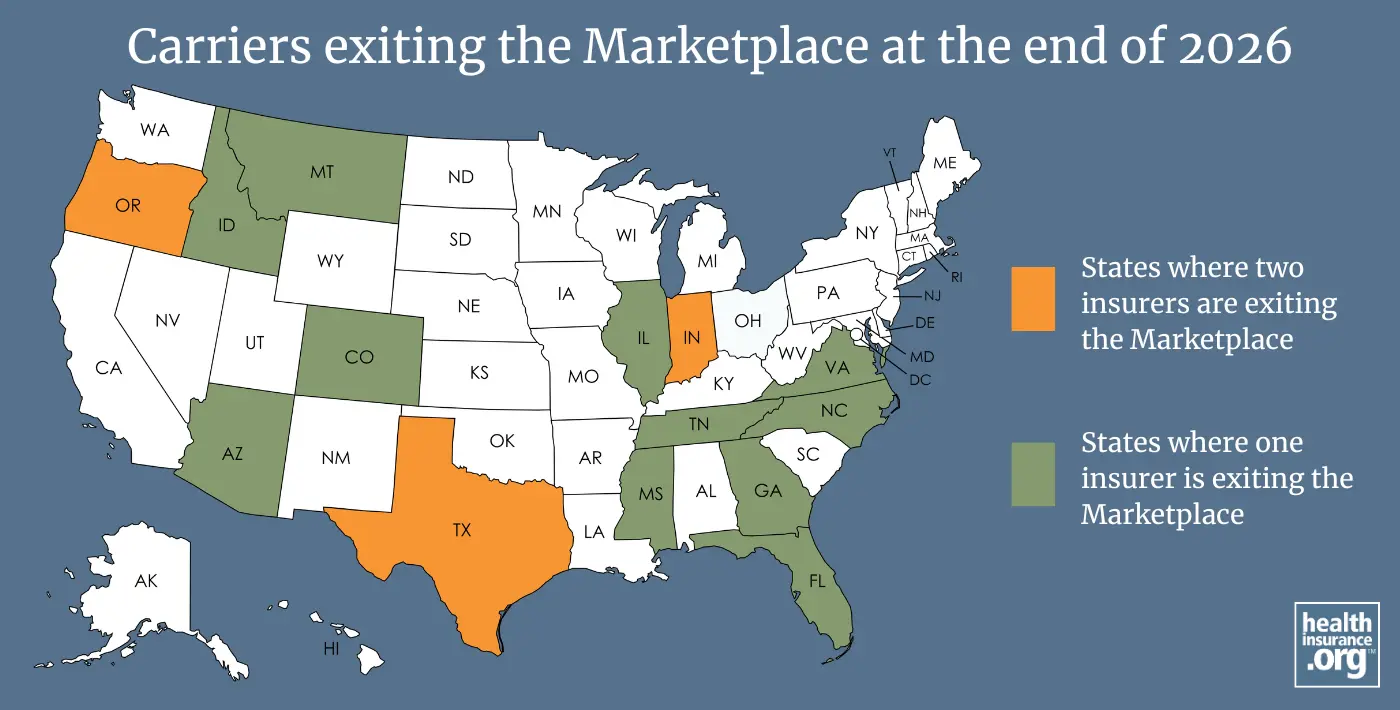
Cigna, which offers Marketplace plans in Arizona, Colorado, Florida, Georgia, Illinois, Indiana, Mississippi, North Carolina, Tennessee, Texas, and Virginia. Across those 11 states, Cigna currently covers about 369,000 Marketplace enrollees. Cigna will not offer Marketplace coverage in any state in 2027.
Baylor Scott & White Health Plan, which covers about 100,000 Marketplace enrollees in Texas.
CareSource will no longer offer Marketplace coverage in Indiana, where it currently insures about 60,000 people. CareSource offers Marketplace plans in nine states in 2026, and it’s unclear whether any other states where CareSource offers plans will be affected.
PacificSource will no longer offer Marketplace coverage in Idaho, Montana, or Oregon, where a combined 60,000 people have PacificSource Marketplace plans.
Providence Health Plan will no longer offer Marketplace plans in Oregon. At the end of 2025, there were nearly 36,000 Oregon Marketplace enrollees with Providence plans.
Across those five carriers, more than 600,000 people will need to select new Marketplace plans for 2027.
Could additional insurer exits still be ahead? Possibly. But it’s still early in the 2027 rate filing season, and the full picture of Marketplace participation may not become clear until much closer to open enrollment, since some insurers have historically waited until the fall to announce Marketplace exits.
Will any carriers exit the market before the end of 2026?
Historically, most Marketplace insurer exits have occurred at the end of the calendar year. Mid-year shutdowns have been rare, with notable exceptions including some ACA CO-OP failures in the early years of the exchanges and the collapse of Friday Health Plans in 2023.
Thus far, all of the Marketplace exits announced this year are scheduled for the end of 2026, so they do not affect anyone’s 2026 coverage. Enrollees can keep their current plan through the end of the year as long as they continue to pay their monthly premiums.
Learn more: What should consumers do if their insurer is leaving the Marketplace?
Why are carriers pulling out of the Marketplace?
Industry groups and insurers have described the current environment as a “perfect storm” for the individual market.
Several major changes are contributing to that uncertainty, including:
All of these factors are causing enrollment declines and a less healthy risk pool in the individual market.
Declining Marketplace enrollment drives carrier decisions
Marketplace enrollment declined in 2026, after five years of steady growth – and according to a Wakely analysis, effectuated enrollment is projected to be 17% to 26% lower in 2026 than it was in 2025.
Although we don’t yet have official nationwide 2026 effectuated enrollment data from Centers for Medicare & Medicaid Services (CMS), NOTUS (News of the United States) has obtained internal CMS documents and reported that 21% of HealthCare.gov enrollees were disenrolled in the early months of 2026 for failure to pay premiums. Across state-run Marketplaces, the drop-off was much smaller, at about 8%, due in part to the supplemental subsidies offered by some state-run Marketplaces.
But nationwide, about 17% of the people who selected a plan during the open enrollment period for 2026 (or whose coverage was automatically renewed) have already lost their coverage for failure to pay premiums.
And some state-run Marketplaces are showing significant declines in effectuated enrollment in early 2026. For example, Georgia’s effectuated Marketplace enrollment dropped from nearly 1.5 million in early 2025 to 950,000 by April 2026. In Washington state (which does offer state-funded subsidies), effectuated enrollment as of February 2026 was down more than 15% from where it had been a year earlier.
Overall, CMS projects that average effectuated Marketplace enrollment will be about 18.9 million people in 2026, although it could potentially drop to as low as 16.5 million. In comparison, average effectuated Marketplace enrollment was 22.3 million people in 2025.
A major reason for the enrollment decline is the expiration of enhanced federal subsidies at the end of 2025. Many Marketplace consumers saw premiums rise sharply when those subsidy enhancements expired. Even though millions of people switched to plans with higher out-of-pocket costs or dropped their coverage altogether, average net premiums in the Marketplace still rose by 58% in 2026.
That sharp increase in net premiums is the primary reason so many people failed to pay their premiums in the early part of 2026. That matters because healthier consumers are generally more likely to drop coverage when premiums increase, while people with ongoing medical needs are more likely to keep their insurance.
As healthier people leave the market, insurers are left covering a smaller but less healthy risk pool. That increases average medical costs per enrollee and puts upward pressure on premiums.
The Trump administration’s rule changes for 2027 could intensify those pressures even further. Federal regulators have projected that the new rules could lead to as many as 2 million additional people leaving the Marketplace.
CMS has also acknowledged that healthier enrollees may be more likely to lose or discontinue coverage under the new rules, potentially contributing to additional premium increases (although CMS notes that these premium increases may be offset by more eligibility verification for special enrollment periods and lower exchange user fees).
Marketplace participation is ultimately a business decision
For insurers, participation in the Marketplace is fundamentally a financial calculation.
Insurers continuously evaluate whether Marketplace coverage is profitable and whether the market appears stable enough to justify continued participation. When enrollment declines, risk pools worsen, and policy uncertainty increases, some insurers decide the business risk is no longer worthwhile.
There can also be state-specific policy factors involved. New Mexico, for example, requires Medicaid managed care insurers to also offer statewide Marketplace coverage. But in most states, Marketplace participation decisions are largely driven by insurers’ assessment of profitability and overall market stability.
Current withdrawals reflect a familiar cycle
Insurer participation in the Marketplaces has been cyclical over time, generally increasing when the individual market was healthier and larger, and decreasing when it was sicker and smaller. We can see a clear illustration of this when we look at how Aetna’s Marketplace participation has shifted in response to changing market conditions.
At the end of 2016, Aetna exited the Marketplace in 11 of the 15 states where it offered coverage. The company then fully exited the ACA exchanges after 2017.
But Aetna later returned to the Marketplace in 2022 and expanded into additional states in 2023. However, the company once again fully exited the Marketplace after 2025.
That pattern mirrors broader Marketplace trends over the past decade.
Insurer participation declined significantly in 2017 and 2018 amid repeated congressional repeal efforts and policy uncertainty surrounding the ACA.
Participation later rebounded during the Biden administration, when enhanced subsidies and other policy changes (including a low-income special enrollment period, fixing the “family glitch,” and Marketplace access for DACA recipients) made Marketplace coverage more affordable and accessible, resulting in far more people with Marketplace coverage.
But the number of insurers participating in the Marketplace declined again for 2026, after several of the Biden-era changes were eliminated. This was the first overall decline in insurer participation since 2018.
Still, today’s Marketplace participation levels remain significantly stronger than they were during the market instability of 2017 and 2018.
In 2018, more than a quarter of Marketplace enrollees only had access to plans from a single insurer. By contrast, despite the recent decline in participation, only 1% of HealthCare.gov enrollees in 2026 had access to just one insurer’s plans.
What should consumers expect next?
Additional Marketplace exits remain possible over the coming months, as insurers finalize 2027 rates participation decisions.
But while the current insurer withdrawals and declining Marketplace enrollment are significant, the individual market has proven to be resilient. It has gone through cycles of expansion, contraction, policy changes, and insurer repositioning over the past decade.
The coming months will provide a clearer picture of whether 2027 represents another temporary contraction – or the beginning of a more significant shift in the Marketplace landscape.