Discover how payroll professionals are moving from back-office invisibility to boardroom influence by leveraging workforce data that protects margins and earns executive trust.
Highlights
Payroll is evolving into a strategic asset through AI-powered analytics and boardroom influence.
Metrics like Productive Labor as a Percent of Revenue (PL%R) demonstrate payroll’s financial impact.
Global payroll teams must build strong foundations and cross-functional alignment to become strategic partners.
Understanding why payroll is a strategic asset in 2026 begins with recognizing a fundamental shift: payroll is no longer just about compliance and timely payments. It’s about financial intelligence, strategic workforce planning, and boardroom influence.
Payroll is at a crossroads. Industry surveys show payroll often represents 40 to 60% of operating expenses, yet many organizations have not modernized how it is governed or led. The “30×30 Initiative” is pushing to elevate payroll leaders to the C-Suite, aiming to place 30 Chief Payroll Officers by 2030. Meanwhile, CFOs and boards are demanding operational insights that directly impact the bottom line, and new global payroll trends are reshaping compliance, transparency, and real-time reporting.
Jump to ↓
Q1: From invisibility to influence
Q2: Proving payroll’s strategic value
Q3: Evolving payroll teams into strategic enablers
The strategic asset imperative: What CFOs need from payroll in 2026
Recent research from KPMG and UKG reveals why payroll must evolve into a strategic asset: payroll remains fragmented, under-resourced, and vulnerable to labor leakage and compliance risk. Only 33% of organizations operate a truly standardized global payroll model, and 92% report having a global payroll strategy, but few achieve the controls and insight required for enterprise scale. AI-powered payroll is now the baseline expectation, with regulators assuming global employers have access to automated calculations, anomaly detection, and audit-ready reporting.
As Forbes notes, technology, including AI, is now the central engine of strategic transformation for the C-suite, with 93% of executives increasing investment in AI and cybersecurity. AI-powered analytics and payroll analytics capabilities are critical for compliance, cost control, and strategic workforce planning, transforming payroll teams into strategic business partners who deliver measurable value. Businesses using analytics are able to reduce labor costs by 5 to 15% annually.
To explore how payroll professionals are navigating this important moment, Checkpoint News gathered insight from three payroll and HR subject matter experts:
Nick Day, ACIPP, ILM7: Founder and Managing Director, JGA Recruitment Group; author of The Payroll Pivot: From Invisibility to Influence
Monica Miller: Executive Payroll & Workforce Strategy Advisor; Former SVP, Workforce Strategy & Payroll, Compass Group; Principal, Monica Miller Payroll & Labor Advisory LLC
Kira Rubiano: Partner – USA, Payrollminds; global payroll transformation leader
Their perspectives frame this month’s Payroll Pulse, which examines how payroll teams shift from operational excellence to boardroom impact, prove strategic value, and evolve into trusted advisors.
Q1: From invisibility to influence
What is the crucial first step for modern payroll professionals to move from back-office invisibility to strategic boardroom influence?
According to Nick Day, the first step in payroll’s pivot toward strategic influence has nothing to do with organizational charts, job titles, or industry campaigns. Instead, it begins with how payroll professionals describe themselves and their work. Day notes that in his decades of recruiting and coaching payroll leaders, one word from one phrase surfaces repeatedly, “I’m just in payroll” and it often comes from professionals managing millions in compliance exposure and controlling the most comprehensive workforce dataset in the organization.
Day argues that language shapes perception long before recognition follows. When payroll minimizes its own contribution, it signals how others should value the function. As he puts it, “In one word, they’ve told the whole room how to value them.” From his perspective, influence cannot be built on self-diminishment, no matter how technically strong the work may be.
While Day supports initiatives like the “30×30” movement to elevate payroll leadership, he cautions that momentum can stall if the profession pushes too hard for the destination without building credibility along the way. He stresses that sustainable influence is earned by changing the conversation at the tables payroll already occupies, such as Finance, HR, and Operations, by speaking in business terms that those stakeholders understand.
In Day’s latest book, The Payroll Pivot, he characterizes payroll as the “Algorithmic Conscience of Work™,” where corporate values, pay equity commitments, and wellbeing promises are ultimately tested in real pay outcomes. He believes payroll professionals begin to shift how they’re perceived when they frame their work through that lens and actively surface insights already embedded in payroll data.
Why payroll professionals are strategic business partners
What holds many professionals back, Day says, is not lack of competence but what he calls the “Fear Tax™”, the cumulative cost of staying silent when payroll already has something valuable to contribute. Strategic influence begins when payroll stops waiting to be asked and starts walking its insight into the room. This mindset shift is essential for payroll professionals who aspire to become strategic business partners rather than transactional processors.
About the expert: Nick Day, ACIPP, ILM7, is Founder and Managing Director of JGA Recruitment Group and author of The Payroll Pivot: From Invisibility to Influence. He is an executive coach for payroll leaders and a champion of the “30×30” movement to elevate payroll to the C-Suite.
Q2: Proving payroll’s strategic value
What specific, revenue-protecting metric demonstrates that a function is a strategic asset, not just an operational cost center?
Monica Miller believes payroll’s strategic value becomes clear when the function aligns its insight with metrics that executive leadership already prioritizes. While payroll has traditionally been framed as transactional, focused on accuracy and timeliness, Miller emphasizes that payroll also controls one of the most material financial variables on the income statement: labor cost.
How payroll analytics drive strategic asset value
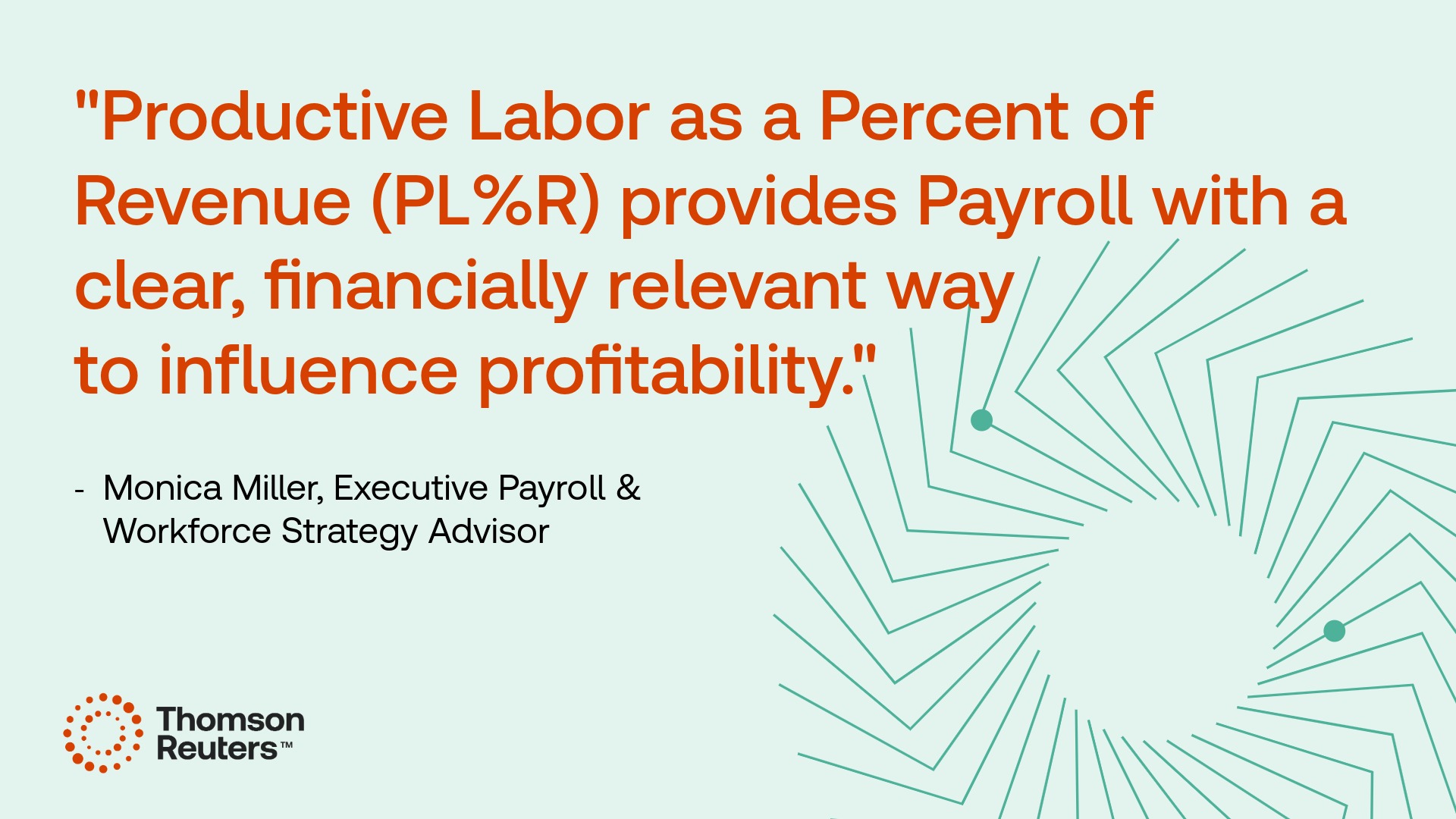
Miller points out that payroll holds a uniquely complete dataset on how labor behaves across the organization, but that value often goes untapped because payroll reporting remains retrospective. The shift happens when payroll connects workforce activity to financial outcomes using metrics the CFO already trusts. One of the most effective, she says, is Productive Labor as a Percent of Revenue (PL%R).
PL%R directly links labor deployment to revenue performance, allowing organizations to identify inefficiencies such as overtime overuse, scheduling misalignment, and process friction. As Miller explains, modest improvements — often in the 2% to 4% range — can be achieved by addressing “labor leakage,” or avoidable spend embedded in day-to-day operations. Unlocking those gains requires tighter integration across Payroll, Time and Attendance, HR, and Finance, combined with the operational context to turn data into action.
Beyond cost optimization, Miller notes that PL%R improvements often cascade into better compliance outcomes, fewer pay errors, and a more predictable employee experience. She frames this not as cost-cutting, but as disciplined workforce stewardship, protecting margin while strengthening trust.
From her perspective, payroll proves its strategic relevance when it shows executives not just what payroll cost last quarter, but how labor decisions today shape financial performance tomorrow; a capability that makes Chief Payroll Officers indispensable to the C-suite.
About the expert: Monica Miller is Executive Payroll & Workforce Strategy Advisor and former SVP, Workforce Strategy & Payroll, Compass Group. She leads Monica Miller Payroll & Labor Advisory LLC and provides executive-level insight on aligning payroll data with CFO and boardroom priorities.
Q3: Evolving payroll teams into strategic enablers
How do you practically evolve a global payroll team from tactical administrators into strategic enablers who align directly with Finance and HR?
For Kira Rubiano, the evolution from tactical execution to strategic enablement starts with stability. She explains that when global payroll teams are overwhelmed by manual work, country-specific exceptions, and constant firefighting, it becomes unrealistic to expect strategic contribution. Before payroll can lift its head to engage cross-functionally, the foundation has to be secure.
Building AI-powered analytics capabilities for strategic payroll
That foundation, Rubiano says, includes clearer processes, stronger controls, better documentation, and more consistency across regions where possible. Just as important is clarifying ownership so payroll is not absorbing issues that properly belong to HR, Finance, vendors, or local stakeholders. Once accountability is defined, payroll regains the capacity to move beyond cycle processing.
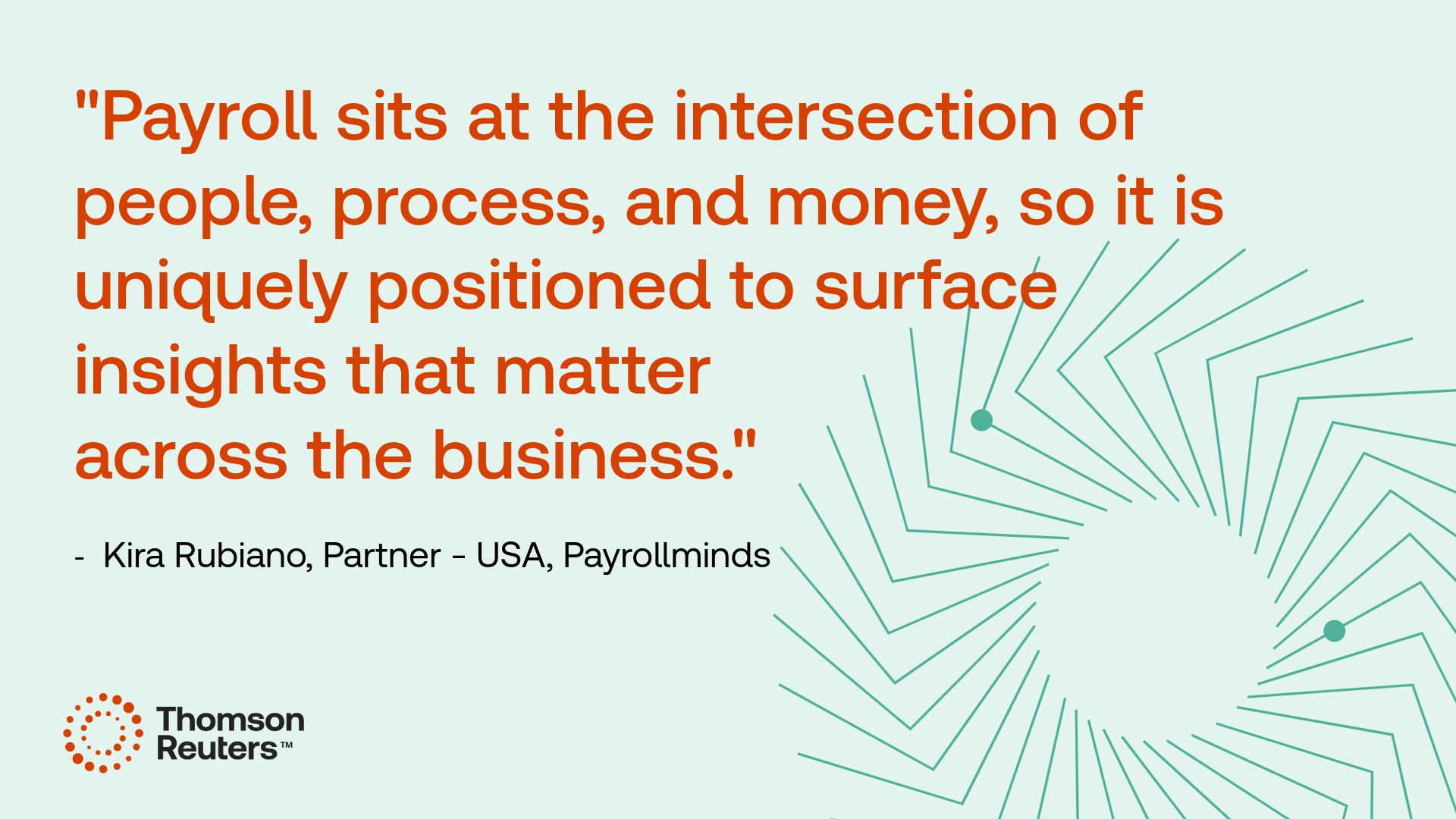
From there, Rubiano emphasizes intentional connection. Payroll teams should be embedded in regular discussions around headcount movement, labor cost trends, accruals, compliance exposure, and workforce planning. Because payroll sits at the intersection of people, process, and money, and increasingly leverages AI-powered analytics, it is uniquely positioned to translate operational signals into insight for both Finance and HR.
Equally critical, she adds, is helping payroll professionals build confidence in their voice. Strategic payroll teams don’t just produce data — they interpret it, explain what it means, and tie it back to business priorities. When payroll professionals are empowered to speak that language, they shift from processors to trusted advisors and become recognized as strategic business partners across the enterprise.
About the expert: Kira Rubiano is Partner – USA at Payrollminds, where she leads clients through payroll process optimization and transformation. She specializes in cross-functional alignment in global business services models.
The strategic asset imperative: What CFOs need from payroll in 2026
Why payroll is a strategic asset in 2026 is no longer a theoretical question. Payroll’s journey from invisibility to influence is underway, driven by Chief Payroll Officers who leverage AI-powered analytics and payroll analytics capabilities while serving as strategic business partners to the C-suite. The transformation requires more than new titles or campaigns.
As this month’s Payroll Pulse illustrates, the real challenge is not whether payroll belongs in the boardroom — it is how payroll professionals govern their role, leverage data, and build credibility with Finance, HR, and executive leadership. Metrics like PL%R, strong foundational processes, and a willingness to speak up are the building blocks for payroll’s strategic future.
Recent global surveys confirm payroll’s financial importance and strategic potential, but also highlight persistent gaps in governance, standardization, and actionable analytics. The rise of AI-powered payroll, real-time compliance, and pay transparency is transforming the profession into a strategic intelligence hub. Winning executive trust requires transparency, risk discipline, and outcome-based business cases. Sustaining payroll’s influence means clean data, strong processes, and rigorous validation before funds move.
Checkpoint and CoCounsel Tax empower Chief Payroll Officers and tax professionals with AI-powered analytics and trusted guidance, helping transform payroll into a strategic asset that drives compliance, efficiency, and boardroom influence.

CoCounsel Tax
The reliable AI tax assistant for tax professionals
Learn more ↗