Updated on April 24th, 2026 by Felix Martinez
CT Real Estate Investment Trust (CTRRF) has three appealing investment characteristics:
#1: It is a REIT, so it has a favorable tax structure and pays out the majority of its earnings as dividends.Related: List of publicly traded REITs
#2: It is a high yield stock based on its 6.4% dividend yield.Related: List of 5%+ yielding stocks
#3: It pays dividends monthly instead of quarterly.Related: List of monthly dividend stocks
You can download our full list of 119 monthly dividend stocks (along with relevant financial metrics like dividend yields and payout ratios), which you can access below:

CT Real Estate Investment Trust’s trifecta of favorable tax status as a REIT, a high yield, and a monthly dividend makes it appealing to individual investors.
But there’s more to the company than just these factors. Keep reading this article to learn more about CT Real Estate Investment Trust.
Business Overview
CT Real Estate Investment Trust (CT REIT) is a closed-end investment trust that owns commercial properties in Canada.
Its portfolio comprises over 375 properties totaling approximately 31.7 million square feet of gross leasable area, primarily net-lease retail properties across Canada.
CT REIT is a leading net-lease REIT in Canada that benefits significantly from its relationship with Canadian Tire Corporation, its largest tenant and controlling unitholder.
This close association and alignment are key competitive advantages, providing important insights into real estate acquisitions and development opportunities. Such opportunities, combined with predictable rent hikes, are the primary growth drivers of CT REIT.
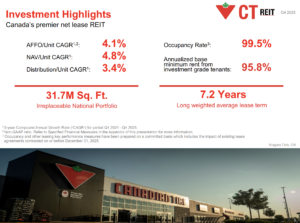
CT REIT exhibits strong performance metrics. Its asset portfolio currently has an exceptionally high occupancy rate of 99.5%.
Source: Investor Presentation
In addition, the REIT receives 95.8% of its annualized base rent from investment-grade tenants, and its remaining leases average 7.2 years, one of the longest average lease terms in the REIT universe.
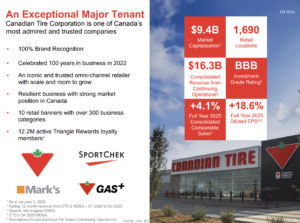
Canadian Tire Corporation, the major tenant of CT REIT, has a 102-year history, a strong market position in Canada, and ample room for future growth.
Source: Investor Presentation
It also has annual revenues of $440 million and a BBB credit rating. The merits of having a major tenant with strong business performance and a solid financial position are obvious.
Growth Prospects
CT REIT is ideally positioned to leverage its relationship with Canadian Tire Corporation and pursue third-party net lease opportunities to complement organic growth. It also benefits from average annual rent hikes of about 1.5%.
Since its IPO, CT REIT has acquired and leased more than 2 million square feet of industrial properties to Canadian Tire Corporation. In addition, other properties of Canadian Tire Corporation are likely to meet CT REIT’s investment criteria.
The company reported solid full-year 2025 results, with revenue increasing to $604.3 million (+4.4%) and net income rising to $517.1 million (+19.1%). Adjusted funds from operations (AFFO) reached $303.1 million, or $1.274 per unit (+2.8%), supported by portfolio expansion and rent escalations.
The REIT maintained strong fundamentals, including 99.5% occupancy and a conservative 39.8% indebtedness ratio.In Q4 2025, revenue grew to $152.9 million (+5.1%) and net income rose sharply to $191.3 million (+41.4%), while NOI increased 4.9% to $121.2 million. FFO and AFFO showed modest growth, with AFFO per unit up 2.9% to $0.317.
Performance was driven by acquisitions, developments, and higher rental income, partially offset by increased expenses and interest costs.
Operationally, CT REIT continued expanding its portfolio, investing $235 million in 2025 and adding ~893,000 square feet, with an additional 629,000 square feet under development (95% pre-leased). Distributions increased 2.8% annually, with a stable payout ratio (~73.5%), reflecting consistent cash flow generation and disciplined growth.
Dividend & Valuation Analysis
In contrast to many REITs, which cut their dividends in 2020-2021 due to the coronavirus crisis, CT REIT proved resilient to that downturn thanks to its robust business model. The REIT grew its FFO per share by 4% in 2020 and by 7% in 2021, and thus it raised its dividend (in USD) by 5% in 2020 and by another 5% in 2021.
Moreover, CT REIT is currently offering a 5.4% dividend yield. Thanks to its defensive business model, a reasonable (for a REIT) payout ratio of 73%, and good interest coverage, the trust is unlikely to cut its dividend in the absence of a severe recession.
In reference to the valuation, CT REIT has traded at 13.1x its adjusted FFO per share over the last 12 months. Given the trust’s modest growth rate, we assume a fair price-to-FFO ratio of 13.0 for the stock.
Therefore, the current FFO multiple is slightly lower than our assumed fair price-to-FFO ratio. If the stock trades at its fair value in five years, it will yield a – 0.1% annualized return.
Considering the 2.5% annual FFO-per-share growth, the 5.4% dividend, and a -0.1% annualized valuation expansion, CT REIT could offer an average annual total return of 7.4% over the next five years.
This is a decent expected return, but investors should probably wait for a more opportune entry point to enhance their future returns and increase their margin of safety.
Final Thoughts
CT REIT has exhibited consistent and reliable business performance over the last decade. It also proved markedly resilient throughout the coronavirus crisis, defending its dividend in sharp contrast to many other REITs.
The stock also offers a 5.4% dividend yield and a decent payout ratio of 73%, making it an attractive candidate for income investors’ portfolios.
On the other hand, investors should be aware that CT REIT is a slow-growth REIT, and hence it is prudent to maintain a wide margin of safety in the stock’s valuation.
CT REIT appears fairly valued right now. Therefore, investors should wait for a meaningful correction of $10 or lower before purchasing the stock.
Additional Reading
Don’t miss the resources below for more monthly dividend stock investing research:
And see the resources below for more compelling investment ideas for dividend growth stocks and/or high-yield investment securities.
Thanks for reading this article. Please send any feedback, corrections, or questions to [email protected].