Updated on April 23rd, 2026 by Nathan Parsh
Business development companies, or BDCs, are attractive investment vehicles for income-generating investors. They generally distribute most of their earnings to shareholders and, as a result, typically have very high yields.
Gladstone Capital Corporation (GLAD) is a BDC with a current dividend yield of 9.5%. It is one of ~140 stocks with a 5%+ dividend yield.
You can see the full list of established 5%+ yielding stocks here.
Including Gladstone Capital, 119 stocks pay dividends each month versus the more traditional quarterly or semi-annual payment schedules.
You can download our full Excel spreadsheet of all 119 monthly dividend stocks (along with metrics that matter like dividend yield and payout ratio) by clicking on the link below:
Gladstone Capital’s dividend yield is higher than the rest of the market. The S&P 500 Index, on average, has a dividend yield of just 1.1%.
However, a high yield is not enough if the underlying business is weak or the dividend is at risk of being cut. This article will discuss whether or not Gladstone Capital is a good investment option for income investors.
Business Overview
Gladstone Capital operates as a Business Development Company and invests in debt and equity securities, generating income primarily from its debt investments.
These investments are made via various equity (~10% of portfolio) and debt instruments (~90% of portfolio), generally with very high yields. Loan size is typically in the $7 million to $30 million range, with terms of up to seven years.
Gladstone Capital chooses targets in stable industries with sustainable margins, cash flows, and favorable growth characteristics.
The company focuses on non-cyclical and non-financial companies to avoid peaks and valleys in its target companies’ earnings. These companies have leadership positions in their respective industries, growth potential, and annual EBITDA between $3 million and $15 million.
Gladstone Capital’s stated goal is to keep paying its hefty dividends to shareholders. Therefore, it is critical that its investment portfolio continues to generate interest and dividend income and capital gains in excess of its operating and financial expenses.
It has a diversified portfolio, both in terms of deal sourcing and industry groups.
Equity investments include preferred or common stock. Gladstone Capital seeks to maintain a 90% – 10% split between debt and equity investments.
Gladstone reported Q1 2025 earnings on February 5th, 2026.
Source: Investor Presentation
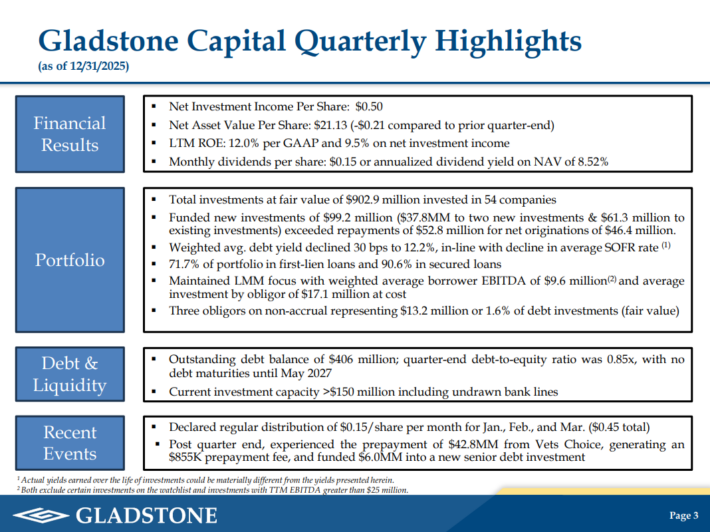
Net investment income came to $0.50 per share, which matched last year’s result. Total investment income, which is akin to revenue, grew 2.4% year-over-year, mostly due to gains in other income. Interest income was $23.9 million.
Total expenses were up $800K than the year-ago period, with higher interest expenses and management fees driving the increase. NAV declined from $21.34 per share to $21.13. Total assets were $923 million, or $903 million at fair value. Gross leverage was 93.3% of net assets.
The company invested $37.8 million in two new portfolio companies and $61.3 million in existing portfolio companies. Management stated that its pipeline of late-stage deals stands at “over $100 million” and should more than offset recent repayments. Common stock distributions totaled $0.45 per share.
For the year, Gladstone is projected to produce NII of $1.95 per share, up from $1.90 previously.
Growth Prospects
Rising interest rates are one of Gladstone Capital’s most compelling growth catalysts. The company benefits from higher interest rates because most of its debt portfolio is in variable-rate securities. We do not expect interest rates to rise in the near-term, which could place a cap on the company’s results.
Looking further back, Gladstone has had a difficult time generating growth. Gladstone’s share issuances have funded higher NII in dollar terms but haven’t earned enough above its cost of capital to move the needle on NII-per-share. Given this history, we estimate Gladstone’s annual growth rate to be 0.0% for the next five years.
The yields on the company’s portfolio influence its ability to earn income, cover expenses, and pay distributions to shareholders.
Gladstone Capital will aim to continue growing its new investments and adding new companies to the total portfolio. Over time, the company’s portfolio yield has decreased 30 basis points to 12.2%.
Despite the rising cost of funding, Gladstone has managed to increase its yield spreads. Gladstone’s portfolio continues to grow in dollar terms, but lending spreads continue to contract.
Dividend & Valuation Analysis
Gladstone Capital pays a monthly dividend, which allows shareholders to receive 12 dividend payments per year, more frequently than four quarterly distributions.
GLAD currently pays a monthly dividend of $0.15 per share. The annualized dividend payout of $1.80 per share is down from last year’s total, but represents a current dividend yield of 9.5%.
We believe Gladstone Capital’s current dividend is sustainable. The Company has a solid track record of steady payouts, even during the Great Recession of 2008-2009. Thanks to its tax classification and favorable fundamentals, the company can maintain its high yield.
BDCs are required to distribute at least 90% of any taxable income. This eliminates income tax at the corporate level, allowing capital gains to be passed through to shareholders, similar to a REIT.
With a projected dividend payout ratio of 92% for 2025, Gladstone Capital’s dividend payout appears to be secure but without much cushion. BDCs will always have high payout ratios due to the tax rule of distributing nearly all of their income, but overall, the dividend coverage is tight.
This means the company may not be able to sustain a major economic downturn and maintain its dividend. As a result, if another significant financial crisis occurs, Gladstone Capital’s dividend could be in further jeopardy.
Assuming continued economic growth, its dividend appears to be sustainable. However, the high payout ratio introduces a relatively high risk to its sustainability, particularly during a recession.
With shares trading at $18.88, the stock has a price-to-NII ratio of 9.7, which is slightly below our 2031 target multiple of 10.0. Reverting to our target multiple would add 0.6% to annual returns over the next five years.
In total, we project total returns of 8.7% per year through 2031.
Final Thoughts
Investors should approach high dividend yields with caution. Although high yields are commonplace in the BDC asset class, many have cut their dividends over the past few years.
For its part, Gladstone Capital reduced its dividend modestly in 2020 but has since grown it above its pre-COVID level. For now, we do not believe another dividend cut is imminent.
However, investors must pay close attention to the company’s future earnings reports. It has a very tight payout ratio, and any significant deterioration in the performance of its investment portfolio could threaten the dividend.
While the high yield and monthly distributions are attractive, we rate shares of Gladstone Capital as a sell due to recent dividend reductions.
Don’t miss the resources below for more monthly dividend stock investing research.
And see the resources below for more compelling investment ideas for dividend growth stocks and/or high-yield investment securities.
Thanks for reading this article. Please send any feedback, corrections, or questions to [email protected].