by Dennis Crouch
Most every patent applicant conducts at least a cursory prior art search before filing. Diligent applicants do a much more complete scouring of references. But there is a category of prior art that no search can uncover: applications that have been filed at the USPTO but not yet published. I have previously called these references “secret springing prior art” because they retroactively spring into existence as prior art only after eventually publishing. Dennis Crouch, Secret Springing Prior Art and Inter Partes Review, Patently-O (Oct. 4, 2024).
For this project I set out to measure just how much “dark matter” is out there. The answer depends on what you mean by “secret,” and the distinction turns out to matter quite a lot.
Two Kinds of Secret. The conventional measure of secret 102(a)(2) prior art asks a simple legal question: was the cited reference published before the applicant filed? If not, the applicant could not have known about it. By that measure, the problem looks large and growing. Nearly 30% of office action rejections now cite at least one legally secret reference, up from about 20% a decade ago.
But this legal definition overstates the practical problem. Many of the references cited as 102(a)(2) “secrets” are continuations or divisionals whose parent application was already published. Others are PCT national stage entries whose WIPO publication predated the citing application. In these cases, the specific document the examiner cited was technically unpublished at the critical date, but the same effective disclosure was publicly available in a family member. A diligent searcher could have found the substance of the reference at the time of filing, even if not the exact document.
To capture this distinction, I classified every 102(a)(2)/102(e) reference as practically secret (no family publication made the disclosure available before the applicant filed) or merely legally secret (the cited document was unpublished when applicant filed, but a parent or related publication may have already disclosed the same content). The results tell a substantially different story than the legal numbers alone.
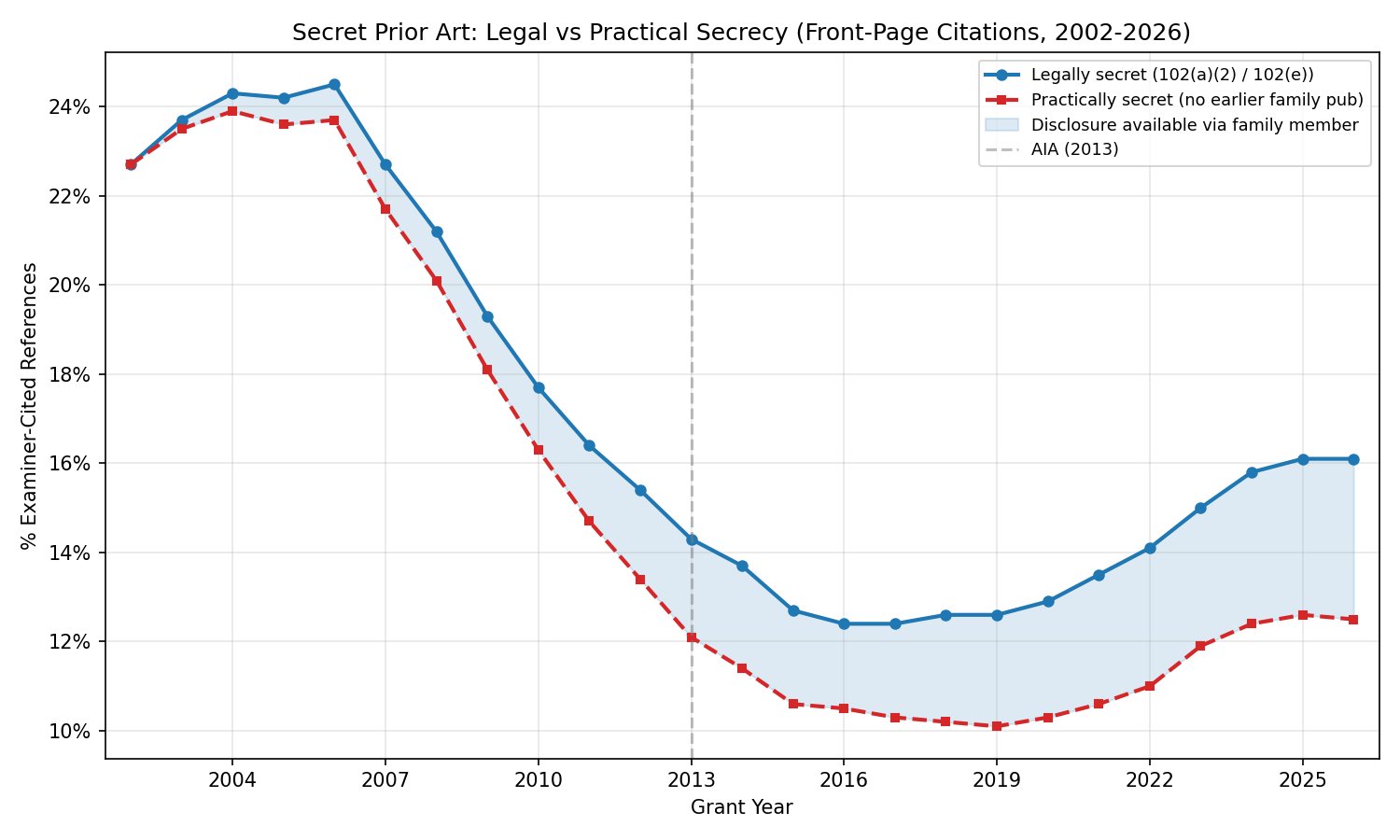
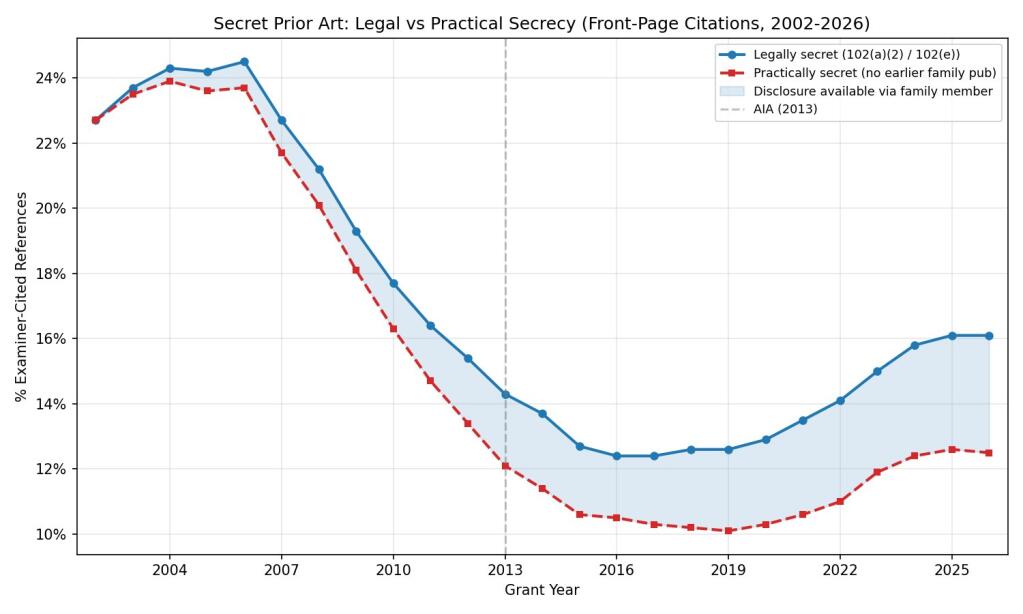
This first chart uses examiner-cited references found on the front cover of issued patents. The blue line shows the legal measure: the percentage of examiner-cited references that were unpublished at the time the applicant filed. The red dashed line shows the practical measure: references where no family member had published the disclosure either. The shaded gap between them represents references that were legally secret but practically discoverable.
Three things stand out. First is the dramatic decline from 2002 to 2015 and that appears in both measures. That decline was a result of the American Inventors Protection Act (AIPA) 18-month publication requirement which genuinely reduced the secret prior art problem. That publication began in 2001, and system required some amount of time before those publications became a central feature of patent examination.
Second, you can see the beginning of a rise in the rates of secret art citation over the past few years. That increase, I believe is driven by a growing global filing volume (more applications in the 18-month unpublished pipeline at any given time) and the AIA’s Hilmer abolition (discussed below). A third driver worth mentioning is the shift toward faster-moving technology areas as a share of overall filings. Those fields have inherently higher secret PA rates because of denser filing in overlapping technology space.
Third is the widening gap between legally secret and practically secret. This third trend is almost entirely explained by rising continuation and international filing rates. The typical patent now is part of a larger patent family – making it more likely that a prior filing has already been published. The gap is essentially a measure of continuation practice intensity interacting with universal pre-grant publication.
What Is Secret Prior Art?
Under 35 U.S.C. § 102(a)(2), a patent application’s effective filing date can serve as its prior art date against later-filed applications, even though the reference was not published until months or years later. For example, if Applicant A files on January 1 and Applicant B files on March 1, A’s application can be used against B once A eventually publishes (typically 18 months after filing). Applicant B had no way to discover A’s application at the time of filing. Under pre-AIA law, this category of prior art was governed by § 102(e). The doctrine traces to the Supreme Court’s 1926 decision in Alexander Milburn Co. v. Davis-Bournonville Co., 270 U.S. 390 (1926). I wrote more on that history back in 2025. Dennis Crouch, Thinking Back on Milburn and Secret/Springing Prior Art, Patently-O (July 15, 2025).
Methodology. My study here draws on two data sources. The front-page citation analysis covers 233 million citation records from 9 million granted US patents (2002-2026), using the grant year as the time axis. For office-action-level analysis, I used a random sample of approximately 10,000 office actions per year from the USPTO Patent Examination Data System API, covering 2008 through early 2026. This includes both non-final and final rejections across all technology areas and includes applications that were ultimately granted and abandoned as well as some still pending.
For each reference cited in a rejection, I computed “regime-aware” prior art dates. Under post-AIA law (applications with effective filing dates on or after March 16, 2013), the reference’s 102(a)(2) prior art date is its earliest worldwide filing date, including foreign priority claims. Under pre-AIA law, the reference’s prior art date is its earliest effective U.S. filing date only, following the Hilmer doctrine, see In re Hilmer, 359 F.2d 859 (C.C.P.A. 1966), as modified to also reach back to English-published PCT applications filed on or after November 29, 2000. I then checked whether any parent application (continuation or divisional) or WIPO PCT publication had made the same disclosure publicly available before the citing application’s filing date. For this study, I ignored the other requirements for 102(a)(2)/102(e) qualification, such as “another inventor.”
The AIPA Story (2002-2015). Before the American Inventors Protection Act of 1999 took effect on November 29, 2000, most pending patent applications remained entirely secret until they issued as patents, which could take years. AIPA introduced mandatory 18-month publication for most applications, dramatically compressing the window during which a pending application could serve as secret prior art.
But AIPA’s effect was not instantaneous. Applications filed before November 2000 that were still in prosecution or recently granted continued to appear as examiner-cited references well into the late 2000s. The data captures AIPA’s gradual impact: the legal secret rate fell from 25% in 2006 to 12% by 2016. By 2015, virtually the entire relevant prior art pool consisted of applications subject to 18-month publication, and both measures bottomed out.
The Hilmer Doctrine and Its Demise
Under pre-AIA law, a foreign-origin patent application’s prior art date was limited to its U.S. filing date, not its earlier foreign priority date. This was known as the Hilmer doctrine, after In re Hilmer, 359 F.2d 859 (C.C.P.A. 1966). The America Invents Act abolished this limitation. Under post-AIA § 102(a)(2) and § 102(d), a reference’s prior art date now reaches back to its earliest worldwide filing date, including foreign priority claims. This change expanded the pool of secret prior art by giving foreign-origin references an earlier effective date.
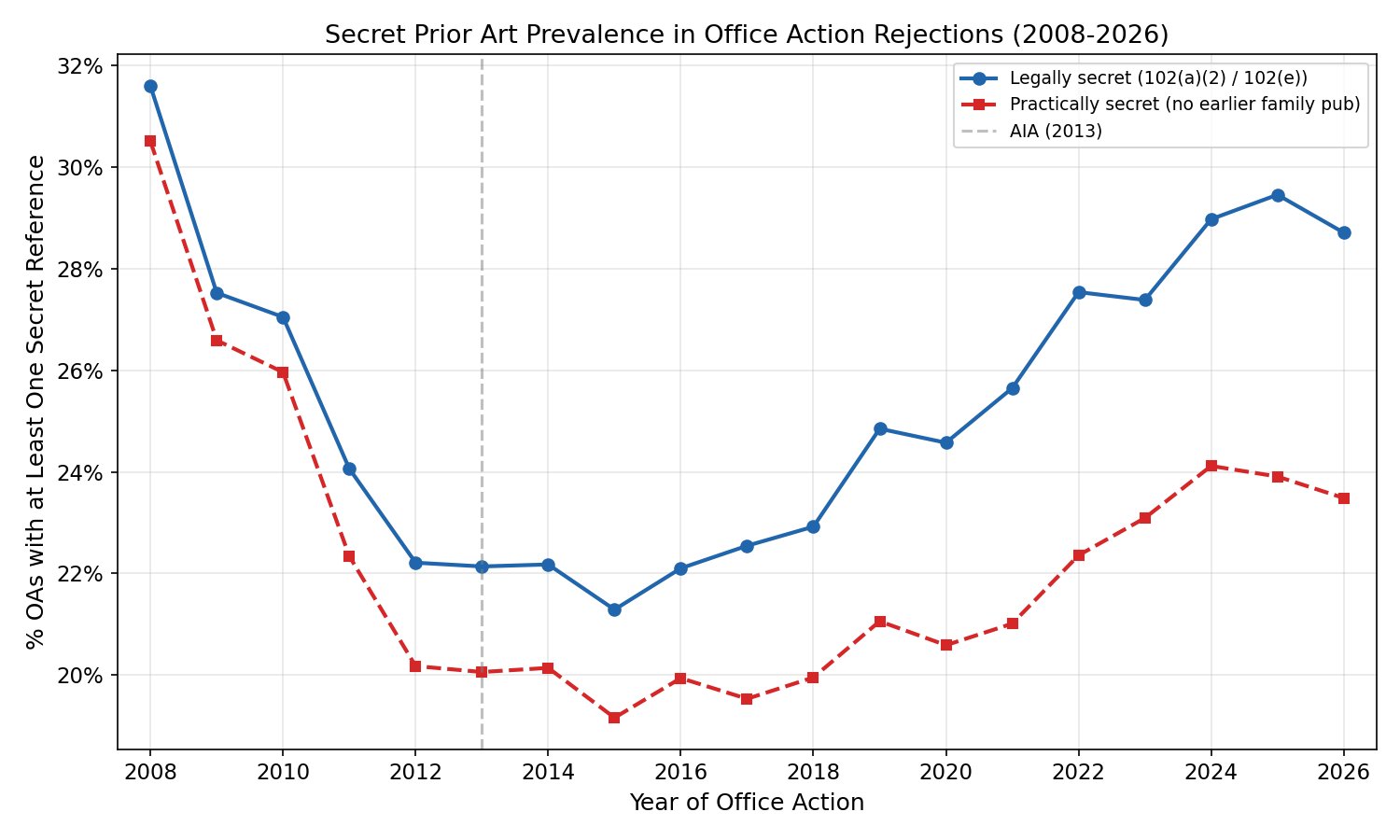
The chart above uses office action rejection data — references used by examiners to reject claims. It shows a similar trend to that seen in just the general citation data. I looked here at the percent of office actions that relied upon at least one secret reference. The idea here is that …
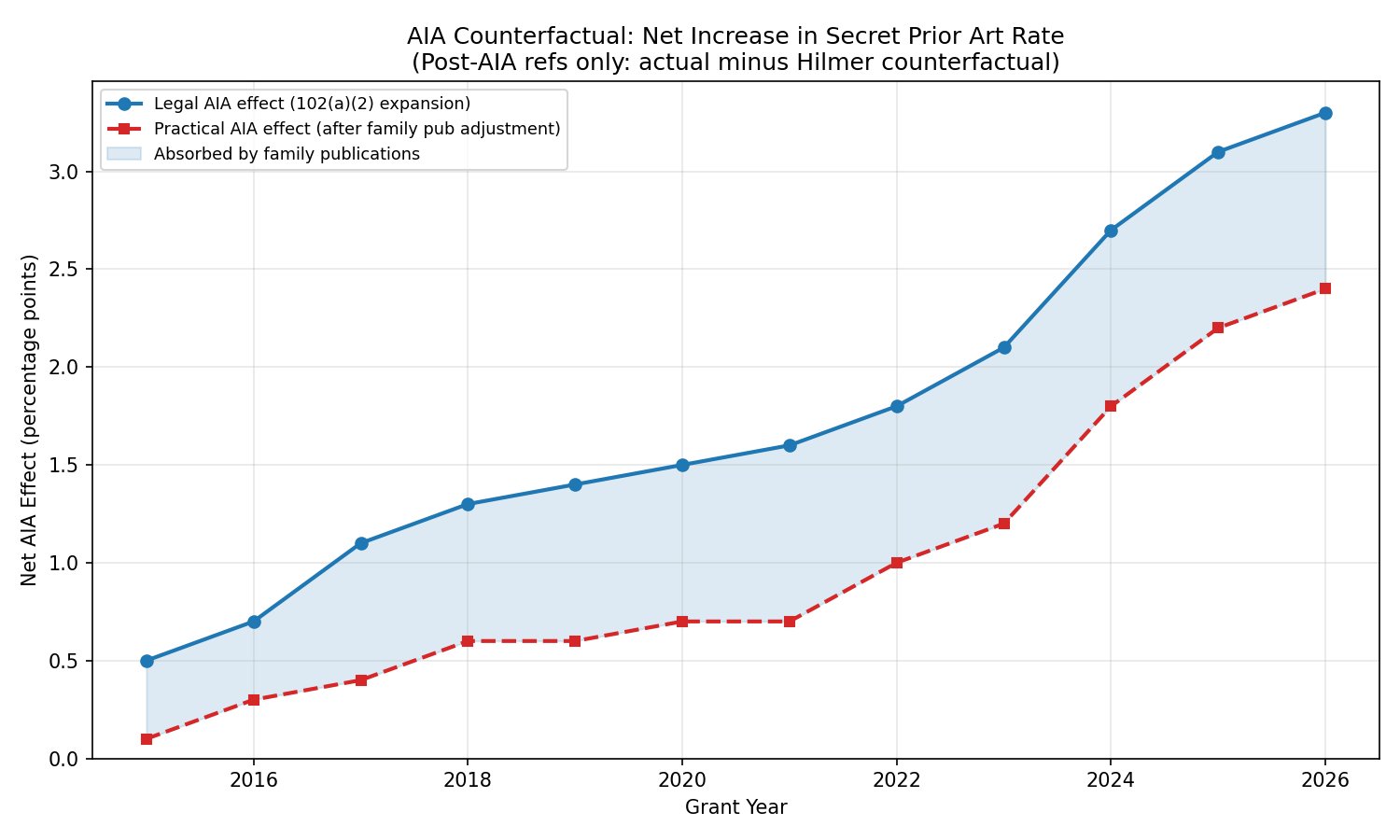
An additional approach I took was a counterfactual analysis, comparing actual secret prior art rates against what the rate would have been under pre-AIA Hilmer rules, estimates that the AIA’s broader definition accounts for 3.2 additional percentage points of legally secret prior art by 2025. But approximately a third of that expansion is not truly secret prior art because those cases had been already published in a different form. When measured by practical secrecy, the AIA’s net contribution drops is about 2.2 percent because many of the foreign-priority references newly captured by the AIA 102(a)(2) had related publications, including PCT applications published by WIPO or continuation families with earlier PGPubs, that made their disclosures available to searchers.
Technology Variation. Secret prior art is not evenly distributed across technologies. Electrical engineering and telecommunications have the highest rates. Slower moving mechanical engineering has the lowest.
What Secret Prior Art Looks Like. About 79% of secret prior art references are published applications (pre-grant publications) with an average secrecy gap of 371 days. The remaining 21% are patents that were not published as applications before grant, with a slightly longer average secrecy gap.
Not What I Expected. When I started this project, my prior assumption was that the accelerating pace of technology development would be compressing prior art into shorter timelines, that examiners would increasingly be citing newer, more recent references as innovation cycles shortened. That intuition turns out to be almost exactly wrong. Mean examiner-cited reference age has grown during this 18-year period from about 4 years to over 6 years. Examiners are reaching further back in time, not less. Even in the fastest-moving fields such as EE and computing, reference ages climbed. Part of the explanation is that the growing cumulative stock of published prior art gives examiners a deeper well to draw from, and improved search tools make it easier to find older references. Technology may be moving faster, but the prior art landscape is getting deeper.
The Lynk Labs Connection. The distinction between legal and practical secrecy matters for the ongoing legal debate, but it does not resolve it. In Lynk Labs, Inc. v. Samsung Electronics Co., 125 F.4th 1120 (Fed. Cir. 2025), the Federal Circuit held that a published patent application could be used as prior art in an inter partes review proceeding even though it was not publicly accessible until after the challenged patent’s filing date. The court concluded that the term “printed publication” in 35 U.S.C. § 311(b) is “temporally agnostic.” Dennis Crouch, Publications Before Publishing and the Federal Circuit’s Temporal Gymnastics, Patently-O (Jan. 14, 2025). The Supreme Court denied certiorari on March 9, 2026, leaving the Federal Circuit’s approach intact.
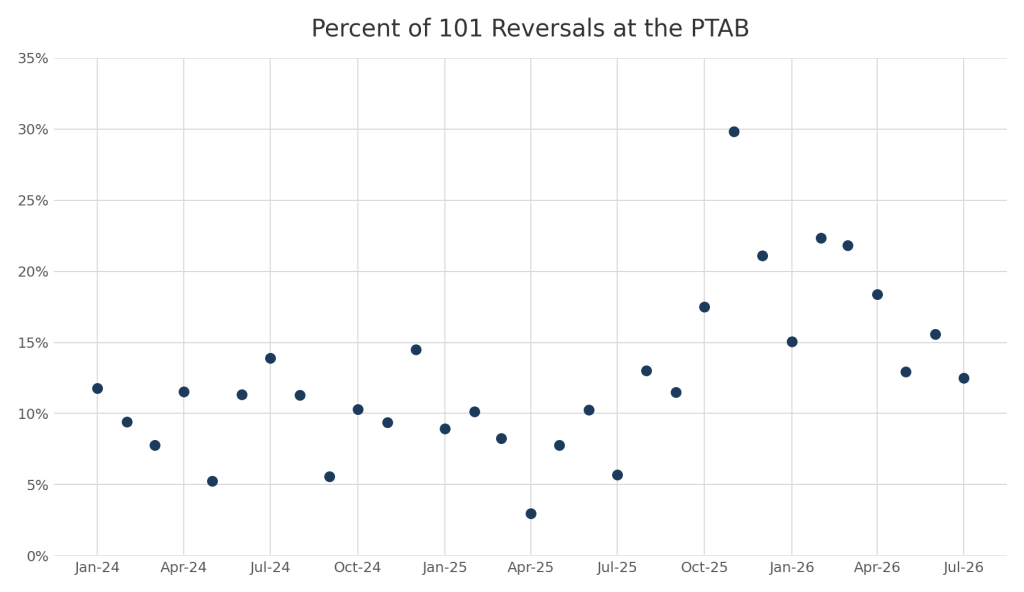
In urging denial, the Solicitor General argued that the question presented had “limited practical importance” because so few cases fall within the secret prior art window. The data presented here rebuts that framing with about 25% of office action rejections relying on prior art that was not available at the time of filing.
The question is not going away. The same § 311(b) issue is squarely presented in the pending Federal Circuit appeal in VLSI Technology LLC v. Patent Quality Assurance LLC, Nos. 2023-2298, -2354 (Fed. Cir.). And the practical consequences remain real: an applicant whose rejection rests on a practically secret reference had no opportunity to design around it, distinguish it during prosecution planning, or even know it existed.
The broader policy question also benefits from this more granular view. The European Patent Office permits secret prior art to be used only for novelty, not for obviousness, confining the inventive step analysis to what a person of ordinary skill actually knew at the relevant date. In the US most uses of 102(a)(2) art is for obviousness rejections. Adopting the European approach would thus eliminate not just a marginal category of rejections, but the primary use of secret prior art in U.S. patent examination.